

How to Improve Ecommerce Conversion Rate: 12 Tested Fixes (2026)

[ SUMMARIZE WITH AI ]
[ FREE CRO TEARDOWN ]
Find the 3 biggest revenue leaks on your store.
Every day a conversion leak goes unfixed, you're paying for traffic that doesn't buy. Get a 5-minute Loom through your PDP, cart, and checkout, with mockups of the fixes. No pitch.
Get My TeardownHow to improve ecommerce conversion rate is the single highest-leverage question most Shopify brands can ask, because every 0.1% lift compounds across every paid click, email send, and organic visit you already pay for. The honest answer to how to improve ecommerce conversion rate is not a list of generic hacks. From 1,200+ A/B tests across $2M+ DTC brands, the patterns that move the needle are narrow: a ruthless audit to find where the funnel leaks, a benchmark check against top performers (not averages), and a structured testing program aimed at the biggest leaks first.
Below are the 12 fixes we have seen improve ecommerce conversion rate fastest on Shopify, ranked by impact and difficulty, with the data behind each. For the benchmark-and-funnel angle, see how to increase your ecommerce conversion rate.
Last updated May 2026. Reviewed against 1,200+ A/B tests run on $2M+ DTC Shopify brands by Julian Samarjiev, Co-founder of Convertibles. Benchmarks cross-checked against Shopify, Baymard Institute, and Klaviyo published data.
Your Starting Point: A Ruthless Conversion Audit
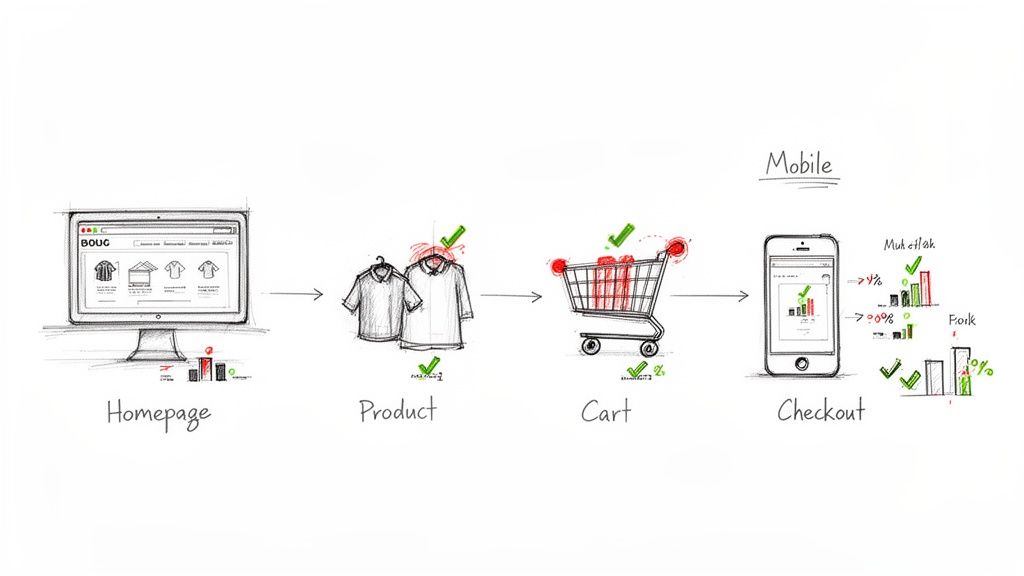
Before you touch a single pixel on your site, you need an honest, data-backed baseline. Too many brands chase shiny new features or frantically copy competitors without first understanding where their own funnel is bleeding cash.
A ruthless conversion audit isn't about checking boxes. It's about creating a "leak map" that pinpoints exactly where you're losing money. This map will guide every single decision you make from here on out. It's the only way to move from guessing what's wrong to knowing where to focus your energy for the biggest return.
Benchmark Against the Best, Not the Average
Knowing your numbers is one thing, but context is everything. The global average ecommerce conversion rate floats somewhere between 2.5% and 3%, but aiming for "average" is a recipe for mediocrity.
Top-tier stores, the ones in the top 20% on Shopify, are consistently hitting 3.2% or higher. The absolute best performers are crushing it at over 4.8%. You have to get specific.
The table below provides a snapshot of performance variance. To see exactly where your store sits against your vertical and the monthly revenue gap to the top performer, run your numbers through our free ecommerce conversion rate calculator.
Conversion Rate Benchmarks By Channel And Industry
| Category/Channel | Average CVR | Top Performer CVR |
|---|---|---|
| Food & Beverage | 4.45% | 6.11% |
| Beauty & Cosmetics | 3.32% | 4.88% |
| Apparel & Fashion | 2.44% | 3.86% |
| Luxury & Jewelry | 1.19% | 1.63% |
| Google Ads | 1.86% | 3.0%+ |
| Email Marketing | 4.64% | 6.0%+ |
| Referral Traffic | 5.40% | 7.5%+ |
| Organic Search | 3.01% | 4.5%+ |
Your real goal isn't to be average. It's to figure out what the top 10% in your specific niche are doing and close that gap.
Pinpoint Your Revenue Leaks
With your benchmarks in place, it's time to get your hands dirty. Dig into your analytics and start slicing the data to find the weak spots in your customer journey. This is where you stop looking at the aggregate conversion rate number and start hunting for specific, costly problems. Once you spot them, put a dollar figure on what those leaks cost so you know which to fix first.
Your audit should slice your data three ways:
- By Traffic Source: Go deeper than paid vs. organic. Is a specific Google Ads campaign tanking your average? How does traffic from Instagram convert compared to TikTok? For example, referral traffic often converts at 5.4%, while some social media channels can be as low as 0.7%. A channel that sends you tons of traffic but generates zero sales isn't an asset; it's a major revenue leak.
- By Device: Desktop converts better on average, but mobile is where most of your customers are. Your job is to quantify the gap. If mobile brings in 70% of your traffic but only accounts for 40% of your revenue, you’ve just uncovered a massive opportunity. That's a clear signal to prioritize your mobile experience.
- By Customer Status: How do first-time visitors perform compared to your loyal returning customers? A low conversion rate for repeat buyers might point to a clunky post-purchase experience or a weak loyalty program. Conversely, if new visitors bounce without buying, it could mean your landing pages aren't communicating your value proposition clearly enough.
A proper audit doesn't just tell you that you have a problem; it tells you where the problem is. It transforms a vague goal like "increase conversions" into a specific objective like "fix the 75% drop-off rate for new mobile visitors coming from our top Facebook ad campaign."
Create Your Leak Map
The final output is what we call a "leak map" - a simple, clear view of where users are dropping off, segmented by source, device, and customer type. This map will visually pinpoint the exact user flows, from the homepage to product pages and through checkout, where you're losing the most people and the most money.
If you want a professional team to handle this level of deep-dive analysis, we offer comprehensive UX audits for Shopify stores that provide this exact kind of granular insight.
This leak map becomes your strategic playbook. It tells you which pages to test first, which audiences need a more personalized touch, and where the biggest financial wins are hiding. With this data-backed foundation, every optimization effort you make is targeted, measurable, and directly tied to your bottom line.
Identify and Understand Your High-Value Segments
A generic site experience gets you a generic conversion rate. Once your audit has shown you where money is leaking out, the next move is to figure out who you’re losing. More importantly, you need to pinpoint who your most profitable customers are.
Real growth doesn’t come from treating every visitor the same. It comes from meticulously tailoring the shopping journey to your highest-value customer segments. This isn't about fuzzy demographics; it’s about creating actionable intelligence that lets you personalize the experience and boost revenue per session.
Your goal is to stop serving a one-size-fits-all website and start creating distinct experiences for the customer cohorts that actually move the needle.
Moving Beyond Simple Demographics
To improve your ecommerce conversion rate in a way that truly impacts the bottom line, you have to segment based on behavior and value, not just age or location. The answers are already in your customer data. You just need to look at it through the right lens.
Start by analyzing your customers based on key value metrics:
- Lifetime Value (LTV): Who are the customers who come back repeatedly, spending far more than anyone else over time? These are your VIPs, and they deserve the red-carpet treatment.
- Average Order Value (AOV): Which shoppers consistently place large orders? They might not buy every month, but when they do, they drive a significant chunk of revenue.
- Purchase Frequency: Pinpoint the regulars who buy on a predictable schedule. These are prime candidates for a subscription model or a killer loyalty program.
When you combine these metrics, detailed personas of your most valuable segments begin to emerge, giving you a clear target for your optimization efforts.
The goal isn't just to put customers in buckets. It's to deeply understand what makes your most profitable groups tick. A VIP coming back for their tenth purchase thinks and acts completely differently than a nervous, high-intent visitor clicking through from a targeted ad for the first time.
Building Your Core Segment Personas
Your data will likely reveal several important groups, but for most brands doing $2M+ in annual revenue, a few critical personas appear almost every time. Focus on building a clear profile for each one - don't just define who they are, but what they desperately need from your site to feel confident enough to buy.
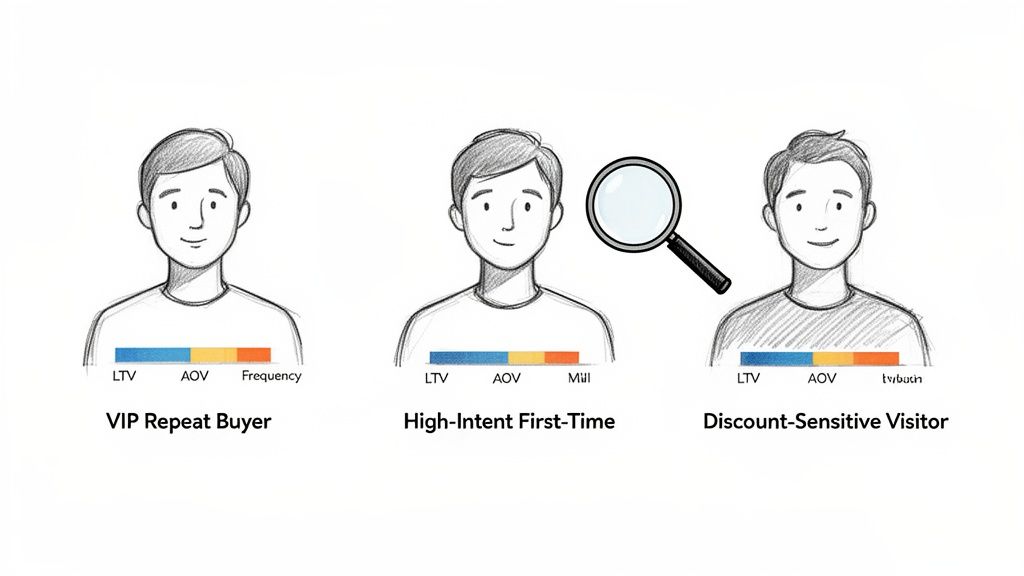
Here are three high-value segments we see and build for constantly:
-
The VIP Repeat Buyer: This group is the bedrock of your brand. They have a high LTV, have bought from you multiple times (say, 3+ orders), and often have the highest AOV. Their problem isn't trust - it's discovery and feeling seen. They don't want to be greeted with the same 10% off pop-up as a brand-new visitor. They’re motivated by finding new products they’ll love and feeling appreciated for their loyalty.
-
The High-Intent First-Time Shopper: This visitor usually comes from a specific paid ad or a high-ranking organic search term. They have a problem and are actively looking for a solution. Their biggest hurdle is trust and risk. They’re asking, "Is this the right product for me?" and "Can I trust this company with my money?" Their motivation is to quickly find an answer and complete their purchase with zero friction.
-
The Discount-Sensitive Visitor: This segment can be tricky. They might have a lower AOV, but they can be converted with the right offer at the right time. They’re the ones who abandon carts, waiting for a promo code to show up in their inbox. Their main friction point is price, and they’re motivated by the thrill of a good deal.
The VIP Repeat Buyer in particular is where retention compounds. For the full playbook on lifting this cohort's value over time, see our guide on improving customer lifetime value.
Mapping the Segment-Specific Journey
With these personas fleshed out, the final piece is mapping their unique journey through your site. For each segment, trace their typical path and zero in on the key moments that either push them toward a sale or cause them to bail.
For your VIP Repeat Buyer, the journey might kick off with a targeted email about a new collection. The make-or-break moment is landing on a homepage that greets them with a "Welcome Back" message or shows them an exclusive early-access banner.
For the High-Intent First-Time Shopper, the journey starts with an ad click. The critical moment is the product detail page. They need to see compelling social proof, clear value propositions, and an iron-clad return policy to get over their initial hesitation.
Understanding these different paths is what real conversion optimization is all about. It’s how you graduate from making broad, site-wide guesses to deploying surgical, segment-specific improvements that produce a measurable lift in revenue.
Create Personalized Onsite Shopping Journeys
You’ve identified your high-value segments. Now, stop serving them a generic website. The real magic in boosting your conversion rate happens when you start building dynamic, tailored experiences that make each visitor feel like the site was made just for them.
This is about creating distinct paths to purchase that speak to the intent and mindset of each segment. A generic journey will always get you generic results. A personalized one is what turns browsers into buyers.
Match Your Onsite Experience to Traffic Intent
The moment a visitor lands on your site is your first, best chance to personalize. Where they came from is a huge clue about what they want, and it should dictate the very first thing they see. Stop showing the same homepage hero banner to every single person.
Instead, create specific versions that match their origin:
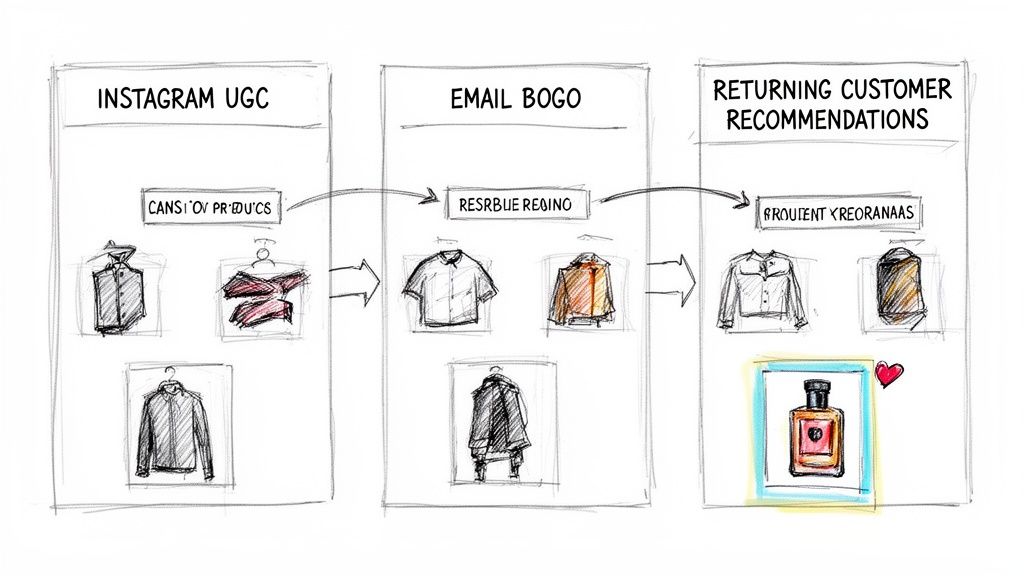
- Social Media Traffic (Instagram, TikTok): These visitors are often in discovery mode and heavily influenced by social proof. Greet them with a hero banner packed with user-generated content (UGC), influencer shots, or "As Seen On" logos. It instantly validates their click and builds trust.
- Email & SMS Subscribers: This is your warm audience. They already know who you are. Hit them with a hero that promotes an exclusive offer - think BOGO deals, a gift with purchase, or early access to a new drop. They don't need an introduction; they need a reason to buy now.
- Paid Search Visitors: If someone clicks an ad for "50% off winter coats," they better land on a page that screams "50% off winter coats." Ensure your landing page hero and product collection directly mirror the ad copy. Anything else is a jarring disconnect that sends them for the back button.
The core idea is simple: Acknowledge where your visitor came from and what they're likely looking for. This small act of recognition makes the experience feel instantly more relevant and can dramatically cut your bounce rate.
Deploy Segment-Specific Pop-Ups and Offers
Your pop-up strategy needs to be as smart as your audience segmentation. That generic "10% Off Your First Order" pop-up is a blunt instrument. It often just gives away margin, especially to VIPs who were going to buy anyway.
Refine that approach with targeted offers that align with what you know about each segment's behavior. This is a non-negotiable part of any serious conversion optimization program.
Here are a few tactical examples from the field:
- For the VIP Repeat Buyer: Turn off the standard discount pop-up for them. Seriously. Instead, use a subtle banner or fly-out that welcomes them back by name and offers early access to a new product or a surprise gift with their next purchase.
- For the High-Intent First-Time Shopper: If they're on a product page and start to leave, trigger an exit-intent pop-up that offers free shipping. For this segment, removing risk is often a more powerful motivator than a small discount.
- For the Discount-Hunter: If they try to bail on a full cart, that's your moment to deploy a more aggressive offer. A pop-up with 15% off or a special bundle deal can be the final nudge they need to cross the finish line.
For a masterclass in this kind of strategic thinking, Drew Marconi, the founder of Intelligems, shared fantastic insights on our podcast about how to approach personalization with offers and testing.
Customize Product Recommendations and Content
The final layer of a personal onsite journey is dynamic content. The products and information you show should change based on who’s browsing. This is how you turn your site from a static catalog into an intelligent shopping assistant.
Move beyond the basic "people also viewed" widgets and get more strategic.
- Returning Customers: Showcase "Recently Viewed" items so they can pick up where they left off. Even better, use "Because You Purchased..." recommendations based on their actual order history to introduce them to relevant, complementary products.
- New Visitors: These shoppers can feel overwhelmed. Guide their discovery with "Trending Now" or "Bestsellers" widgets. This uses social proof to help them quickly find the products other customers are raving about, cutting through choice paralysis.
By building out these tailored pathways, you create a one-to-one shopping experience that speaks directly to what motivates each of your key segments. This is how you stop hoping for conversions and start engineering them.
Weave in Social Proof and User-Generated Content
A personalized journey gets a shopper’s attention, but social proof builds the trust needed to turn a curious visitor into a loyal customer. People don't just want to hear from you how great your product is - they need to hear it from people just like them. This is how you quiet the voice of doubt and prove your product delivers on its promises.
User-Generated Content (UGC) is a core driver of your bottom line. Move beyond basic star ratings and turn your customers into your most authentic and powerful sales team. Your goal is to strategically sprinkle their voices and experiences throughout your site at every critical decision point.
Go Beyond Star Ratings with Strategic UGC Placement
Most brands just slap a star rating widget under the product title and call it a day. That’s the bare minimum. If you want to move the needle on conversions, get smarter about where and how you use social proof to dismantle specific objections along the buyer’s journey.
-
On Your Product Pages: This is your main battleground. Feature rich photo and video review galleries that show your product being used in real life. Let shoppers filter reviews by relevant attributes - think body type, skin tone, or specific use case. A skincare brand, for example, could let a visitor with "oily skin" see reviews only from other customers with oily skin. That level of targeted relevance is incredibly persuasive.
-
Throughout the Checkout Flow: Purchase anxiety peaks right when someone is about to pull out their credit card. This is the perfect moment for a subtle, reassuring nudge. A snippet from a five-star review or a stat like "Over 10,000 satisfied customers" in the cart or on the checkout page can be the final push someone needs to click "complete purchase."
-
On Category and Collection Pages: Why wait until the product page to build trust? Use visual UGC to create "shoppable" galleries that link directly to products. Showcasing real customer photos on these higher-funnel pages helps visitors imagine the product in their own lives more effectively than a sterile studio shot.
The data backs this up. Websites that feature UGC see an average conversion rate of 3.2%, a huge leap from sites that don't. When users engage with that content, the likelihood of a purchase can more than double. It’s a clear demonstration of how powerful social validation is.
Activate Your Community to Get More Content
You can't showcase great UGC if your customers aren't creating it. Passively waiting for reviews to trickle in won't cut it. You need a proactive system for encouraging and collecting high-quality social proof.
Your best bet is a robust post-purchase email and SMS flow. But don't just ask for a review - incentivize it. Offer loyalty points, a discount on their next purchase, or entry into a giveaway for customers who submit a photo or video. Frame the request as an invitation to join your community, not just a transaction for their feedback.
To get the ball rolling on visual content, you might want to look into specialized UGC video tools. These platforms can help streamline the process of sourcing, managing, and displaying compelling video testimonials.
Pro Tip: Don’t just ask, “How did you like your order?” Ask a specific, leading question that generates a more useful response. For a clothing brand, try: “We’d love to see how you styled it! Share a photo for 100 bonus points.” This prompts the exact kind of visual content you can use on your site.
Turn Your Social Feeds into On-Site Sales Channels
Finally, bridge the gap between your social media and your on-site experience. Your Instagram feed is likely already a goldmine of influencer content and customer photos. Put it to work.
Integrate a shoppable Instagram feed on your homepage or a dedicated gallery page. This does two things: it adds a constant stream of fresh, authentic content to your store and it drastically shortens the path from discovery to purchase. When a visitor sees a product they love in a real-world photo, they should be able to click and buy it right then and there.
By transforming your website into a community-powered shopping destination, you're doing more than just selling a product. You're building a brand that people trust, connect with, and genuinely want to be a part of. That’s the ultimate conversion strategy.
Build a High-Impact CRO Testing Program
Every great idea you have for your store, from a slick new homepage hero to a complete product page overhaul, is just a guess until you prove it with cold, hard data.
This is where a structured testing program comes in. It’s what separates the brands that see tiny, incremental bumps from those who achieve real, compounding growth. Think of it as the engine that turns your smart hypotheses into actual revenue. This isn't about fiddling with button colors. A high-impact program tests bigger, more meaningful changes to your value proposition, page layouts, and promotional strategies.
The goal is to build a continuous feedback loop: test, measure, learn, and then scale what works across the site.
Prioritizing Your Testing Roadmap
Once you start thinking this way, your list of test ideas will explode. The challenge isn't coming up with ideas; it's figuring out which ones will actually move the needle. Without a system, it's easy to do what's easiest, but the easiest tests rarely deliver the biggest wins.
You can use the PIE framework (Potential, Importance, Ease) to cut through the noise and prioritize your testing roadmap. It forces a data-driven conversation about where to spend your most valuable resource: your team's time.
- Potential: How much room for improvement is there? A product page with a high bounce rate has way more potential than an already-solid "About Us" page.
- Importance: How valuable is the traffic to this page? A test on your main collection page that gets thousands of high-intent visitors a day is far more important than one on a forgotten blog post.
- Ease: How hard is this going to be? A simple headline change is worlds away from a complete checkout redesign that ties up your developers for weeks.
Score each test idea from 1 to 10 for each PIE category, then average them out. The tests with the highest scores jump to the top of your list. This simple exercise immediately shifts the focus from "what's easy?" to "what will make us the most money?"
From Simple A/B Tests to Complex Experiments
As your testing program gets more sophisticated, so should your tests. A/B testing is the foundation, but real growth often comes from understanding the combined effects of multiple changes. This is where multi-variation testing comes in.
It's especially critical for brands that need Shopify 2.0 theme upgrades and A/B testing services to unlock these more advanced personalization features.
A standard A/B test might compare one new headline against the original. A multi-variation test could test two new headlines, two different hero images, and two different calls-to-action all at the same time. This is how you discover the single most profitable combination of elements and learn much faster what really resonates with your customers.
Building trust and guiding shoppers toward a purchase is a multi-step process. Social proof, for example, isn't just one thing; it's a flow.
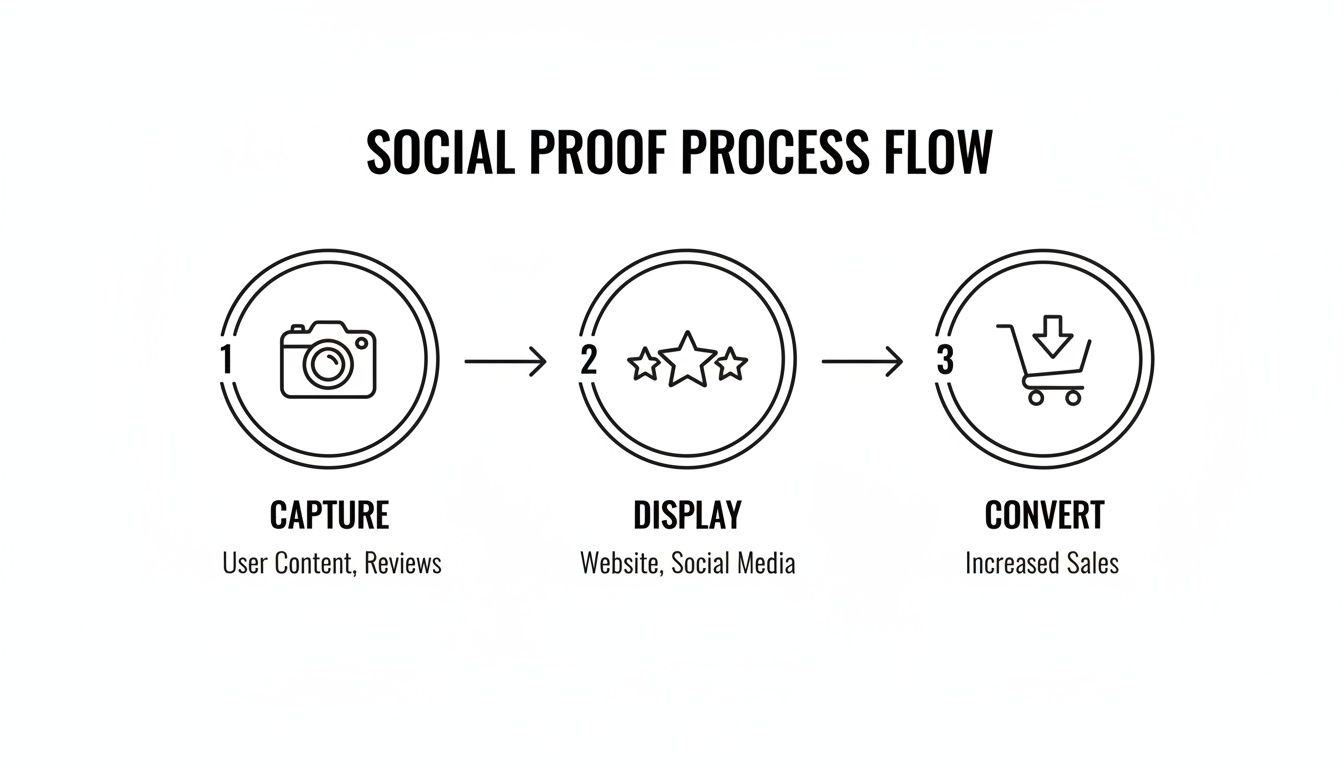
As you can see, it starts with capturing customer content, displaying it where it matters, and using it to convert the next shopper.
Ensuring Statistical Significance Before You Scale
The single biggest mistake we see brands make: ending tests too early.
A test result means nothing until it reaches statistical significance, which is typically a 95% confidence level. This means you can be 95% sure the result isn't a random fluke.
Don't get excited and call a winner after just two days, even if one version is crushing it. To reliably improve your ecommerce conversion rate, let tests run for a full business cycle - at least one to two weeks - to smooth out any daily spikes or dips in traffic.
Rolling out a "winner" that isn't actually a winner can do more harm than running no tests at all.
A Look at a 90-Day Roadmap
To make this more concrete, here’s what a focused, 90-day plan could look like. This isn’t a rigid template, but it shows how you can build momentum by tackling different areas of the customer journey each month.
| Month | Focus Area | Key Initiative/Test | Primary KPI |
|---|---|---|---|
| Month 1 | Product Discovery | Test new PDP layout vs. control | Add to Cart Rate |
| Month 1 | Product Discovery | Multi-variation test: hero image, headline, CTA on top-selling collection | Collection Page CVR |
| Month 2 | Cart & Checkout | A/B test a one-page vs. multi-step checkout | Checkout Completion Rate |
| Month 2 | Cart & Checkout | Test trust badges and express payment options in cart | Cart-to-Checkout Rate |
| Month 3 | Site-wide Trust & Urgency | Implement and test dynamic social proof notifications | Site-wide CVR |
| Month 3 | Site-wide Trust & Urgency | Test a new promotional offer strategy (e.g., GWP vs. %) | Average Order Value (AOV) |
This kind of roadmap keeps the team aligned and ensures you're always working on high-impact initiatives. By prioritizing ruthlessly, testing boldly, and waiting for valid data, you create a powerful system that turns your website into your most effective salesperson.
Your Next Move: Implement One Change
Reading this guide is a start, but action is what drives results. The biggest mistake is trying to do everything at once. Instead, pick one high-impact area from this playbook and commit to executing it in the next 30 days.
- If you're flying blind, start with a ruthless conversion audit. Create your leak map.
- If you treat all customers the same, define your VIP segment. Build them a personalized welcome experience.
- If you're guessing what works, set up your first A/B test. Use the PIE framework to pick a real needle-mover.
Focus on a single, meaningful win. This builds momentum and creates a culture of data-driven growth. This systematic approach is how you improve your ecommerce conversion rate not just once, but continuously.
Frequently Asked Questions
What is a good ecommerce conversion rate in 2026?
The global average is 2.5-3%, but the top 20% of stores hit 3.2% or higher and top performers exceed 4.8%. Benchmark against your specific industry and traffic mix rather than the overall average. Mobile typically converts lower than desktop despite driving 70% of traffic.
What should I fix first to improve my conversion rate?
Start with a conversion audit segmented by device, traffic source, and visitor type to find your biggest leak. Then watch 20-30 session recordings from that segment to see where users struggle. Fix the highest-impact drop-off point first rather than optimizing randomly.
How many tests should I run to improve conversion rate?
Deploy 2-4 experiments monthly using a PIE framework (Potential, Importance, Ease) to prioritize. This cadence balances learning speed with statistical rigor. Focus on high-traffic, high-revenue pages first for the fastest measurable impact.
Does social proof actually improve conversion rates?
Yes. Sites with user-generated content average 3.2% conversion rate versus lower benchmarks without it. Place UGC on product pages, checkout, and category pages. Incentivize reviews by asking specific, leading questions post-purchase rather than generic review requests.
We work on tactics like these daily, book a call to get 3 custom (tailored for your business), researched personalization ideas to get you started.