

Shopify Conversion Rate Optimization for Scaling Brands

[ SUMMARIZE WITH AI ]
[ FREE CRO TEARDOWN ]
Find the 3 biggest revenue leaks on your store.
Every day a conversion leak goes unfixed, you're paying for traffic that doesn't buy. Get a 5-minute Loom through your PDP, cart, and checkout, with mockups of the fixes. No pitch.
Get My TeardownShopify conversion rate optimization isn't about tweaking button colors. For brands scaling past $3M, it's a systematic process of digging into your data, understanding how real people use your site, and methodically removing the roadblocks that cost you sales every day. It's about turning the traffic you already have into significantly more revenue.
Shopify CRO at a Glance
- Benchmarks: The median Shopify store converts at 1.4%; the top 10% hit 4.7% or higher
- Audit framework: Three pillars - quantitative analytics, qualitative session recordings, and technical/heuristic review
- Realistic goal: Aim for a 15-20% relative lift in your main conversion metric within six months
- Lean tool stack: GA4 + session recordings (Clarity or Heatmap) + A/B testing (Intelligems)
- Testing rules: Run tests for full business cycles (1-2 weeks minimum) and wait for 95% statistical significance before calling a winner
You wouldn't start renovating a house without a blueprint. The same principle applies to your store.
Finding the Leaks: How to Audit Your Shopify Funnel

Before you launch an A/B test, you must figure out where your funnel is leaking money. Jumping straight into testing without a proper audit is a recipe for wasted time and inconclusive results. It's like trying to fix an engine without knowing which part is broken.
An effective audit for a 7 or 8-figure brand isn't a quick glance at Google Analytics. It's about layering multiple data sources to see the store through your customers' eyes. Be mindful of the common pitfalls in Shopify tracking, which can easily throw you off course.
Start with the Numbers (Quantitative Analysis)
Your audit begins with a deep dive into your store's performance data. The goal is simple: find the pages and user segments with the biggest drop-offs. Don't fixate on the overall conversion rate; the real insights are in the segments.
Here's what to look for:
- Device Performance: Is your mobile experience lagging behind desktop? A 1-second delay in mobile load times can impact conversion rates by up to 20% according to a Google study. For brands with heavy mobile traffic, consider progressive web apps or native mobile apps. Solutions like MobiLoud convert your Shopify store into a native mobile app, which can improve mobile conversion rates by reducing load times and creating a more app-like experience.
- Traffic Source Analysis: How do visitors from your Meta ads behave compared to those from organic search? Pinpointing underperforming channels is a huge win.
- New vs. Returning Visitors: Your loyal customers likely behave differently from first-time visitors. Friction almost always hits new users the hardest.
This first step tells you where the problems are. Now, it's time to figure out why they're happening.
Uncover the 'Why' with Qualitative Insights
Once you've flagged the high-drop-off pages, you need to see what's actually happening on them. This is where you move from spreadsheets to human behavior.
A common mistake is treating your Shopify store as a static brochure. In reality, it's a dynamic environment where every element either helps or hurts the user's path to purchase. Session recordings and heatmaps are your direct window into that live experience.
We use tools like Heatmap or Microsoft Clarity to watch anonymized session recordings of real users. You can see where they get stuck, what they try to click on, and where they show frustration through "rage clicks" or erratic scrolling. This is where your best test ideas will come from.
Perform a Heuristic and Technical Evaluation
The final layer is a hands-on review of your site against established usability principles. This heuristic analysis looks for inconsistent messaging, confusing navigation, or weak calls-to-action across the entire journey. We walk through the site like a new customer, from the ad to the thank-you page.
At the same time, a technical check ensures that site performance isn't the real villain. We always check:
- Page Load Speed: Using Google PageSpeed Insights to measure Core Web Vitals is non-negotiable.
- Mobile Checkout Flow: We manually test the entire checkout process on different phones and browsers.
- App Performance: Are any third-party apps slowing down your site? They often are.
This rigorous audit separates average stores from top performers.
Shopify Conversion Rate Benchmarks
See how your store's performance compares to industry benchmarks across different tiers.
| Performance Tier | Typical Conversion Rate | Potential for Uplift |
|---|---|---|
| Top 10% | 4.7% or higher | Focus on micro-conversions and advanced personalization |
| Median Store | 1.4% | Significant room for growth through foundational CRO |
| Bottom 20% | 0.5% or lower | Critical usability and technical issues likely exist |
Source: Data compiled from multiple industry reports, including Littledata.
The typical Shopify store converts at just 1.4%. The top 10% of merchants consistently hit 4.7% or higher, a relative lift of over 235%. That gap is pure opportunity.
If you have not benchmarked your CVR against your vertical yet, that is the first move. Our ecommerce CVR calculator returns industry-specific average and top performer ranges for 9 verticals, plus the monthly revenue gap at your current traffic and AOV.
By combining these three audit pillars - quantitative, qualitative, and technical - you move from guessing to knowing. You'll end up with a prioritized backlog of data-backed hypotheses, ensuring every test you run is aimed at a real problem and has the highest possible chance of delivering a win.
Finding and Getting to Know Your Best Customers

If you're treating every visitor to your Shopify store the same, you're leaving money on the table. To move the needle, you have to stop optimizing for the "average" user - who doesn't exist - and start creating experiences for the specific customer segments driving the most revenue.
This means shifting from broad assumptions to a sharp, data-backed understanding of who your most valuable customers are. This is not demographic guesswork. It's about digging into your data to map how people behave on your site, giving you a clear roadmap for optimization that actually works.
Going Deeper Than Basic Segments
Segmenting by new vs. returning visitors is a starting point, but it's just scratching the surface. For brands doing millions in revenue, the gold is found by layering multiple data points to create much richer customer profiles. Your true high-value segments are defined by a combination of behaviors, not just one.
Let's look at segmentation strategies with teeth:
- Traffic Source x Purchase History: How do repeat buyers from a specific Meta ad campaign behave compared to first-time buyers from organic search? This tells you which channels deliver profitable, loyal customers, not just clicks.
- AOV Tiers: Customers with an average order value over $200 are a different breed than those who spend $50. They have different motivations and are interested in different products. Separating them lets you tailor offers and recommendations that hit the mark for each group.
- Discount Affinity: This one is critical. You need to know who only buys with a coupon versus who consistently pays full price. This insight helps you protect your margins by reserving big discounts for the price-sensitive crowd while rewarding your loyal, full-price buyers in other ways.
Building Profiles for Your High-Value Customers
Once you've identified these core segments, the real work begins: enriching them with qualitative data to get the full picture. This is where you connect the what (from your analytics) with the why (from real customer interactions).
To get these insights, dig into:
- Post-purchase surveys: Go to the source. Ask your best customers what they love about your products and, more importantly, what almost stopped them from buying.
- Customer service tickets: What are the common questions or pain points for your top AOV tier? Your support team is sitting on a goldmine of data.
- Product reviews: Sift through five-star reviews from repeat buyers. Look for patterns in the language they use and the features they highlight.
By blending behavioral data with direct customer feedback, you can build detailed profiles that are more than just numbers. You start to truly understand their intent, their frustrations, and the specific value propositions that matter most to each high-value group.
This deep understanding is the bedrock of any conversion strategy that drives growth. For example, your "High AOV, Repeat Purchaser" segment probably values product quality and exclusivity far more than a generic 15% off coupon. Maybe they get early access to new collections instead. It's no surprise that a report from Segment found that 62% of business leaders reported that targeted experiences have increased customer loyalty. This kind of granular segmentation is how you pull it off.
Turning Segments into Higher Conversions
Identifying your best customers is only half the job. Now you have to activate those insights by creating tailored on-site experiences. The profiles you've built should directly fuel your testing hypotheses and optimization campaigns.
For instance, you could show visitors from a high-performing influencer campaign a unique hero banner that features that influencer's endorsement. Or, for returning customers, you might create a specific product recommendation block showing items that are frequently bought together by others in their AOV tier.
This strategic approach ensures your CRO efforts are always aimed at the users who have the biggest impact on your bottom line. You graduate from one-size-fits-all optimization to a more precise, profitable system of segment-specific conversion.
Designing Onsite Experiences That Convert
You've done the hard work of pinpointing your high-value customer segments. Now what? The biggest mistake is to keep showing them the same generic, one-size-fits-all website as everyone else.
It's time to build targeted onsite experiences that mean something to these specific groups. This is where segment-driven optimization stops being a buzzword and becomes a core part of your Shopify conversion strategy, one that directly impacts your bottom line.
The goal isn't just to make things look different for different people. It's about creating a more relevant, more persuasive journey. You want each of your valuable segments to land on your site and think, "This place gets me." This means translating segment insights into dynamic content, unique offers, and messaging that resonates.
Practical Optimization Strategies for Shopify
Forget just dropping a customer's first name in an email. Real optimization means changing fundamental parts of the user journey based on where they came from and what they've done before. We're talking about tangible changes that make a measurable difference.
Here are a few high-impact plays we might run for our clients:
- Campaign-Specific Hero Banners: Someone clicks a Meta ad for your new skincare line. The last thing they should see is a homepage hero banner pushing your best-selling makeup. Match the creative. Show them a hero that mirrors the ad's look and message, instantly reassuring them they've landed in the right spot.
- Segment-Driven Product Recommendations: A returning VIP customer with a high AOV doesn't need to see your generic "bestsellers" list. That's a missed opportunity. Instead, show them a "New Arrivals in Your Favorite Category" block or a "Complete the Look" bundle based on their last purchase. It shows you're paying attention and increases their order value.
- Geographically-Targeted Offers: Maybe you've noticed that customers in California gobble up free shipping offers, while your New York base responds better to a straight 15% off. Use that intel to show different promotional banners based on their location. This localized approach respects regional buying habits and can protect your margins.
Dynamic Content and Tailored Messaging
The most powerful optimization creates a seamless thread from the ad right through to the checkout. The visuals, the offer, the vibe - it all needs to flow. This continuity is massive for building trust and killing the kind of confusion that sends bounce rates through the roof.
So many brands get this wrong. They run a super-specific ad and then dump the user on a generic collection page or the homepage. That "scent trail" is immediately broken. Smart CRO means making sure the promise you made in the ad is fulfilled the second they hit your site.
Think about a brand selling both high-tech athletic wear and comfy loungewear. A user who clicks an ad for performance running shorts needs to land on a page that screams, "Engineered for Your Best Run Yet," complete with testimonials from actual athletes. But the person who clicked the loungewear ad should see "Unwind in Ultimate Comfort," surrounded by cozy, relaxing lifestyle shots. Same brand, totally different worlds.
Leveraging Tools for Segment-Specific Experiences
Pulling this off consistently requires the right tech stack. Shopify is a fantastic foundation, but you'll need specialized tools to deploy and test these experiences without bogging down your site speed or bugging your developers for every change.
Tools like Intelligems are built for this. They let you move beyond simple A/B testing of button colors and into more sophisticated experiments. You can split-test prices, shipping thresholds, and even entire content sections for different audiences. It's a level of testing that, until recently, was accessible only to massive enterprise retailers. For a documented example, see how a subscription buy-box value-breakdown test lifted conversion 18% on a Shopify Plus brand.
By combining your deep customer knowledge with the right tools, you can systematically test and roll out experiences that truly connect with your most important customers. This is how you stop having a static product catalog and start running a dynamic, conversion-focused machine. The next step is making sure you have a rigorous testing framework to validate it all.
Building a Rigorous A/B Testing Program
Great ideas are just opinions until data proves them right. A disciplined A/B testing program is the engine that drives any serious Shopify CRO strategy, turning your educated guesses into measurable revenue. It's the difference between "I think this will work" and "I know this works."
This isn't about throwing random button color tests at the wall to see what sticks. It's about building a repeatable, systematic process for shipping tests, validating the results, and learning from every one. That means picking the right tools, writing solid hypotheses, and running experiments that don't torpedo your site's performance.
For a look at what a mature testing program actually produces, see our index of 33 Shopify A/B test case studies with $2.3M+/month in aggregate measured lift.
Choosing Your Testing Toolkit
The tools you use can make or break your program. For Shopify Plus brands, you need something that plays nice with the platform, offers deep segmentation, and - most importantly - doesn't slow down your site. Client-side tools that cause that annoying "flicker" effect can poison your test results and frustrate users.
You can also use server-side testing platforms. They serve test variations directly from the server, which means the experience is seamless and flicker-free. This approach is non-negotiable for maintaining site speed and data integrity, especially when you're testing bigger swings like page layouts or pricing models.
Structuring a Sound Hypothesis
A strong hypothesis is the bedrock of any test worth running. Without one, you're just making random changes. A good hypothesis should be clear, testable, and directly connected to a problem you found in your data audit.
We use a simple framework to keep our hypotheses sharp:
- Observation: Based on [data source], we see that [user segment] is struggling with [specific problem].
- Hypothesis: We believe that by implementing [the change], we will achieve [the desired outcome].
- Measurement: We will validate this by tracking [primary KPI] and expect to see a [predicted uplift].
Here's a real-world example: "Based on session recordings, we see mobile users abandoning the cart after adding multiple items. We believe that by adding a mini-cart slider, we will reduce the friction of cart management. We will measure this by tracking checkout completion rate and expect to see a 5% increase."
This structure forces you to tie every test back to a business goal.
The whole process boils down to a simple, repeatable loop: identify the opportunity, build a better experience, and then test it to prove it works.

This cycle of insight, execution, and measurement is what separates guessing from growing.
Executing Tests Without The Common Pitfalls
Running a clean test is just as important as having a good idea. A few rookie mistakes can send your whole program off the rails and lead you to make costly, data-devoid decisions.
The single biggest mistake we see is stopping a test too early. You might see an exciting 20% lift after two days, but that result is almost always noise. Statistical significance requires patience.
Here are the non-negotiable rules we live by:
- Calculate Sample Size First: Before you launch, figure out how many visitors each variation needs to see to get a reliable result. A free tool like VWO's sample size calculator is perfect for this.
- Run Tests for Full Business Cycles: Let your experiments run for at least one full week, ideally two. This smooths out any weirdness from weekday vs. weekend traffic patterns.
- Aim for 95% Statistical Significance: Don't call a winner until your confidence level hits at least 95%. Anything less, and you're gambling.
Sticking to these principles is how you get results you can trust. You can find more examples of this in action by exploring these Shopify CRO case studies.
Establishing a Testing Cadence
To keep the momentum going, you need a plan. A testing cadence helps organize your efforts and ensures you're consistently shipping experiments that matter. For a growth-stage brand, this means focusing on different parts of the funnel each month to spread your impact.
Here's what a sample testing cadence for one quarter might look like:
Sample Testing Cadence for a Growth Stage Brand
| Month | Focus Area | Example Tests | Primary KPI |
|---|---|---|---|
| Month 1 | Homepage & Navigation | New hero messaging, updated nav structure, social proof placement | Homepage CVR, AOV |
| Month 2 | Product Detail Pages (PDPs) | New image gallery format, revised product descriptions, trust badges | Add to Cart Rate |
| Month 3 | Cart & Checkout | Mini-cart functionality, express checkout options, upsell offers | Checkout Completion Rate |
This structure prevents you from getting stuck optimizing just one page and ensures you're always working on high-impact areas. It provides a clear roadmap for your team and keeps the wins coming.
For documented examples on each tier of this cadence, see our homepage story-first module test that added $130K/month for a premium brand (month 1 work) and our product gallery text-overlay test that added $15.8K/month (month 2 work).
Perfecting Your Ad to Landing Page Message Match
You can pour $100,000 a month into Meta and Google ads, driving what should be high-intent traffic to your store. But if people land on a page that feels disconnected from the ad they just clicked, you're lighting that budget on fire. This disconnect, or poor message match, is one of the most common and costly mistakes in ecommerce.
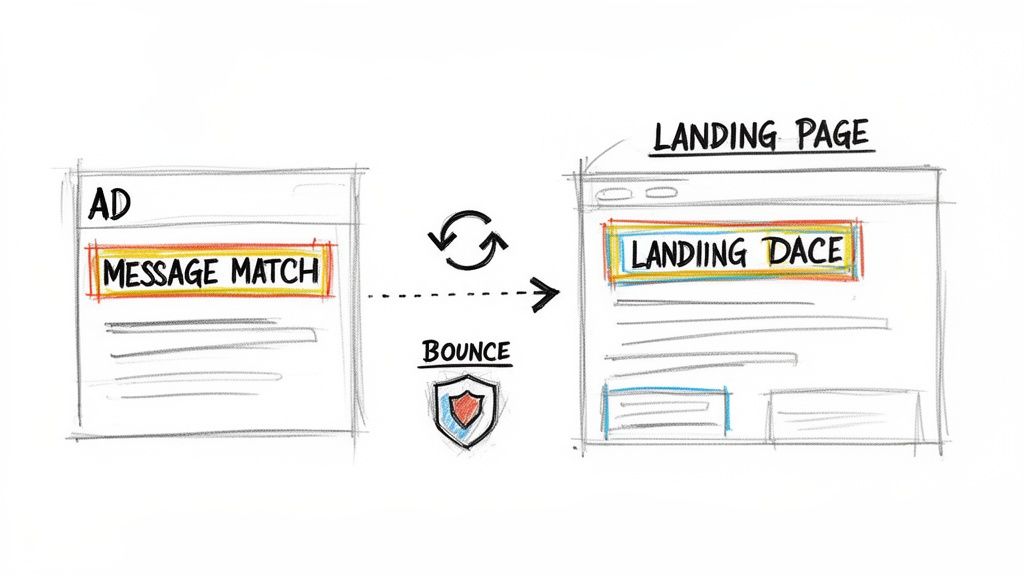
Message match is a non-negotiable part of any serious Shopify conversion rate optimization strategy. The idea is simple: the headline, copy, imagery, and offer in your ad need to be instantly reflected on the landing page. It's about immediately delivering on the promise you made in that ad.
When you get this right, you create a seamless, trustworthy experience that reassures the visitor and keeps them on site. When you break that "scent trail," you create confusion and skepticism. That's when they hit the back button and you lose a sale.
Why Generic Pages Kill Your ROAS
Dumping all your paid traffic onto your standard homepage or a generic collection page is a guaranteed way to tank your return on ad spend (ROAS). Someone who clicks an ad for "Men's Performance Running Shorts" has a specific need. They don't want to land on a page showing your entire men's collection, forcing them to sift through hoodies and sweatpants.
That extra work forces them to re-orient themselves and start their search all over again. Most won't bother. That click you paid for is wasted.
A study by McKinsey found that companies that excel at targeted customer experiences generate 40% more revenue from those activities than average players. Strong message match is the very first step in that journey. It's the initial handshake that tells a visitor, "You're in the right place."
This starts the moment a user sees your ad, not just when they're on your site. By creating dedicated landing pages for your high-spend campaigns, you maintain that critical continuity from the first click all the way to conversion.
Building High-Converting Ad-to-Page Funnels
The fix is to build dedicated, campaign-specific landing pages that act as a direct extension of your ads. This isn't as resource-intensive as it sounds with the flexibility of modern Shopify themes.
Here's what this looks like in practice for your main traffic sources:
For Meta Ad Campaigns
Let's say you're running a Meta campaign targeting new mothers with an ad for your "Organic Cotton Baby Swaddles."
- Weak Match: The ad links to your general "New Arrivals" page. Bad idea.
- Strong Match: The ad links straight to a dedicated landing page. The headline screams, "The Softest Organic Cotton Swaddles They'll Ever Sleep In," echoing the ad copy. The hero image is the exact same swaddle from the ad creative. You've even got testimonials from other moms featured right up top.
For Google Ads
Now, imagine a user searches Google for "waterproof winter hiking boots" and clicks your ad.
- Weak Match: You send them to your main "Boots" category, a jumbled mix of fashion boots and rain boots. They'll bounce.
- Strong Match: The ad takes them to a pre-filtered collection page showing only waterproof winter hiking boots. You could add a banner at the top that reinforces the ad's value props, like "Free Shipping on All Hiking Boots" or "Gore-Tex Certified."
This level of specificity isn't a "nice-to-have" detail; it's fundamental to getting the most out of every dollar you spend on ads. By perfectly aligning the pre-click and post-click experience, you cut friction, build instant trust, and create a clearer path to the add-to-cart button.
Your Shopify CRO Questions, Answered
When running a high-growth Shopify store, moving CRO from a buzzword to a needle-moving strategy brings up practical questions. Let's get into what brand owners and marketing managers really want to know.
How Long Until We See Results from a CRO Program?
This is always the first question, and the honest answer is: it depends on where you're starting.
If your site is full of obvious friction, like a confusing mobile checkout or slow product pages, you can often spot big wins in the first 30 to 60 days. These are the foundational fixes.
But a real, compounding CRO program is a long game. A/B tests that are statistically sound need time to run, usually two to four weeks just to gather enough clean data.
The goal isn't a one-and-done lift. It's about building a system of continuous improvement. You see true momentum build over a full quarter as you stack wins, learn from every test, and drive sustainable revenue growth.
What Is a Realistic Conversion Rate to Aim For?
Forget about industry benchmarks for a minute. A "good" conversion rate is completely relative. A luxury furniture brand might be successful at 0.8%, while a fast-fashion store at 2.5% could be leaving money on the table. Your price point, traffic source, and brand positioning all play a huge role.
Instead of chasing a magic number, focus on improving your own baseline.
A solid goal when you're starting out is to aim for a 15-20% relative lift in your main conversion metric within six months. If your store converts at 2.0% today, your target is to get that up to 2.3% or 2.4%. It's a tangible goal that keeps the team focused. If you want to crunch some numbers yourself, a tool like a conversion rate calculator can be a great starting point.
What Tools Are Essential for Shopify CRO?
You don't need a dozen different tools. One of the biggest mistakes we see is brands overloading their sites with client-side scripts that slow everything down - the opposite of what you want.
Here's the lean, powerful stack we use with scaling brands:
- Analytics: Google Analytics 4 is your foundation. It's the source of truth for all your quantitative data. Shopify analytics are also getting quite good.
- Qualitative Insights: You need to see why users are doing what they're doing. A tool like Microsoft Clarity or Heatmap for session recordings and heatmaps is non-negotiable.
- A/B Testing: To run sophisticated, flicker-free tests on everything from pricing to page layouts, you need a Shopify dedicated platform. We rely on Intelligems.
- Surveys: Getting direct feedback is invaluable. Simple post-purchase surveys using a tool like Fairing can uncover incredible voice-of-customer data.
That's it. This setup gives you everything you need to find problems, understand customer behavior, and validate your ideas without the bloat.
Who Should Be on the CRO Team?
You don't need to hire a whole department. For most brands doing $3M+, a killer CRO function is a team sport played by a few key people, whether they're in-house or an agency partner.
The core players are usually:
- A Strategist/Manager: This person owns the roadmap, prioritizes tests based on potential impact, and makes sense of the results. This might be a Head of Ecommerce, a Growth Manager, or your agency lead.
- A Developer: Someone has to build the tests. You need a developer who is comfortable with Shopify themes and split testing platforms.
- A Designer/UX Specialist: This person's job is to turn a promising hypothesis into a clean, intuitive design for your test variations.
This small group can drive an effective program. The secret is consistent communication and a relentless focus on the KPIs that matter. Every test should be a clear step toward a more profitable customer experience.
Ready to replace guesswork with a data-driven CRO program that turns your existing traffic into more revenue? At CONVERTIBLES, we run full-stack conversion optimization for scaling Shopify brands - audits, A/B testing, and ongoing iteration backed by real data. Book a call to map your CRO strategy.