

7 Actionable Ecommerce Personalization Examples for Shopify Brands in 2026

[ SUMMARIZE WITH AI ]
[ FREE CRO TEARDOWN ]
Find the 3 biggest revenue leaks on your store.
Every day a conversion leak goes unfixed, you're paying for traffic that doesn't buy. Get a 5-minute Loom through your PDP, cart, and checkout, with mockups of the fixes. No pitch.
Get My TeardownFor ecommerce brands scaling past $3M, one-size-fits-all optimization hits a wall. The next stage of growth isn't about finding a single 'best' version of your site; it's about creating multiple best versions tailored to specific customer segments. This shift from generic CRO to a segmented personalization program is what separates fast-growing brands from the rest. The problem is that most resources offer vague ideas or outdated tactics, leaving you guessing about what actually moves the needle.
In this guide, we cut through the noise. We break down actionable ecommerce personalization examples you can implement immediately. We’ll go beyond surface-level descriptions and provide the strategic framework for each: who to target, what to test, and how to measure success by profit per visitor, not just conversion rate. These are the strategies we use at CONVERTIBLES to drive five to six-figure monthly revenue lifts for our clients.
You won't find generic success stories here. Instead, you will get a curated list of the best resources and platforms for discovering high-impact personalization opportunities. We've included direct links and screenshots for each, so you can see precisely how to apply these concepts to your own Shopify Plus store. This is your playbook for building a sophisticated testing program that delivers real, measurable gains. Let's dive in.
1. CONVERTIBLES: Segment-Specific Onsite Experiences
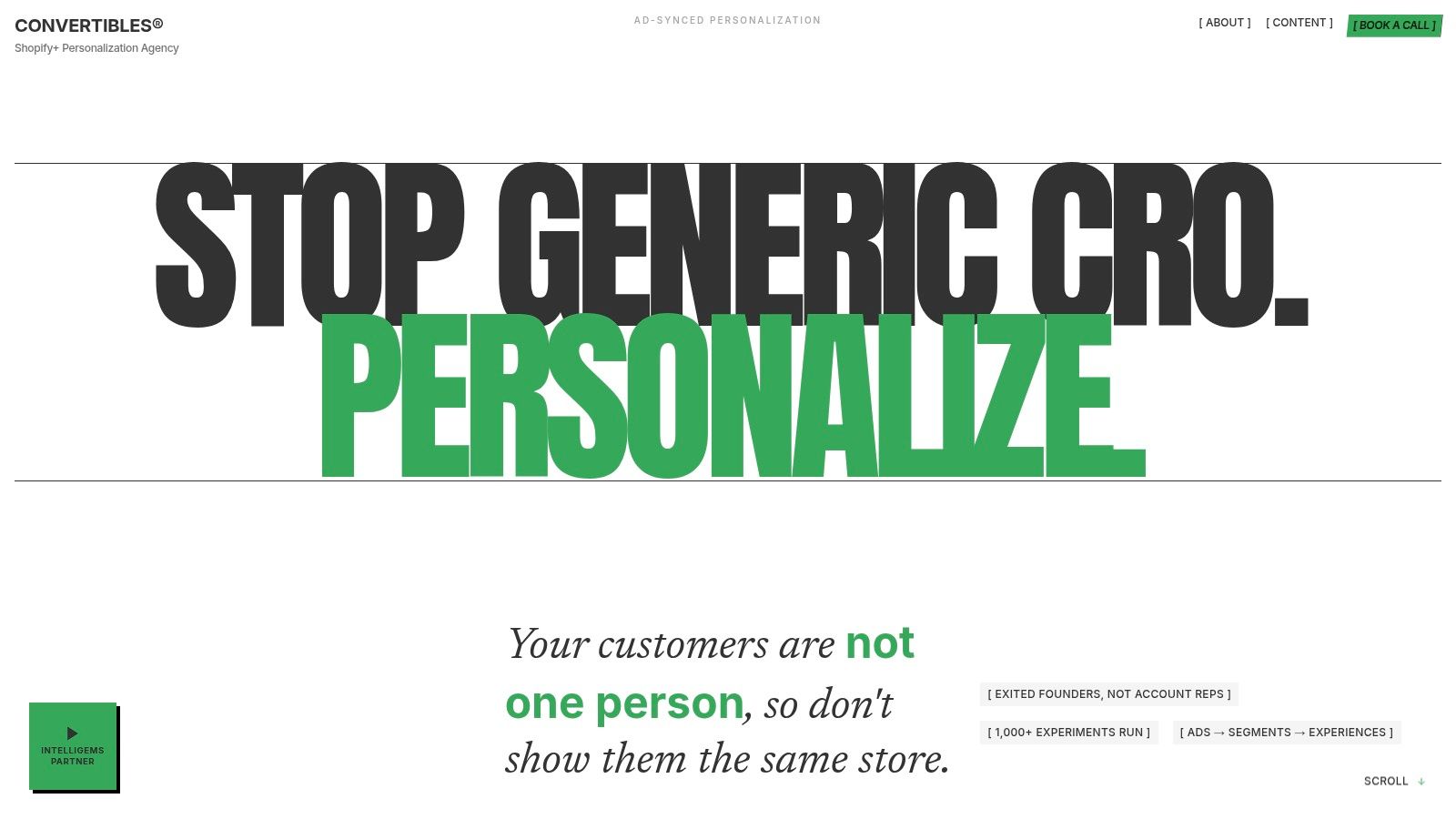
For Shopify Plus brands ready to graduate from generic, one-size-fits-all A/B testing, CONVERTIBLES offers a focused, high-impact approach to personalization. Instead of testing small changes for the entire audience, this agency specializes in creating distinct, segment-specific onsite experiences that directly map to high-value traffic sources. This methodology positions them as a standout choice for brands seeking to maximize profit-per-visitor, not just incremental conversion rate lifts.
Their core philosophy is built on ads-to-site continuity. CONVERTIBLES aligns the messaging, offers, and creative from your paid media campaigns (identified via UTM parameters) with the landing page and subsequent browsing experience. This ensures a visitor arriving from a TikTok campaign focused on a specific product benefit sees a site experience that reinforces that exact message, creating a seamless and persuasive customer journey. This disciplined focus on matching user intent is a powerful ecommerce personalization example that directly impacts ad spend efficiency and revenue.
Key Features and Strategic Approach
CONVERTIBLES moves beyond basic CRO by building and testing multiple, simultaneous site versions tailored to different audience segments. Their process is structured to deliver tangible financial results, backed by a robust tech stack and transparent workflow.
- Segment-Driven Testing: They design and deploy 2–4 tailored experiences per month, targeting segments based on traffic source, campaign, device, geography, or lifecycle stage. This allows brands to test aggressive hypotheses (like different offers, pricing, or messaging) on specific cohorts without risking baseline conversion.
- Profit-per-Visitor Validation: Unlike agencies that chase conversion rate, their primary success metric is profit-per-visitor. By partnering with Intelligems, they can run sophisticated tests on pricing and offers, accurately measuring the impact on bottom-line profitability.
- Proprietary Toolkit (TestBuddy): Clients gain access to a real-time dashboard that provides complete transparency into the testing roadmap, live experiment performance, and historical data. This tool demystifies the optimization process and keeps stakeholders aligned.
- Ads-to-Site Continuity: Their expertise lies in creating a frictionless path from ad click to conversion. A visitor from a "Free Shipping" Google Ad will land on a page where that offer is prominent, while a visitor from an influencer's post about a specific collection will be directed straight to a tailored version of that collection page.
Who It's For and What to Expect
This is a premium, retainer-based service designed for a specific type of ecommerce brand.
- Ideal Client: Shopify Plus stores with $3M–$200M in annual revenue, spending at least $50,000 per month on paid media.
- Prerequisites: Clients should also have in-house or partner teams for media buying and general development, as CONVERTIBLES maintains a tight focus on personalization.
The agency's structure is that of a strategic partner. Clients engage in bi-monthly strategy calls and have constant visibility through the TestBuddy dashboard. To truly enable segment-specific experiences, it's crucial to understand how to effectively define your audience. You can find more comprehensive details and practical approaches with these actionable customer segment examples. The results are often significant and rapid, with documented single-test uplifts generating between $60,000 and $110,000 in additional monthly revenue.
| Feature Analysis | Strength |
|---|---|
| Focus | Hyper-Specialized: Exclusively personalization and profit optimization, not a generalist agency. |
| Methodology | Segment-First: Moves beyond site-wide A/B tests to build tailored experiences for key audiences. |
| Measurement | Profit-Driven: Uses profit-per-visitor as the key metric, aligning optimization with business goals. |
| Transparency | High: Proprietary TestBuddy dashboard provides clients with real-time data and roadmap visibility. |
For brands that have hit a ceiling with traditional CRO and want a partner dedicated to unlocking revenue through sophisticated, segment-based personalization, CONVERTIBLES represents a clear and powerful path forward.
Website: https://convertibles.dev
2. Dynamic Yield – Personalization Inspiration Library
Dynamic Yield's Personalization Inspiration Library is less of a tool and more of a strategic swipe file for ecommerce operators. It’s a curated, searchable database of over 100 real-world personalization campaigns, offering a direct look into what leading brands are testing and implementing on their sites. This isn't just a gallery of screenshots; it's a playbook of actionable ideas.
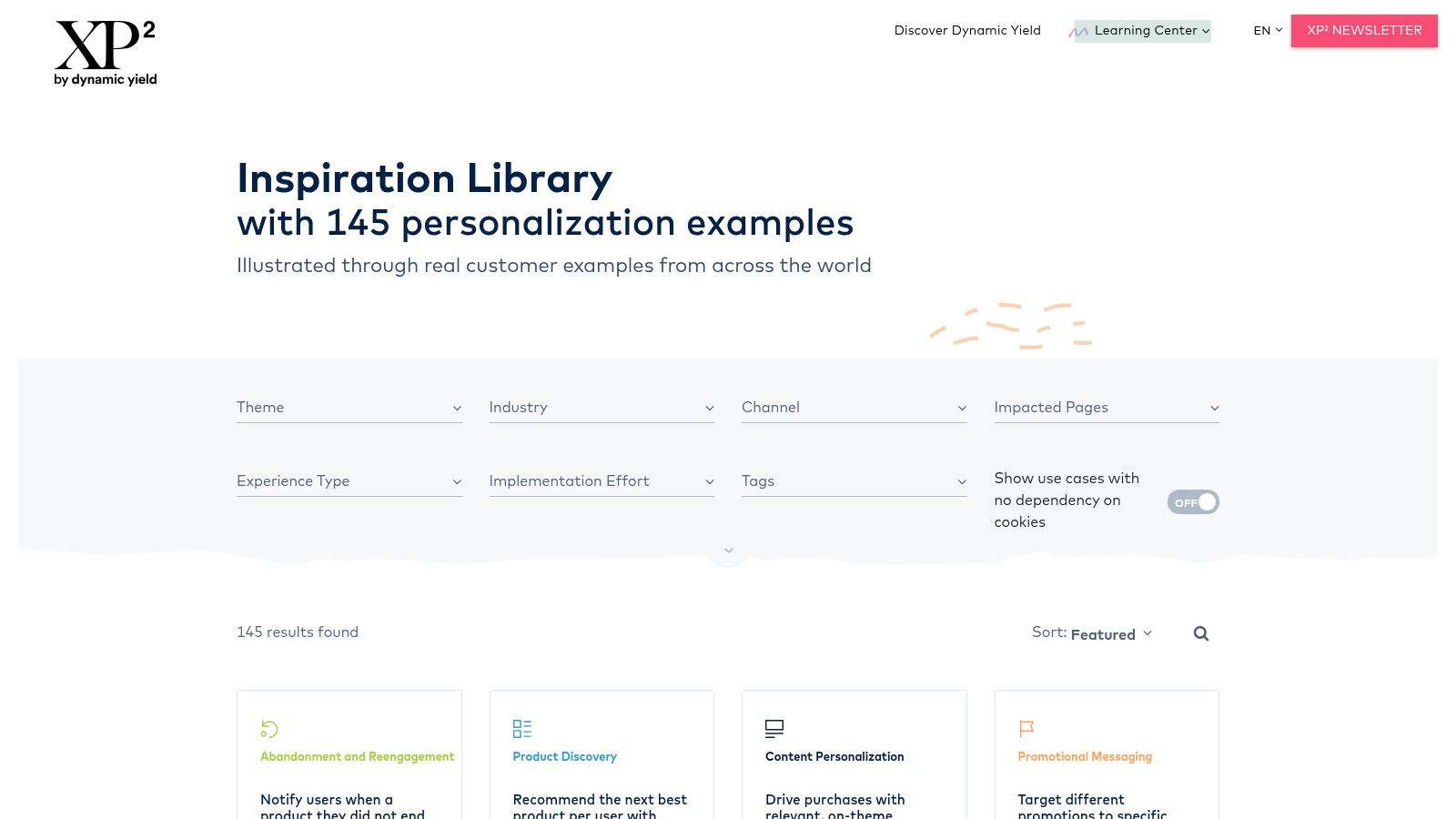
For busy marketing teams, this library cuts down on brainstorming time and provides a solid foundation for building a personalization roadmap. You can move from a vague idea like "we should personalize our homepage" to a specific, proven tactic like "let's show a 'trending' social proof banner to first-time visitors who arrived from a social media ad campaign." Each example provides enough context to understand the why behind the strategy.
What Makes It Stand Out
The library's key differentiator is its powerful filtering system, which allows you to find highly relevant ecommerce personalization examples tailored to your exact needs. You can filter campaigns by:
- Industry: Find tactics used by brands in your specific vertical, like Fashion & Apparel or Home & Furniture.
- Page Type: Zero in on ideas for the Homepage, Product Listing Page (PLP), Product Detail Page (PDP), Cart, or Checkout.
- Business Goal: Filter for campaigns designed to increase AOV, improve conversion rates, or drive engagement.
- Effort to Implement: Quickly find low-hanging fruit or plan for more complex, high-impact initiatives.
This structured approach transforms abstract personalization concepts into concrete actions. Many examples link directly to templates within the Dynamic Yield platform, accelerating the path from idea to live experiment. If you're looking for a deeper understanding of the core concepts, you can learn more about the principles of website personalization.
Access and Pricing
The inspiration library itself is completely free and publicly accessible. You don't need to be a Dynamic Yield customer to browse the examples.
However, implementing these ideas often requires a personalization platform. Dynamic Yield's full platform is an enterprise-level solution with quote-based pricing, placing it at a higher price point than many tools aimed at smaller Shopify stores.
Practical Takeaways
- Use it for your testing roadmap: Before your next CRO meeting, filter the library by your target page (e.g., PDP) and business goal (e.g., increase CVR). Pick two or three relevant examples to build your next test hypotheses.
- Validate your ideas: See if other brands have already successfully tested an idea you're considering. This can provide the confidence and data needed to get internal buy-in.
- Learn the "what" and "why": Don't just copy the examples. Analyze the strategic thinking behind them. Ask why a brand would target a specific segment with a particular message on a certain page.
Website: Dynamic Yield Personalization Inspiration Library
3. Nosto – AI Personalization Case Studies and Platform
Nosto offers a powerful AI-driven personalization platform, but its most valuable asset for strategic inspiration is its deep catalog of ecommerce case studies. With a strong footprint in the Shopify and Shopify Plus ecosystems, Nosto provides a lookbook of real-world personalization campaigns from recognizable DTC brands. These aren't just high-level success stories; they are detailed breakdowns of how brands personalize everything from product recommendations and search to category merchandising and post-purchase upsells.
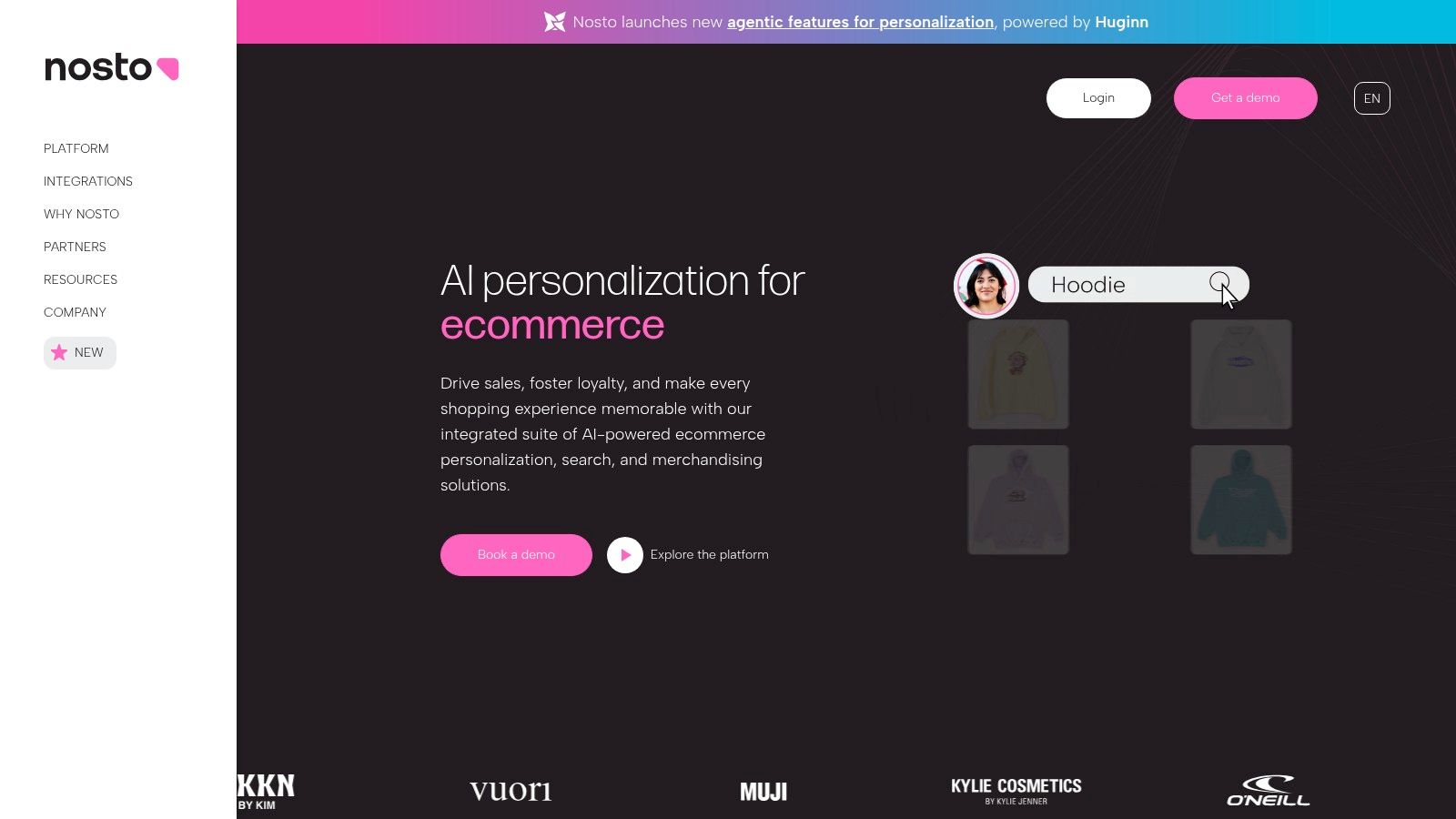
For a growth manager or ecommerce operator, this collection is a goldmine. The case studies translate the abstract power of AI into tangible outcomes, often including the specific revenue lifts and conversion rate increases observed. This makes it easier to build a business case for investing in personalization by modeling your potential ROI based on a similar brand's documented success.
What Makes It Stand Out
Nosto's key differentiator is its focus on measurable outcomes across the full customer journey. While many platforms show examples of on-site widgets, Nosto's case studies demonstrate a more holistic approach, connecting on-site behavior to email campaigns and post-purchase flows. This provides a complete picture of a unified personalization strategy. You can see ecommerce personalization examples that cover:
- On-Site Merchandising: How brands use AI to dynamically sort category pages based on user affinity, boosting product discovery.
- Triggered Emails: Examples of abandoned cart or browse abandonment emails that feature personalized product recommendations based on the items viewed.
- Search Personalization: Tactics for re-ranking search results to prioritize products a specific shopper is most likely to buy.
- Post-Purchase Upsells: How to leverage order confirmation pages and emails to suggest relevant complementary products, increasing customer lifetime value.
The platform's built-in A/B testing capabilities are often highlighted in the case studies, showing how brands validate their personalization logic with hard data. This focus on testing and measurement provides a clear framework for implementation. Exploring broader applications, such as how AI for Fashion: Visualize Your Style with AI-Driven Shopping, further illustrates how artificial intelligence is creating more tailored and effective retail experiences.
Access and Pricing
The library of case studies and resources is free to access on the Nosto website. You can browse detailed examples without being a customer.
However, Nosto's personalization platform itself is a premium solution with quote-based pricing. It is a sales-led process, so you will need to connect with their team for a demo and a custom quote based on your site traffic and specific needs.
Practical Takeaways
- Build your business case: Use Nosto’s documented case studies to forecast the potential impact of a personalization strategy at your company. Find a brand in a similar vertical and use their revenue lift as a benchmark.
- Expand beyond the homepage: Look for examples of personalization on category pages, search results, and in email campaigns. These are often high-impact, underutilized areas for optimization.
- Think in segments: Analyze how brands in the case studies define their customer segments. This can give you new ideas for targeting your own audience based on behavior, purchase history, or traffic source.
Website: https://www.nosto.com/
4. Shopify App Store – Personalization Apps
While other tools on this list are standalone platforms, the Shopify App Store is the essential ecosystem where personalization strategies become reality for millions of merchants. It’s a marketplace filled with hundreds of specialized apps designed to implement specific personalization tactics, from AI-driven product recommendations and dynamic bundles to cart upsells and pop-up offers. For Shopify brands, this is the most direct path from an idea to a live feature on their site.
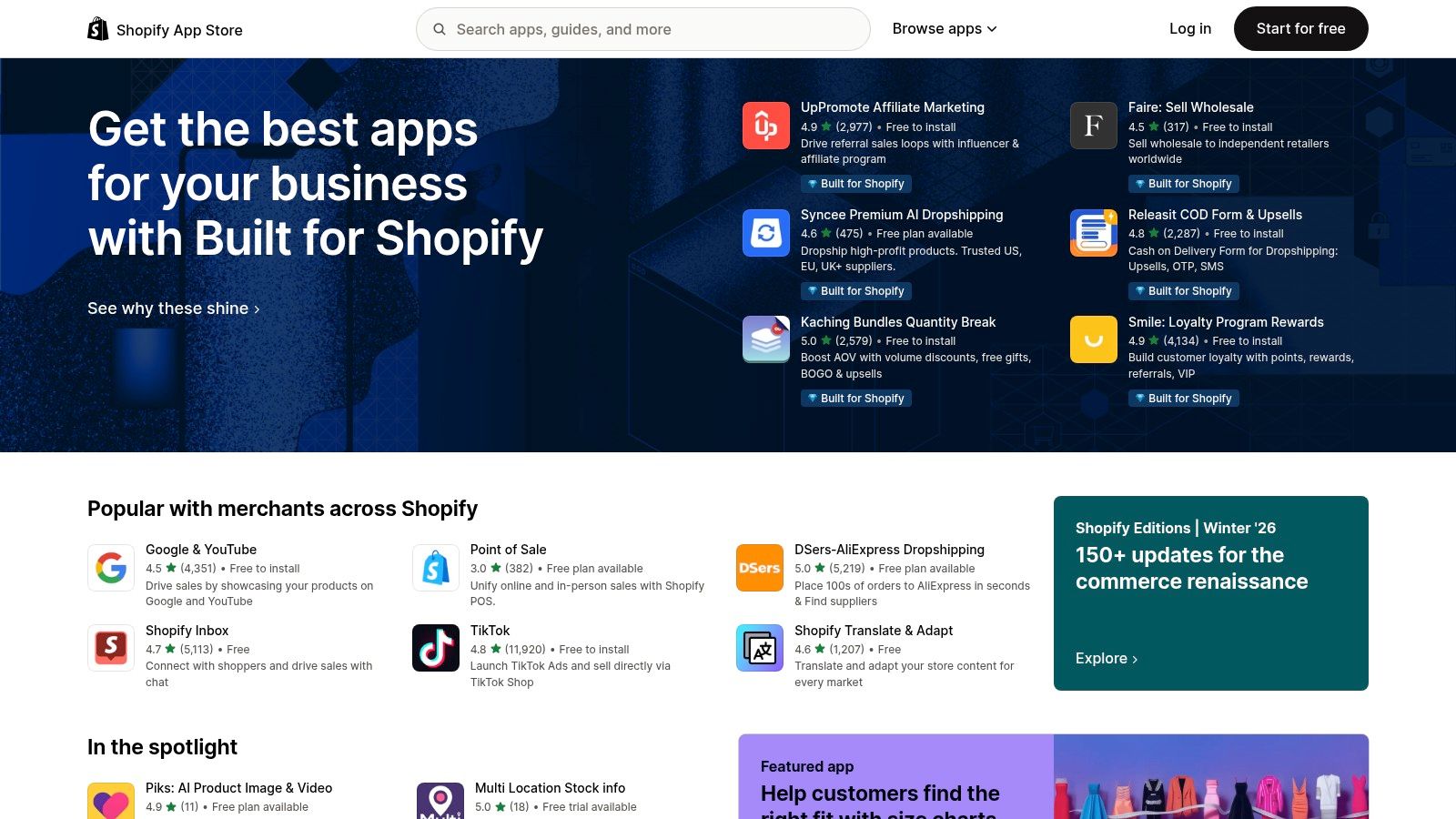
This app-based approach democratizes access to powerful personalization. Instead of committing to a single, monolithic enterprise suite, brands can assemble a best-in-class stack tailored to their needs. A merchant might use one app for "frequently bought together" widgets on the PDP, another for a post-purchase survey, and a third for exit-intent pop-ups. This modularity allows for rapid testing and iteration without significant engineering resources.
What Makes It Stand Out
The Shopify App Store's primary advantage is its seamless integration and low-friction deployment. You can find, vet, and install an app to execute a specific personalization tactic in minutes. This speed transforms the store into an operational launchpad for ecommerce personalization examples.
Key strengths of the ecosystem include:
- Vast Selection: With hundreds of apps in categories like "Recommended products" and "Upselling and cross-selling," merchants have an unparalleled choice of vendors to fit any budget or technical requirement.
- Social Proof and Vetting: Each app listing includes community reviews, ratings, and detailed feature lists. This crowdsourced feedback helps teams quickly gauge an app's quality, support, and reliability before committing.
- Transparent Trials & Pricing: Most apps offer a free trial period and clear, tiered monthly pricing. This model de-risks the adoption of new tools, allowing brands to test functionality and measure ROI before a financial commitment.
- Plug-and-Play Functionality: Apps are built to work directly with Shopify's data structures (products, customers, orders), enabling fast setup for common use cases like displaying personalized recommendations based on purchase history.
Access and Pricing
Access to the Shopify App Store is free for all Shopify merchants. The cost lies in the apps themselves.
Pricing models vary widely, from free plans with basic features to enterprise-level subscriptions costing thousands per month. Most personalization apps use a tiered subscription model based on usage, such as order volume, monthly revenue, or feature set. This allows brands to start small and scale their investment as they grow.
Practical Takeaways
- Solve One Problem at a Time: Don't try to build a full personalization engine at once. Identify a single, high-impact goal (e.g., increase AOV from the cart page) and find the best-rated app for that specific job.
- Read the Reviews Carefully: Pay close attention to recent one and two-star reviews. They often highlight critical issues with theme compatibility, app speed, or customer support that may not be apparent from the marketing copy.
- Test App Impact on Site Speed: Before fully committing, use a free trial to install an app on a duplicate of your theme. Test its impact on core web vitals and page load times, as poorly coded apps can hurt performance and conversion. For a deeper dive, you can explore more strategies for optimizing Shopify conversion rates.
Website: Shopify App Store
5. Baymard Institute – Ecommerce UX Research Catalog
The Baymard Institute's Ecommerce UX Research Catalog is not a software tool but a foundational research library for any serious ecommerce team. It provides hundreds of data-backed UX guidelines, real-world examples, and performance benchmarks that act as the strategic "why" behind high-impact personalization. Instead of guessing what to test, Baymard shows you which UX patterns consistently fail or succeed, giving your personalization strategy a proven starting point.
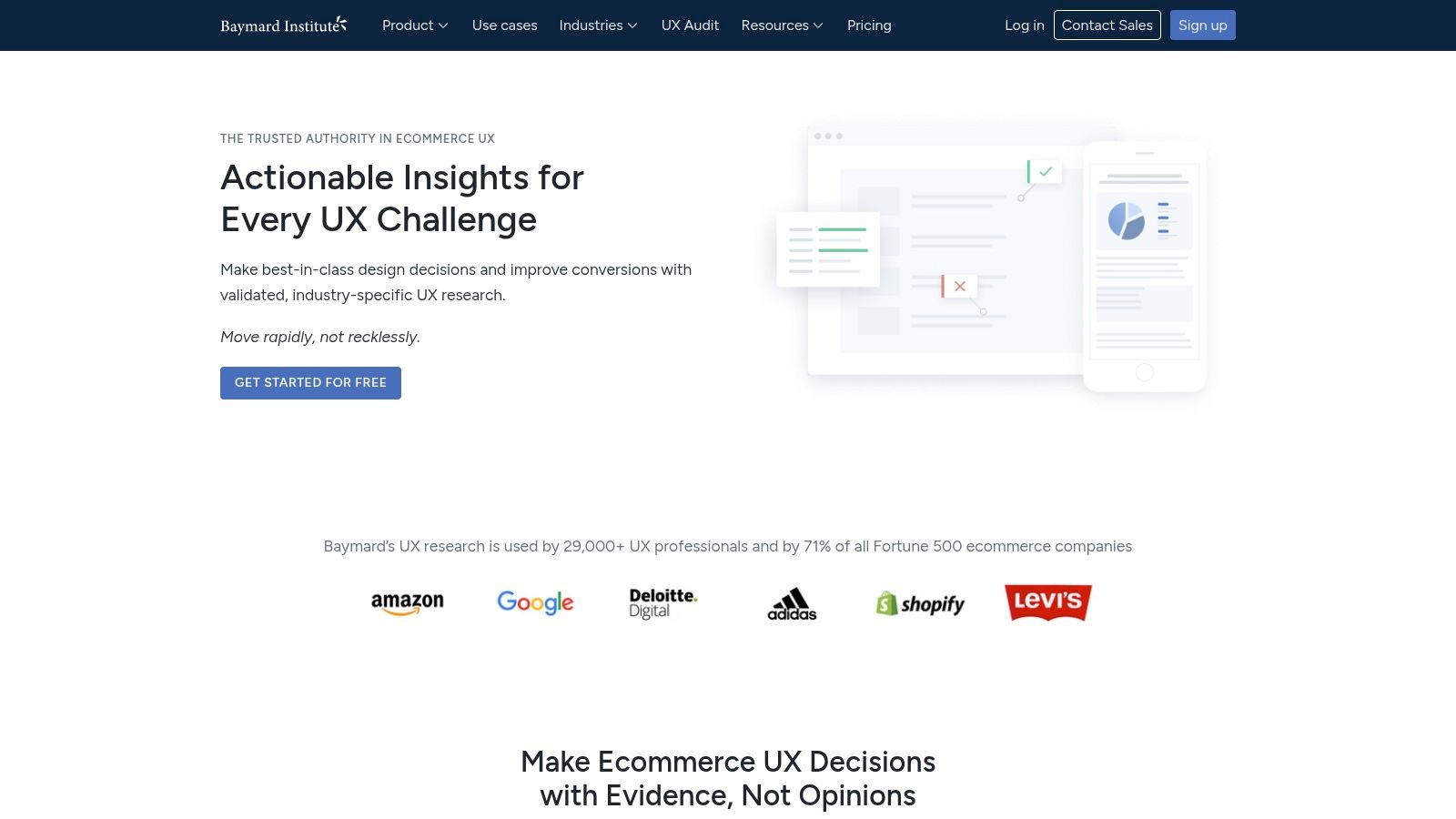
For growth and marketing managers, Baymard's research is invaluable for identifying where personalization can solve core usability issues. For example, if their data shows that 20% of users abandon checkout due to a confusing coupon field, you have a clear mandate to personalize that experience. You can test displaying a targeted message like, "First-time customer? Use code WELCOME10," but only for new visitors, avoiding friction for returning customers.
What Makes It Stand Out
Baymard’s primary differentiator is its rigorous, large-scale usability testing methodology. The guidelines aren't based on opinion; they are derived from thousands of hours of one-on-one user testing, providing a level of evidence that is hard to dispute. This research-backed approach is perfect for finding ecommerce personalization examples that are grounded in actual user behavior.
- Deep Research: Access 600–700+ specific UX guidelines covering every part of the customer journey, from homepage navigation to checkout form fields.
- Best-Practice Examples: See how leading ecommerce brands implement (or fail to implement) these guidelines, providing clear visual references.
- Benchmarking Data: Compare your site’s performance against industry leaders and understand the potential KPI impact of addressing specific UX flaws.
- Strategic Foundation: Use the research to identify the most critical friction points on your site, which then become the prime targets for your personalization and A/B testing efforts.
Instead of just copying a tactic, you learn the underlying usability principle, allowing you to create more effective and nuanced personalization campaigns.
Access and Pricing
Baymard offers a limited selection of articles and guidelines for free. This is a great way to get a feel for the depth and quality of their research.
Full access to the entire research catalog, including all guidelines, benchmarks, and premium content, requires a "Baymard Premium" subscription. This is a significant investment, typically aimed at enterprise-level teams and serious CRO practitioners who need to build a data-driven optimization culture.
Practical Takeaways
- Inform Your Personalization Roadmap: Use Baymard's research to audit your Product Detail Pages (PDPs) or checkout flow. Identify the top 3-5 UX guidelines your site violates and build personalization tests around fixing them for specific user segments.
- Strengthen Your Hypotheses: When proposing a new test, back it up with Baymard’s data. Instead of saying, "I think we should change the image gallery," you can say, "Baymard's research shows that our current gallery style causes user confusion; a test implementing their recommended pattern is likely to improve engagement."
- Train Your Team: The catalog is an exceptional training resource. Have your marketing, design, and development teams review the guidelines for the specific pages they work on to create a shared understanding of what a high-converting experience looks like.
Website: https://baymard.com/
6. GoodUI – Evidence (A/B‑tested patterns and leaked experiments)
GoodUI’s "Evidence" section is a running catalog of over 500 real A/B tests and leaked experiments from various industries, including a significant number from ecommerce. It operates as a data-driven inspiration board, offering experiment-backed patterns that can fuel a high-impact personalization strategy. Rather than relying on opinion, GoodUI provides tangible proof of what moves the needle, helping teams prioritize ideas validated by actual results.
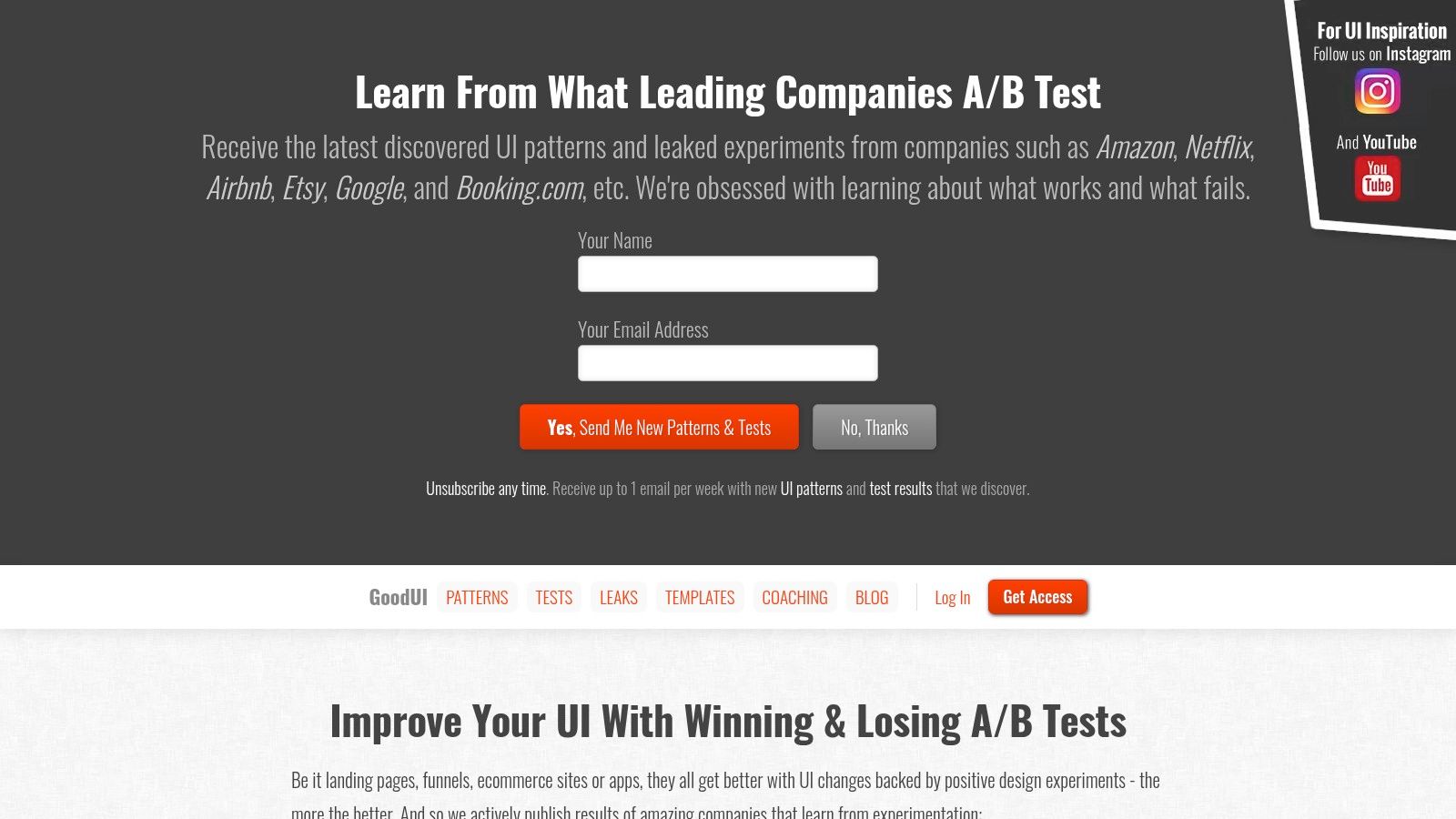
For ecommerce operators, this library is a shortcut to building better hypotheses. Instead of guessing what might work, you can browse through hundreds of tests that show the observed lift (or drop) in conversions. This transforms your brainstorming sessions from "what if we tried this?" to "here's evidence that a similar change drove a 5% lift for another brand; let's adapt it for our audience."
What Makes It Stand Out
The core value of GoodUI is its focus on A/B test evidence as the foundation for design and personalization decisions. Each "Evidence" post is a short, digestible summary of an experiment, outlining the control, the variation, and the resulting impact on a key metric. This makes it one of the most practical resources for finding proven ecommerce personalization examples.
The platform’s filtering system is simple yet powerful, allowing you to quickly find relevant patterns:
- Tags: Easily filter for tests related to Personalization, Pricing, Checkout, Urgency, or Social Proof.
- Page/Screen: Narrow down your search to find tests run on product pages, cart pages, or checkout flows.
- Metric: See which experiments were designed to improve conversions, clicks, or signups.
- Device: Differentiate between patterns that work best on desktop versus mobile.
This evidence-based approach removes much of the guesswork from conversion optimization, allowing teams to build a personalization roadmap based on a foundation of successful experiments from a broad range of companies.
Access and Pricing
A large portion of the "Evidence" library is free to access, providing significant value without any cost. You can browse many of the A/B test results and patterns publicly.
However, to unlock advanced filters (like sorting by impact score), view more detailed experiment data, and access the full catalog, a paid "Pro" membership is required. The paid plan is designed for teams that want to deeply integrate this data into their regular CRO and personalization workflows.
Practical Takeaways
- De-risk your personalization ideas: Before launching a personalization campaign, search GoodUI for similar tests. Seeing positive results from other brands can provide the data needed to justify resource allocation and get stakeholder buy-in.
- Find adjacent opportunities: Look at successful tests in other industries. A pattern that increased signups for a SaaS company might be adapted to boost newsletter subscriptions or account creations on your ecommerce site.
- Build a "swipe file" of patterns: Don't just look for one-off ideas. Identify recurring patterns (e.g., adding social proof near a CTA) that consistently show positive results and build a backlog of tests based on these proven concepts.
Website: GoodUI Evidence
7. Intelligems – Price/Offer Personalization & Testing for Shopify
Intelligems is a Shopify-native experimentation platform that moves beyond typical on-site content personalization. It focuses directly on the commercial levers that drive profitability: prices, offers, and shipping thresholds. For brands looking to understand how different price points or promotional strategies impact not just conversion rate but overall profit, Intelligems provides the toolkit to test these sensitive variables safely and effectively.
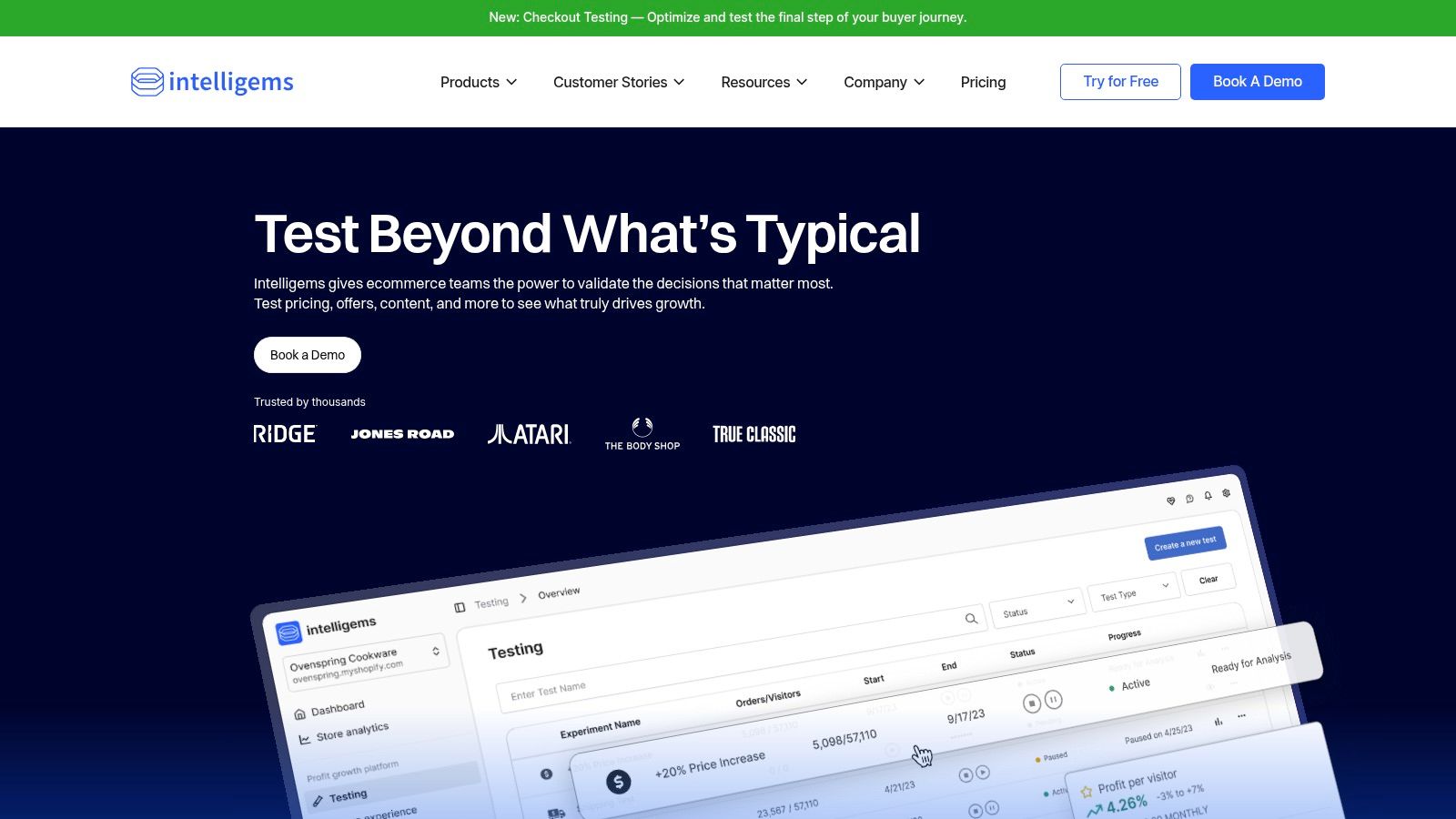
This platform enables merchants to run A/B tests on things like a 10% discount versus a 15% discount, or a $50 free shipping threshold versus a $75 one. It addresses a critical gap in many personalization strategies by connecting on-site experience directly to margin and revenue outcomes. Instead of just personalizing a headline, you can personalize the actual offer a specific audience segment sees, measuring the true financial impact.
What Makes It Stand Out
Intelligems' primary differentiator is its laser focus on profit-aware personalization. While most platforms focus on optimizing for conversion rate (CVR), Intelligems has built-in profit analytics that help you see which test variation generates the most bottom-line profit. This is crucial for finding the sweet spot between maximizing sales and protecting margins.
Its unique capabilities for Shopify merchants include:
- Price & Shipping A/B Testing: Safely test different product prices or shipping rate structures to see how customers respond.
- Offer Personalization: Experiment with different discount values or types (e.g., % off vs. $ off) for various customer segments.
- Checkout Content Testing: Personalize and test content directly within the Shopify checkout, a notoriously difficult area to customize.
- Shopify-Native Integration: Built specifically for Shopify and Shopify Plus, ensuring a smoother implementation and user experience.
These features make it an ideal tool for brands that have mastered basic CRO and are ready to tackle more complex, high-impact financial optimizations.
Access and Pricing
Intelligems offers clear, public pricing tiers based on your store's monthly order volume, making it accessible for growing Shopify brands. Plans start at $299/month for stores with up to 2,500 monthly orders and scale up from there.
This transparent, usage-based model is a significant advantage over enterprise tools that require custom quotes, allowing teams to evaluate the tool's ROI more easily. They also provide extensive public documentation, which helps teams understand implementation and QA processes before committing.
Practical Takeaways
- Test your discount strategy: Instead of guessing the optimal discount for your next sale, run an A/B test. Pit a 15% discount against a 20% discount and measure which one generates more total profit, not just more orders.
- Optimize your free shipping threshold: A common ecommerce question is "What should our free shipping threshold be?" Use Intelligems to test different levels (e.g., $50 vs. $75) to find the point that best increases Average Order Value (AOV) without hurting conversion.
- Personalize offers by traffic source: Show a more aggressive "Welcome" discount to first-time visitors from high-cost paid channels like Google or Facebook to maximize ROAS, while showing a standard offer to organic visitors.
Website: Intelligems
Top 7 Ecommerce Personalization Comparison
| Item | Implementation complexity | Resource requirements | Expected outcomes | Ideal use cases | Key advantages |
|---|---|---|---|---|---|
| CONVERTIBLES | Medium–High (agency-run) | High: Shopify Plus, Intelligems, premium retainer | Large profit-per-visitor uplifts; documented six-figure monthly revenue gains | High-traffic Shopify Plus brands scaling paid media | Segment-specific experiences, profit-driven methodology, ads-to-site continuity |
| Dynamic Yield Library | Low (browseable) | Low for access; High if using the full platform | Faster ideation, proven templates | Teams seeking inspiration for their testing roadmap | Searchable library, filterable examples, direct template links |
| Nosto | Medium | Medium–High: premium platform cost | Increased AOV and CVR via AI-driven recommendations | Brands wanting AI-driven recommendations and merchandising | Deep Shopify integration, detailed case studies, built-in A/B testing |
| Shopify App Store | Low–Medium (app install) | Low–Medium: app subscription fees | Rapid deployment of specific personalization tactics | Merchants needing quick, tactical solutions on Shopify | Wide vendor choice, transparent pricing, fast implementation |
| Baymard Institute | Low (consume research) | Medium: subscription cost, dev resources to implement findings | Better-informed personalization strategies, reduced UX friction | Teams building a UX-grounded optimization program | Deep research-backed guidelines, benchmarks, best-practice examples |
| GoodUI Evidence | Low (browseable) | Low (free content) to Medium (Pro access) | Data-backed test ideas, improved hypothesis quality | Teams needing validated patterns to inform A/B tests | Large catalog of real A/B tests, filterable results, clear data |
| Intelligems | Medium (Shopify-native) | Medium: tiered pricing based on order volume | Margin-aware uplifts from price/offer optimization | Shopify merchants focused on pricing, offers, and profit | Direct price/offer A/B testing, profit-focused analytics |
Your Next Step: From Examples to Execution
We’ve explored a powerful collection of ecommerce personalization examples, from the AI-driven strategies showcased by Nosto to the specific pricing tests enabled by Intelligems. Seeing these case studies and replicable patterns from resources like Dynamic Yield and GoodUI is inspiring. However, the true value isn't in admiring what others have done; it's in translating those insights into a structured, revenue-driving program for your own Shopify Plus store. The difference between stagnant growth and a compounding optimization engine lies in moving from inspiration to systematic execution.
The most successful brands don't just run random A/B tests. They build a personalization roadmap. They view every visitor segment as a distinct opportunity to deliver a more relevant, persuasive, and profitable customer journey. This isn't about guesswork. It's about forming a clear hypothesis, shipping a targeted experience, and measuring the impact with precision.
Distilling the Core Principles of Personalization
As you move forward, keep these core takeaways from the examples we've covered at the forefront of your strategy:
- Segmentation is Your Foundation: The most impactful personalization starts with identifying your most valuable visitor segments. Are they new visitors from a specific Meta campaign? High-AOV returning customers? Or perhaps visitors who viewed a product but didn't add it to their cart? Each group has unique motivations and requires a tailored approach.
- Hypotheses Drive Purposeful Tests: A strong personalization effort is never a shot in the dark. Every change should be backed by a clear hypothesis: "We believe that by showing first-time visitors from paid search a 'Why Us?' section instead of a generic banner, we will increase add-to-cart rates by 10% because it builds immediate trust and differentiates our brand."
- Focus on Profit, Not Just Conversion Rate: Tools like Intelligems highlight a crucial shift in optimization. A higher conversion rate is meaningless if it comes from deep discounts that destroy your profit margins. Always measure the impact of your tests on profit per visitor and Customer Lifetime Value (LTV) to ensure your personalization efforts are genuinely growing the business.
- Start Small, Scale What Works: You don't need to personalize every element of your site at once. Choose one high-impact segment and one clear hypothesis. For example, target 'first-time visitors from Google Ads' and test a personalized welcome offer. Measure the results, learn from the data, and then expand the winning strategy to other channels or segments. This iterative process creates momentum and minimizes risk.
Building Your Personalization Tech Stack
The tools we've discussed each serve a different purpose. Choosing the right one depends on your immediate goals.
- Are you struggling with inspiration and strategy? Dive into the libraries from Dynamic Yield and Baymard Institute to understand user behavior and identify common friction points.
- Are you ready to test different offers, discounts, or shipping thresholds? Intelligems is purpose-built for this, allowing you to optimize for profit, not just conversions.
- Do you need an all-in-one platform for broad-stroke personalization like product recommendations and dynamic content? Nosto offers a powerful, AI-driven suite to handle these tasks.
Your tech stack should support your strategy, not define it. Start with the problem you want to solve, then select the tool that solves it most effectively. The goal is to create a seamless ads-to-site experience that feels curated for each user, turning anonymous traffic into loyal customers. These ecommerce personalization examples are your blueprint; now it's time to build.
Frequently Asked Questions
What is ecommerce personalization and how is it different from CRO?
Traditional CRO tests one experience against variations for all visitors. Personalization tailors different experiences to specific visitor segments based on behavior, traffic source, or lifecycle stage. Personalization unlocks gains that one-size-fits-all testing cannot achieve by treating different audiences differently.
How do I start with personalization if I have never done it before?
Start by identifying 3-5 high-value visitor segments based on behavior data you already have: new vs returning visitors, traffic source, and purchase history. Then create one personalized experience for your highest-value segment and measure profit per visitor impact before scaling.
What tools do I need for Shopify personalization?
At minimum, Google Analytics 4 for segment identification and a testing platform like Intelligems that integrates natively with Shopify. For price and offer personalization, Intelligems includes built-in profit analytics. Start with one tool and expand as your program matures.
How do I measure personalization ROI?
Measure profit per visitor by segment, not sitewide conversion rate. A personalized experience might lift one segment while having no effect on another. Run controlled tests comparing the personalized experience against the generic one for each segment to isolate the true revenue impact.
We work on tactics like these daily, book a call to get 3 custom (tailored for your business), researched personalization ideas to get you started.