

High-Profit Facebook Ad Strategies for 8-Figure Ecommerce Brands

[ SUMMARIZE WITH AI ]
[ FREE CRO TEARDOWN ]
Find the 3 biggest revenue leaks on your store.
Every day a conversion leak goes unfixed, you're paying for traffic that doesn't buy. Get a 5-minute Loom through your PDP, cart, and checkout, with mockups of the fixes. No pitch.
Get My TeardownForget chasing cheap reach and blasting broad audiences. For ecommerce brands scaling past $3M annually, the old Facebook ad strategies playbook is broken. The new game is about engineering profit from high-intent customers by connecting segmented ad campaigns directly to personalized on-site experiences.
This is a fundamental shift from volume to value. It's how you turn ad spend into measurable lifts in conversion rates and, critically, profit per visitor. This guide is a tactical playbook for DTC teams ready to build a system that ties every ad dollar directly to the bottom line.
The New Playbook: From Ad Click to Conversion
The days of optimizing for the lowest cost-per-click are over. Facebook's ad platform now rewards brands that create a cohesive, high-value journey. Great creative isn't enough, that creative, the audience segment, and your offer must align perfectly with the experience a user has the second they land on your site.
This isn't about generic tips, it's about building an operational system. The goal is a foundation that drives higher conversion rates and bigger average order values, turning your ad spend into a predictable growth engine.
Shifting from Reach to Revenue Density
Meta’s ad ecosystem has pivoted hard toward what we call "revenue density." While global ad reach stagnated, Meta's revenue soared. This signals that sophisticated advertisers are paying for performance, not just impressions.
In Q4 2023, Meta’s average revenue per user in the U.S. and Canada hit a staggering $68.44. This number forces a strategic shift. You can't afford to chase cheap CPMs across billions of users, you must concentrate your budget on tightly defined, high-value segments. Winning advertisers are extracting maximum revenue from the 20-40% of their audience that behaves like their best customers.
The core of a modern Facebook ad strategy is no longer just who sees your ad. It’s about creating a seamless, personalized journey from ad click to checkout, ensuring the post-click experience delivers on the ad's promise.
The Foundation of a Modern Strategy
Success requires an integrated system. To execute this, you must master the fundamentals of how to run ads on Facebook for real results.
Here’s what this new playbook looks like in practice:
- Segment-Driven Campaigns: Stop thinking in broad demographics. Build campaigns around sharp behavioral segments like first-time buyers, high-AOV customers, or loyalty program members.
- Ad-to-Site Continuity: This is non-negotiable. The message, offer, and creative in your ad must be mirrored on the landing page. This creates a frictionless, intuitive user experience.
- Onsite Personalization: Use tools to dynamically change your site’s content based on the ad segment a visitor arrived from. This is how you maximize relevance, urgency, and conversion rates.
- Profit-Focused Measurement: Ditch vanity metrics like CTR. Measure what actually matters: Marketing Efficiency Ratio (MER) and profit per visitor for each key segment.
This guide will walk you through building and executing this system.
How to Build Your High-Value Audience Segments
The most effective Facebook ad strategies are never built for a general audience, they're precision-engineered. For any brand serious about growth, this means shifting focus from basic lookalikes and wide demographics to the 3 to 5 most profitable customer segments you already own.
The game isn't just about finding new customers, it's about getting smarter about the ones who already drive your business. The plan is to build a clear audience architecture that becomes the playbook for your campaigns, creative, and offers. This starts by digging into the first-party data you already have in platforms like Shopify and Klaviyo.
Moving Beyond Basic Targeting
Your most powerful data isn't in Ads Manager, it’s in your own backend. This is your first-party data, and it lets you build audiences based on what people actually do, not just what an algorithm thinks they're interested in.
Think about the distinct tribes within your customer base. A skincare brand has ‘Subscription Loyalists’ and ‘One-Time Gifters.’ A fashion retailer has ‘VIP Members’ who buy at full price and ‘New Trend Seekers’ who arrive from an influencer campaign. Each group requires a different conversation.
To start, identify a few core segments using your sales data:
- High AOV Customers: Customers who consistently spend more than your average order value (e.g., top 20% by lifetime spend).
- Repeat Purchasers: Your loyalists, those who have bought two, three, or more times.
- Discount Shoppers: Customers who only purchase during a sale or with a coupon code.
- First-Time Buyers (Last 30-60 Days): A critical group to nurture toward a second purchase.
- Lapsed High-Value Customers: Once-great customers who haven't purchased in the last 90 or 120 days.
Getting this segmentation right is the bedrock of a sophisticated ad strategy.
Building Your Segments in Practice
Once you've identified these groups, build them as Custom Audiences inside Facebook. Export customer lists from your e-commerce platform or ESP and upload them directly into Facebook's Audiences tool.
On Shopify Plus, you can filter your customer list by tags, total spend, or order count. To create a 'High AOV' segment, export all customers with a total spend over $500. For 'Repeat Purchasers,' pull a list of everyone with three or more orders.
The real magic is creating a mirror of your business's core value drivers inside the ad platform. When you upload a list of your top 1,000 customers, you're not just creating an audience. You're giving Meta's algorithm a crystal-clear picture of your ideal customer.
This process transforms advertising from a guessing game into a data-driven operation.
Activating Segments for Profitability
With your high-value segments built, you can run specific, profitable plays. Your 'Repeat Purchasers' could see ads for new product launches first, with messaging that acknowledges their loyalty. Your 'Lapsed High-Value' segment might get a compelling win-back offer designed to reignite their interest.
This approach is non-negotiable. Facebook has over 3 billion monthly active users, making it an incredibly noisy place. Blasting the same generic message to everyone is the fastest way to burn ad budget. When the average user clicks on about 12 ads per month, you have to make every one count. Brands systematically buying profitable market share are aligning ad creative and offers with these granular segments. You can discover more insights from the latest business on Facebook statistics.
This granular approach also fuels better conversion optimization. An ad targeting 'Discount Shoppers' with a "20% Off" headline should click through to a landing page where that sale is front and center. This ad-to-site continuity validates the user's click and removes friction, which in turn leads to higher conversion rates.
Your first move is to map out those 3-5 core segments and get them uploaded. This single action is the first step toward a more resilient and profitable advertising system.
Connect Ad Creative to Personalized Onsite Experiences
Getting qualified traffic to your site is only half the battle. A common expensive mistake is running a brilliant, segment-specific ad only to dump that traffic onto a generic landing page. It's a jarring disconnect that shatters the user journey and torches your ad budget.
Winning on Facebook requires seamless continuity from ad to site. The promise you make in your creative must be immediately validated the moment a user lands. This is where you bridge the gap, connecting ad campaigns directly to personalized onsite experiences and creating a frictionless path that confirms the user's click was the right decision.
This flow chart breaks down how to turn raw data into highly targeted campaigns.
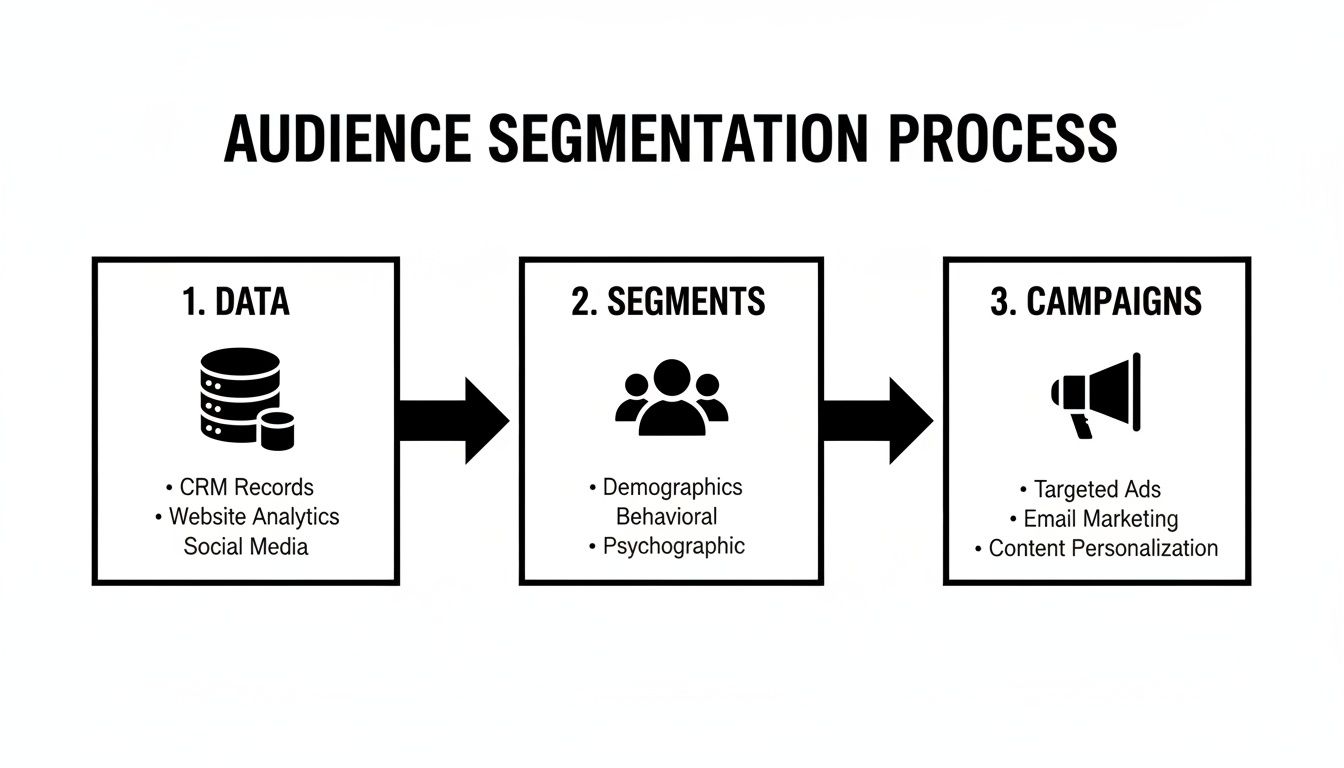
Following this process ensures every campaign is built on a foundation of real customer behavior, creating post-click experiences that feel relevant and drive action.
Mapping Ad Offers to Onsite Personalization
The core principle is to match the message. If your ad targets repeat customers with a "Bundle & Save" offer, the landing page must feature that exact bundle, front and center. Go further: the headline should acknowledge their loyalty, and product recommendations should be based on past purchases.
This is the tactical side of website personalization, a strategy focused on tailoring the user experience to specific audience segments. Get a deeper look in our guide on what website personalization is and how it works.
Here is a practical matrix for connecting ad segments to specific onsite tactics.
Ad-to-Site Personalization Matrix Example
| Audience Segment | Facebook Ad Offer or Angle | Personalized Onsite Experience |
|---|---|---|
| High AOV Customers (> $250) | Exclusive first look at a new, premium product line. | A dedicated landing page with a hero banner featuring the new collection. The headline reads, "An Exclusive Preview for Our VIPs." All sitewide discount banners are dynamically hidden to protect margins. |
| First-Time Buyers (Prospecting) | "Discover Our Best-Sellers. Free Shipping On Your First Order." | Lands on a curated "Top-Rated" collection page. A sticky bar reinforces the "Free Shipping" offer, and social proof like customer reviews is prominently displayed. |
| Cart Abandoners (Last 7 Days) | "Still thinking it over? Your cart is waiting." Ad shows the exact product they abandoned. | A pop-up appears on the homepage saying, "Welcome back! Here's what you left behind," with a direct link to their pre-filled cart. A timer might add urgency, like "Complete your order in 10 minutes for 10% off." |
| Loyalty Program Members | "You've Earned It! Redeem Your Points for Exclusive Rewards." | The user lands on a personalized dashboard showing their points balance. The hero banner highlights exclusive, members-only products they can redeem with points. |
Mapping these journeys removes guesswork and clarifies what to build, test, and measure.
Implementing Dynamic Onsite Elements
Personalization extends beyond the hero banner. To build a true conversion engine, dynamically alter site elements to maintain relevance throughout the entire session.
Key tactics include:
- Dynamic Headlines and Subheadings: Instantly change landing page text to mirror the copy from the ad that brought them there.
- Segment-Specific Hero Banners: Show different hero images and CTAs based on visitor type, new vs. returning, high-AOV vs. discount shopper.
- Tailored Product Recommendations: Ditch generic suggestions. Instead, show products relevant to the user's past purchases or browsing history.
- Personalized Pop-Ups: Trigger different pop-ups for different segments. A first-time visitor sees a 10% off welcome offer, while a repeat customer sees a loyalty program invitation.
By creating this cohesive journey, you are actively reducing friction, building trust, and giving each user a compelling reason to convert. The experience feels intuitive and designed specifically for them, because it is.
The Role of Visuals in a Cohesive Journey
This continuity must extend to your visuals. The product imagery and style in your Facebook ads should be identical to what users see on the landing page. Inconsistent visuals create a jarring experience and can cause users to question if they clicked the right link.
To elevate both ad creative and the onsite experience, explore how new technology can create better, more consistent visuals at scale. Enhance your creative and personalization by exploring how AI product photography can transform your e-commerce presence. AI can generate different lifestyle shots or place products in new scenes, giving you a massive asset library for ad testing and personalized site banners.
Connecting your ad creative to a personalized onsite experience is the critical step that turns traffic into revenue. It’s the difference between hoping for conversions and engineering them.
Getting Real About Measurement and Attribution
Measurement in the post-iOS 14 world is a competitive advantage. You cannot rely on Facebook's in-platform reporting alone to scale profitably. The goal isn't to find a perfect attribution model, it doesn't exist. The goal is to build a reliable system to make smarter decisions about where to allocate budget.
Building Your Single Source of Truth
The smartest Facebook ad strategies are built on a foundation of blended data. Relying solely on Ads Manager reports provides a skewed, often inflated, view.
A practical attribution setup pulls data from three essential places:
- Facebook Ads Manager: Your starting point for platform metrics like CPM, CPC, and ad-level engagement. Treat it as directional data, not absolute truth.
- Your Shopify Backend: This is your ground truth, where real numbers like sales, revenue, and AOV live. It tells you what actually happened.
- Google Analytics: This gives you the bigger picture of user behavior, traffic sources, and how different marketing channels interact.
Triangulating data from these three sources gives a clearer picture of how Facebook ads truly impact your bottom line.
A major mistake is basing budget decisions on Facebook's 7-day click attribution window. A more reliable approach is to look at your Shopify sales and MER over a 24-hour period. This smooths out attribution gaps and keeps the team focused on immediate, real-world impact.
The Only Metrics That Matter for Profit
To make good decisions, track the right things. Move past vanity metrics and zero in on numbers that reflect business health and profitability.
Marketing Efficiency Ratio (MER) should be your north star. Calculate it by dividing total store revenue by total ad spend (Total Revenue / Total Ad Spend). This gives a clear, high-level view of marketing effectiveness, sidestepping channel-specific attribution debates. An MER of 4.0 means you're making $4 for every $1 spent on ads.
Profit Per Visitor (PPV) is where things get actionable. This metric connects ad spend directly to the profitability of each customer segment. Calculating PPV for your 'High AOV Customers' versus 'First-Time Buyers' shows exactly which audiences drive real value, enabling precise budget allocation.
Why UTMs Are Non-Negotiable
Solid measurement requires systematic tracking, meaning UTM parameters are not optional. It’s the only way to truly understand the journey from ad click to purchase.
A consistent UTM structure allows you to trace performance accurately in Google Analytics. You can see exactly which campaigns, ad sets, and individual ads are driving traffic and revenue.
For example, a clean UTM like utm_campaign=Q4-Sale-Prospecting instantly tells you the goal and audience. Without this detail, you're flying blind. This is foundational for any serious conversion optimization effort.
Building Your High-Tempo Testing Roadmap
Brands that consistently win have a disciplined, systematic approach to testing. A high-tempo testing roadmap separates ad accounts that tread water from those that become predictable growth engines. It’s about a structured plan that delivers consistent, compounding gains.
We're moving from minor creative tweaks to testing major offer and landing page variations that can fundamentally change performance.
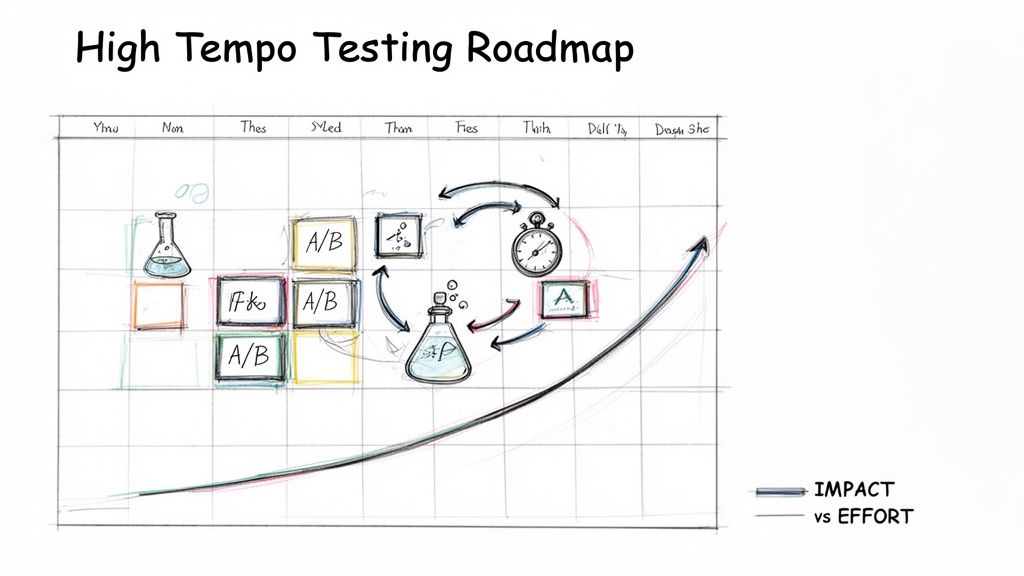
This isn't about random ideas, it’s a blueprint for prioritizing experiments based on potential impact, structuring them correctly, and letting results from one test inform the next. You're building an optimization flywheel.
How to Prioritize Your Tests for Maximum Impact
Not all tests are created equal. Many brands get stuck testing minor variables like button colors while ignoring the big levers that move profit. A simple framework keeps you focused.
Map potential tests based on their likely impact versus the effort required.
- Low-Hanging Fruit (Low Effort, High Impact): Quick wins. Think testing a new headline on a high-traffic landing page or a different angle in ad text for a core segment.
- Big Swings (High Effort, High Impact): Require more resources but offer massive potential. This could be testing a "Bundle & Save" offer against a standard 15% off discount, or building a fully personalized landing page for VIPs.
- Incremental Gains (Low Effort, Low Impact): Small tweaks like CTA button copy or minor image variations. They have a place but shouldn't dominate your testing calendar.
- Resource Drains (High Effort, Low Impact): Avoid these. This is spending weeks on a complex feature only a tiny fraction of your audience will see.
Your roadmap should mix these, but start with low-hanging fruit while planning one or two "big swings" each quarter. This balanced approach yields quick feedback while you work on game-changers.
Structuring Tests Inside and Outside of Ads Manager
Effective testing happens in two arenas: inside Facebook Ads Manager and on your website. You need both for a complete optimization strategy.
Inside Ads Manager, constantly run simple A/B tests on core campaign elements, isolating one variable at a time. For example, test two different ad creatives with the same audience and copy. Or, test two audiences (like a 1% Lookalike vs. a broad interest-based audience) with the same creative and offer.
The most profitable Facebook ad strategies extend far beyond the ad platform. While in-platform testing can improve click-through rate, the real profit lift comes from optimizing what happens after the click. On-site testing validates which personalized experiences drive more revenue.
This is where you graduate from simple A/B tests. Understanding the differences between multivariate testing vs A/B testing is a huge advantage. A multivariate test can simultaneously test multiple headlines, hero images, and offers on a single page to find the best-performing combination.
The Economic Case for Post-Click Testing
As CPMs and CPCs rise, the highest ROI lever is no longer a small bump in CTR. For brands on platforms like Shopify, it's a structural uplift in conversion rate and average order value once high-value segments hit your site. Optimizing the post-click experience is the most direct path to improving profitability.
Creating Your Testing Calendar
A roadmap is a living calendar that guides your team's efforts. A simple quarterly calendar brings structure and focus to your optimization program.
Here’s what a single month might look like:
- Week 1: Launch a creative A/B test in your top-of-funnel campaign (e.g., video vs. static image). Simultaneously, launch an on-site test comparing your standard product page to a version with a new "Shop the Look" section, targeted only at your 'New Visitors' segment.
- Week 2: Analyze the results. Did the video ad lower CPC? Did the new PDP section increase AOV for new visitors?
- Week 3: Roll out the winning creative across all prospecting campaigns. Begin planning your next big swing, like a new offer to win back lapsed customers.
- Week 4: Launch the new offer test to your lapsed customer segment, driving traffic to a dedicated landing page that reinforces the "welcome back" message.
Following a structured calendar moves you from reactive to proactive, strategic optimization. This high-tempo approach is how you turn your ad account and website into a system that generates predictable growth.
Still Have Questions? Let's Talk Specifics
Even the best playbook can leave questions when it's time for execution. Here are common questions from ecommerce teams implementing these segment-driven campaigns.
How Many Audience Segments Should We Actually Start With?
Don't overcomplicate it. For most brands doing $3M to $200M in revenue, starting with three to five core segments is the sweet spot. It’s enough to see real performance differences without overwhelming your team.
Start with these low-hanging fruit from your Shopify or Klaviyo data:
- New Prospects (Top of Funnel): People who have never purchased from you.
- VIP Customers: Your best customers who return and consistently spend more than average.
- Lapsed High-Value Customers: High-value customers who haven't purchased in 90+ days.
Once you have a solid workflow, you can get more granular.
What Kind of Budget Do We Need for Onsite Personalization?
This is about making your current ad spend work harder. If your brand is already spending over $50,000 a month on Facebook ads, you have sufficient traffic to run meaningful A/B tests and see a serious return from personalizing the post-click experience.
The real cost isn't in personalization tools. It’s in the ad spend you're already wasting by sending highly targeted traffic to a generic, one-size-fits-all website. That’s a massive budget killer. The investment in personalization typically pays for itself quickly from the conversion lift on traffic you're already paying for.
How Do We Know This Is Actually Working? What's the Real ROI?
The only way to measure true ROI is to isolate variables with clean onsite testing.
For a campaign aimed at a specific segment, use a testing tool to split the traffic. Send half the users to your standard website experience (the control group). The other half goes to the new, personalized version (the variant).
By measuring the conversion rate, average order value, and, most importantly, the profit per visitor for both groups, you can calculate the exact revenue lift. This takes measurement out of Facebook's platform and ties your work directly to bottom-line results.
Does This Mean We Should Stop Using Broad Targeting?
Not at all, but you have to be smarter about it. Broad targeting remains a powerful tool for top-of-funnel campaigns, especially as Meta’s AI improves. The common mistake is what happens after the click.
The key is to connect that broad campaign to a personalized 'New Visitor' experience on your site. The landing page for this traffic should feature your best-sellers, a strong introductory offer, and social proof to build trust. Sending broad traffic to the same homepage your VIPs see is lazy. The advanced play is to personalize the first impression.
The most profitable Facebook ad strategies today are holistic systems. They begin with precise audience segmentation, align ad creative and offers to those segments, and connect everything to a personalized post-click experience engineered to convert. This is how you move from renting traffic to building a predictable growth engine. Your next step is to identify your top 3-5 customer segments and map out a single personalized journey for one of them. Start there, prove the model, and scale.
Book a free strategy call today to build a predictable growth engine for your brand.