

How to Increase Average Order Value with Proven Tactics

[ SUMMARIZE WITH AI ]
[ FREE CRO TEARDOWN ]
Find the 3 biggest revenue leaks on your store.
Every day a conversion leak goes unfixed, you're paying for traffic that doesn't buy. Get a 5-minute Loom through your PDP, cart, and checkout, with mockups of the fixes. No pitch.
Get My TeardownIf you're serious about increasing your average order value (AOV), it’s time to move beyond the tired "free shipping over $50" banner. For high-growth brands, the real wins come from a smarter, segment-specific approach. This means customizing the entire onsite experience based on who the customer is, where they came from, and what they're trying to do.
This playbook delivers high-impact strategies that drive profitable growth, not just vanity metrics.
Last updated May 2026. Reviewed against 1,200+ A/B tests run on $2M+ DTC Shopify brands by Julian Samarjiev, Co-founder of Convertibles. Tactics cross-checked against Shopify, Baymard Institute, and Klaviyo published research on AOV, bundling, and cross-sell behavior.
Why Standard AOV Tactics Fall Short
Many direct-to-consumer brands hit a wall with their conversion efforts. They A/B test a button color, tweak some copy, and maybe play with a site-wide free shipping offer. But the needle on profit per visitor barely budges.
Why? Because a one-size-fits-all strategy ignores the most basic rule of ecommerce: not all visitors are the same.
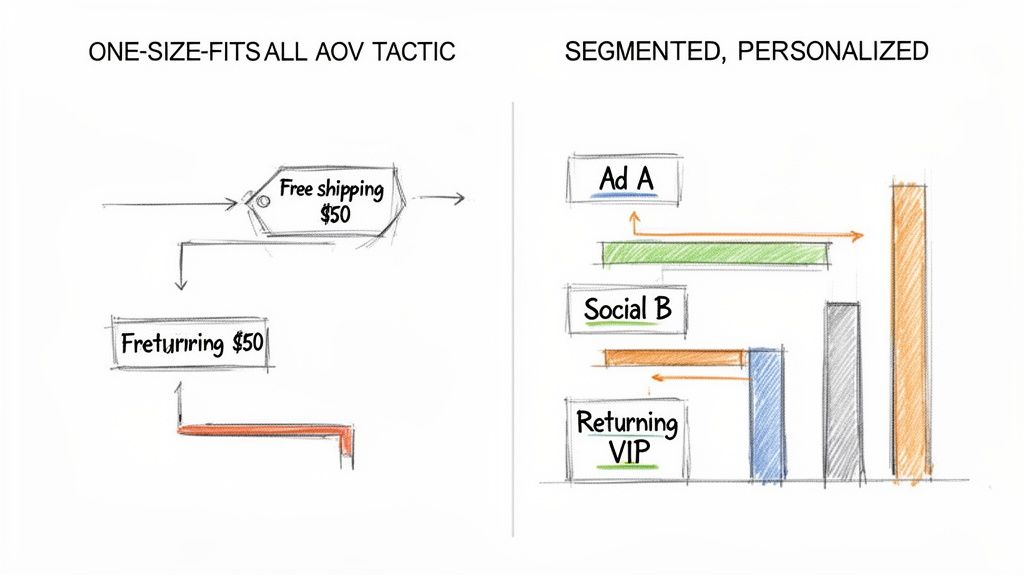
A first-time visitor from a TikTok ad for a viral product has a completely different mindset than a loyal VIP customer browsing your latest collection. Showing them both the same generic upsell or shipping offer is a massive missed opportunity. You're not just leaving money on the table; you're delivering a forgettable experience.
The Limits of Generic CRO
Generic conversion rate optimization (CRO) treats every visitor like a statistic, optimizing for a single, site-wide average. For brands scaling to eight and nine figures, this approach is a dead end.
- It Ignores User Intent: A static free shipping threshold of $75 might work for some, but it's going to feel out of reach for customers whose natural cart size is closer to $40. They will just abandon.
- It Wastes Ad Spend: You spend a fortune bringing highly targeted traffic to your site. A generic onsite experience immediately breaks that personalized journey, tanking conversion rates and your return on ad spend (ROAS).
- It Fails to Maximize LTV: When you don't recognize and reward your best customers, you miss crucial chances to build loyalty and increase their lifetime value.
The core problem with standard AOV tactics is that they optimize for the 'average' user, a user who doesn't actually exist. True growth comes from creating precise, data-backed experiences for your most valuable customer segments.
Shifting to a Segment-Specific Mindset
The key to increasing average order value is to stop thinking in broad strokes and start personalizing with precision. This means matching your offers and onsite experience to specific user segments based on their traffic source, purchase history, and real-time behavior.
Let's look at the most powerful levers you have. The table below outlines how a simple shift in thinking, from generic to personalized, can unlock significant growth.
High-Impact AOV Levers for Growth-Stage Brands
| Strategy Area | Generic Tactic (Low Impact) | Personalized Tactic (High Impact) | Target Metric |
|---|---|---|---|
| Product Bundles | Static "Frequently Bought Together" widget | Dynamic bundles based on cart contents or user segment | Units Per Transaction (UPT) |
| Upsells & Cross-Sells | One-size-fits-all pop-up on every product page | In-cart offers based on cart value or customer LTV | Conversion Rate (CVR) |
| Pricing Strategy | Simple volume discounts (e.g., "Buy 3, Get 15% Off") | Tiered pricing with value-based incentives (e.g., free gift) | Profit Per Visitor |
| Free Shipping Thresholds | A single, site-wide threshold (e.g., "Free Shipping on $100+") | Dynamic thresholds based on the user's current cart value | Cart Abandonment Rate |
| Post-Purchase Offers | Generic "Thank you" page with a discount for next time | One-click offers personalized to the just-purchased items | Customer Lifetime Value (LTV) |
This targeted approach is proven to work. The worldwide AOV recently climbed to $144.57, an 8.7% year-over-year increase, largely driven by these more sophisticated strategies. You can dive deeper into the data and discover more insights about eCommerce AOV benchmarks.
Brands that map their high-value segments and personalize offers accordingly have seen revenue lifts of $60K-$110K monthly from a single successful test. This is the foundation for a high-impact optimization program that stops wasting ad spend and starts building real, compounding returns.
Going Beyond Generic Upsells and Cross-sells
Upsells and cross-sells are table stakes for boosting AOV. But if you're still relying on a generic "frequently bought together" widget, you're leaving a lot of money on the table. For sophisticated brands, success comes from making these offers feel less like a sales pitch and more like a genuinely helpful recommendation.
It’s about shifting from a one-size-fits-all approach to using customer data to make hyper-relevant suggestions at the right moment.
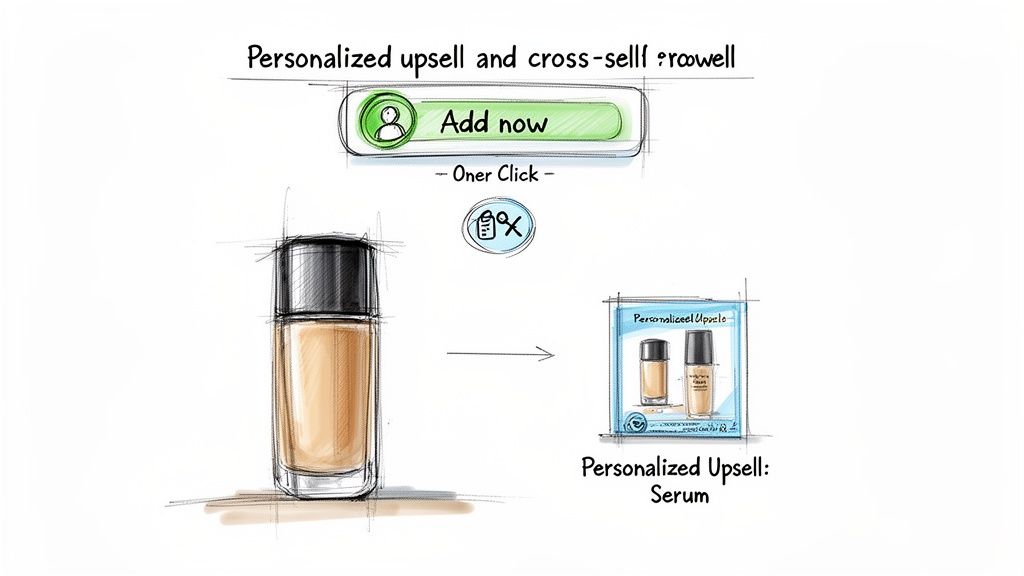
The trick is to present the right offer to the right person at the right time. For example, instead of just showing your top-selling lipstick to everyone, a beauty brand could offer a complementary setting spray to someone who adds foundation to their cart. This shows you understand their needs and makes the add-on feel like a natural next step. To get the fundamentals right, it helps to understand What Is Upselling and Cross Selling Explained.
Pre-Purchase Offers In The Cart
Think of the cart as your prime real estate. It's a high-intent, low-distraction environment, making it the perfect spot for a subtle order bump. Forget aggressive pop-ups that break the shopping experience; a well-executed in-cart offer feels like a natural part of the checkout flow.
The key here is relevance. Your offer has to make sense based on what's already in the cart, the customer's buying history, or their specific segment.
Here are a few ways we’ve seen this work brilliantly:
- The Complementary Add-On: A customer buys a pair of premium leather shoes. You offer a low-cost leather care kit right in the cart. It’s a classic cross-sell that makes their initial purchase even better.
- The "Complete the Look" Prompt: Someone adds a blazer to their cart. Instead of a random accessory, your in-cart offer shows them the matching trousers to complete the suit. Simple, but effective.
- The Segment-Specific Bump: You see a repeat customer who usually buys your entry-level products. When they add one to their cart, you can use a small in-cart upsell to suggest a larger or more premium version.
The best in-cart offers are no-brainers: low-cost, high-value additions that don't require much thought. We're talking about impulse buys that solve an immediate need. A $15 add-on to an $80 cart feels natural; a $50 one just feels pushy.
Post-Purchase One-Click Upsells
This is one of the most powerful and lowest-risk plays in the AOV playbook. A post-purchase upsell is an offer you make after the customer has already paid, right on the thank-you page.
Because they’ve already put in their payment and shipping info, they can accept your offer with a single click. This completely removes the risk of cart abandonment that a pre-purchase upsell might create. It’s all upside.
For these to work, they have to be highly contextual and feel like a logical extension of what they just bought. Some examples:
- Product Refills: A customer just bought a 30-day supply of your best-selling supplement. The post-purchase offer? A second bottle at a small discount.
- Travel-Size Versions: For a skincare brand, this is a slam dunk. Offer a travel-size version of the full-size product they just purchased. Perfect for their gym bag or an upcoming trip.
- Extended Warranties: If you sell electronics or other high-ticket items, offering a one-click extended warranty is a high-margin way to tack on extra value.
The Technology Behind Personalization
Pulling off these advanced strategies isn't something you can do out of the box. Shopify Plus brands typically lean on dedicated apps and personalization platforms to build, test, and automate these offers. If you’re serious about scaling, you need a solid grasp of what website personalization is and the tech that drives it.
Tools like Intelligems are great for this. You can create rules that show specific upsells to different customer segments, for instance, testing one offer for first-time visitors and a completely different one for your returning VIPs. By analyzing the results, you can quickly find what works and double down on the offers that drive the biggest lift in both AOV and, more importantly, profit per visitor.
Using Strategic Bundles and Tiered Pricing to Drive Higher Spend
Of all the tactics out there, strategic bundling is one of the most reliable ways to bump up your average order value. This isn’t just about slapping a "frequently bought together" widget on a product page and calling it a day.
When you get it right, a bundle solves a complete problem for your customer. It makes the bigger purchase the most obvious, logical, and valuable choice. The goal is to move beyond just grouping random products and start creating curated experiences that simplify the buying journey.
Different Bundling Strategies for Different Goals
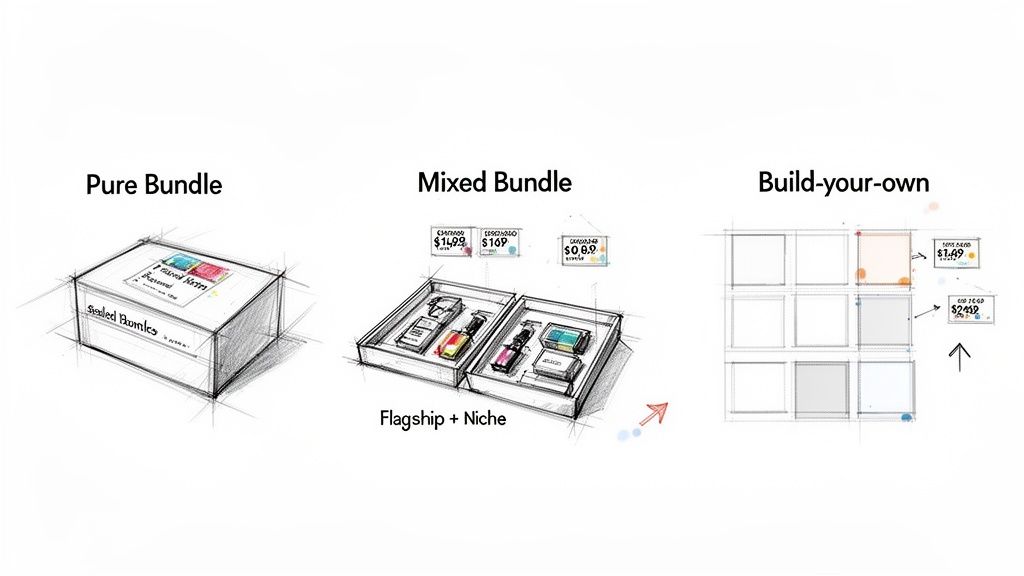
Not all bundles work the same way. The right approach depends on your product catalog, customer behavior, and your objective. Let's break down three powerful types of bundles that high-growth brands lean on heavily.
-
Pure Bundles: Think of these as pre-packaged kits sold as a single item, like a "Skincare Starter Set" or a "Complete Coffee Brewing Kit." They're fantastic for getting new customers acquainted with your ecosystem, usually with a small discount to sweeten the deal.
-
Mixed Bundles: This is a smart way to pair a bestseller with a lesser-known or slower-moving item. For example, you might bundle your most popular face wash with a new, complementary toner. It's a great play for driving product discovery and moving inventory while lifting the total cart value.
-
Build-Your-Own Bundles: This is where personalization really shines. You let customers create their own kits from a curated selection of products. Often, the discount gets better as they add more items. It gives them a sense of control and ensures they get exactly what they want, which almost always leads to higher satisfaction and AOV.
The best bundles don't just offer a discount; they offer a complete solution. A customer buying a new camera isn't just buying hardware; they're buying the ability to take great photos. When you bundle it with a memory card, a case, and a lens cleaner, their purchase instantly becomes more valuable and useful.
Executing Tiered Pricing Without Devaluing Your Brand
Tiered pricing and volume discounts are another great lever, but they require a strategic approach. If you’re not careful, you can accidentally train your customers to just wait for a sale. The focus should always be on rewarding a higher spend with more value, not just slashing prices.
Instead of a generic "Buy 3, Get 15% Off," think about value-based tiers. An apparel brand could offer a free pair of socks on orders over $150 and a free t-shirt on orders over $250. This adds something tangible and nudges customers to hit that next threshold without cheapening your core products.
The key is to test different thresholds and offers for specific customer segments. A first-time visitor might respond best to a free shipping offer, while a VIP customer might be more motivated by early access to a new product. This requires a disciplined approach to experimentation and a solid grasp of your ecommerce merchandising best practices.
Bundling Is a Proven AOV Driver
There’s plenty of data to back this up. Since 2019, global AOV has jumped by about 30%, and smart merchandising has been a huge part of that. While marketplaces often see an AOV around $35, branded DTC sites frequently hit 2-3x that number.
Take the baby and child product category, for example. It saw a massive 71% year-over-year increase to $362 per order, driven almost entirely by high-value bundles like stroller systems and furniture sets. The numbers don't lie: strategic packaging works. You can explore more detailed eCommerce benchmarks here.
For Shopify brands doing anywhere from $3M to $200M in revenue, creating and testing personalized bundles is a well-documented path to growing AOV. When you make the larger purchase the easiest and most logical option, customers will naturally spend more.
Fine-Tuning Your Shipping Thresholds and Adding Gamification
Your free shipping threshold is likely an educated guess. But it shouldn't be. This single number is one of the most powerful psychological levers you can pull to bump up your average order value. When you get it right, it stops being a shipping cost and starts being a predictable AOV booster.
The biggest mistake brands make is slapping a generic, site-wide threshold on their store, something like "Free Shipping on Orders Over $100." This one-size-fits-all approach misses the mark. For a customer who only planned on spending $40, that $100 goal feels like a massive jump, and it's a fast track to an abandoned cart.
How to Find Your Optimal Threshold
Instead of guessing, use data to find the sweet spot. The goal is to set a threshold that feels like a small, achievable stretch for the majority of your customers.
First, you need to find your modal order value. This isn't your average order value (AOV); it's the most common order total in your store. If your AOV is $85 but most people actually spend around $60, that $100 threshold is way too high. A much smarter move is to set your threshold about 15-20% higher than your modal value.
So, for that $60 modal order, a threshold around $75 makes perfect sense. It gently nudges the customer to add just one more small item to their cart. It feels like they're unlocking a reward, not being forced to spend more.
Don't Treat Every Customer the Same
The real value unlocks when you start personalizing these thresholds. A static offer is a huge missed opportunity. Your customers are different, so your shipping incentives should be too.
Consider segmenting your approach:
- New vs. Returning Customers: For first-time buyers, test a lower, more inviting threshold to secure that first conversion. For your loyal VIPs, you might set a slightly higher bar, perhaps paired with a small gift.
- Traffic Source: Someone clicking a high-intent Google Shopping ad is probably less price-sensitive than a user who came from a TikTok ad for a single viral product. Tailor the offer to match their intent.
- Geography: A $75 threshold might work great for domestic orders. But for international customers where shipping eats into your margins, a $150 threshold might be what you need to stay profitable.
When you tailor your free shipping minimums, you’re aligning the incentive with the customer's context. This makes the offer feel relevant and achievable, which is exactly what you need to get them to add that extra item to their cart.
Turn "Spending More" into a Game
Once you've got your threshold strategy locked in, you need to make hitting that number feel like a fun challenge. This is where gamification comes in. It’s about creating a sense of progress and accomplishment that makes people want to add more to their cart.
A simple progress bar in the slide-out cart is incredibly powerful. Visual cues like, "You're just $12.45 away from free shipping!" create a psychological pull that’s hard to ignore. Suddenly, it’s not about "spending more money," it’s about "unlocking a reward."
This approach directly tackles a huge reason for cart abandonment: surprise shipping costs. We know from plenty of industry research that people would often rather add another product to their cart than pay for shipping. By making the path to that reward clear and engaging, you turn a major point of friction into your best AOV-boosting tool.
To illustrate this, let's look at a few ways you can gamify the experience to encourage bigger carts.
AOV Gamification Tactics and Their Impact
| Tactic | Psychological Principle | Example Implementation | Potential AOV Lift |
|---|---|---|---|
| Progress Bar | Goal Gradient Effect | A visual bar in the mini-cart that fills up as the user adds items, showing how close they are to free shipping. | 5-10% |
| Tiered Rewards | Incentive Motivation | "Spend $75 for free shipping. Spend $100 and get a free gift!" | 10-15% |
| "Mystery" Gift | Curiosity & Anticipation | Offer a free "mystery gift" on all orders over a certain threshold, creating intrigue. | 8-12% |
| Points Multiplier | Reward & Reinforcement | "Earn 2x loyalty points on all orders over $125 this weekend only." | 5-15% |
These tactics work because they tap into basic human psychology. They make the shopping experience more interactive and rewarding, shifting the customer's focus from the cost to the benefit.
Building Your AOV Optimization Roadmap
A great strategy is just a document until you put a solid execution plan behind it. All the tactics we've discussed, from personalized upsells to dynamic shipping thresholds, only start making you money when you test them systematically. Think of this as your blueprint for building a continuous optimization engine.
Let's walk through a tangible 90-day roadmap you can put into action. We'll go from hypothesis to validated learnings, prioritizing tests that give you the biggest impact early on. Quick wins are key for building momentum.
The First 30 Days: Identifying High-Value Segments
Your first month is about laying the groundwork. Before you can personalize anything, you need to know who you're personalizing for. That means digging into your analytics and getting to know your most valuable customer segments.
Start by asking a few critical questions:
- Who are our VIPs? Pull a list of your top 5-10% of customers by lifetime value. What do they have in common? Do they gravitate toward certain product categories?
- Which ad campaigns drive the highest AOV? Analyze your ad performance by the initial AOV of the customers they bring in. A Meta campaign driving high-volume, low-AOV sales needs a different on-site experience than a Google Shopping campaign that attracts high-intent buyers.
- Are there geographic differences? Do shoppers in California consistently spend more than those in New York? This is gold for informing tests around dynamic shipping thresholds.
By the end of this phase, you should have 3-5 clearly defined, high-value customer segments. These become the bedrock of your entire testing program.
Days 31-60: Brainstorming and Prioritizing Experiments
Now that you know your key segments, it's time to brainstorm AOV-boosting experiments tailored to them. The goal is to match the right tactic to the right audience. Ditch generic ideas and focus on specific, testable hypotheses.
Here’s how to structure your brainstorming session:
- Pick a Segment: For example, "First-time visitors from our viral TikTok campaign."
- Set a Goal: We want to increase their initial AOV by 15% without tanking our conversion rate.
-
Brainstorm Tactics:
- Test a lower free shipping threshold just for them.
- Offer a low-cost, impulse-buy product as an in-cart cross-sell.
- Create a "starter kit" bundle that includes the viral product plus two complementary items.
Once you have a list of potential tests for each segment, run them through an ICE score (Impact, Confidence, Ease). This simple framework forces you to think critically about which tests are most likely to deliver big returns with the least effort. Your highest-scoring ideas move to the top of your testing sprint.
Days 61-90: Structuring and Launching Tests
This is where the rubber meets the road. Every single test needs a clear structure, from the hypothesis to the KPIs you'll be tracking. A well-defined experiment is the difference between a clear "yes/no" answer and an ambiguous result that teaches you nothing.
Here’s what a test could look like for a beauty brand:
Example Test Roadmap: Beauty Brand
-
Test 1 (High Impact, Medium Effort): Personalized Post-Purchase Upsells
- Hypothesis: Showing a complementary serum as a post-purchase upsell to customers who buy our best-selling foundation will increase profit per visitor by 10%.
- Segment: All customers who purchase the "Flawless Finish Foundation."
- KPIs: AOV, Profit Per Visitor, Post-Purchase Conversion Rate.
-
Test 2 (Medium Impact, Low Effort): Dynamic Shipping Thresholds
- Hypothesis: Offering a $65 free shipping threshold to East Coast customers (versus our standard $85) will increase AOV by 8% in that region.
- Segment: Customers with a shipping address in specific East Coast states.
- KPIs: Regional AOV, Cart Abandonment Rate.
This kind of process transforms something like shipping incentives from a simple cost center into a powerful strategic tool.
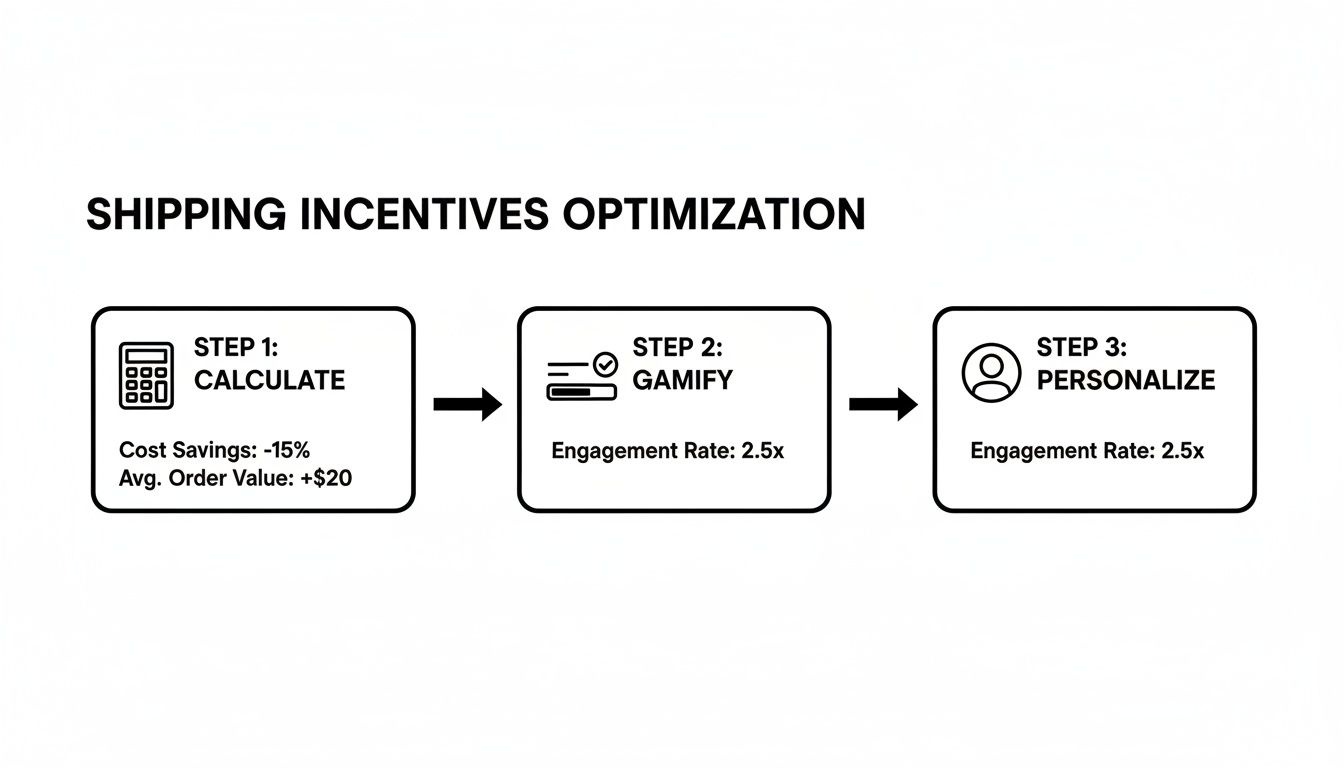
As you can see, there's a clear progression from calculating your baseline, to gamifying the experience, and finally personalizing offers for maximum impact. By following this roadmap, you build a structured, repeatable process for growing your AOV. You're not just running random tests; you're building an optimization engine that learns, improves, and delivers compounding returns over time.
Measuring Success and Scaling Your Wins
Launching AOV-boosting experiments is exciting, but it's only half the job. Without solid measurement, you’re just flying blind. You need to know if your strategies are working, and that means tracking the right metrics and connecting revenue lifts directly to your changes.
A rising AOV looks great on a dashboard, but it doesn't tell the whole story. A poorly designed upsell can bump up the average order value but kill the conversion rate, leading to a net loss in revenue. The real goal is profitable growth.
Defining Your Core Metrics
To get a clear picture of performance, you need a balanced scorecard of metrics. This is the only way to ensure your AOV wins are contributing to the bottom line, not just inflating a vanity metric.
- Profit Per Visitor (PPV): This should be your north star. It combines AOV and your conversion rate, telling you exactly how much profit you're making from every person who lands on your site.
- Conversion Rate (CVR): Keep a close eye on this one. If your AOV is climbing but your CVR is taking a nosedive, that new offer is likely creating too much friction for shoppers.
- Customer Lifetime Value (LTV): This is the long game. When you’re looking at the impact of your AOV tactics, it’s critical to see how they help increase customer lifetime value over time.
Attributing Lifts and Analyzing Segments
To accurately pin revenue changes to specific tests, you need a disciplined approach. For most AOV initiatives, that means running controlled experiments. To dig into the differences and figure out what’s right for your brand, you can learn more about multivariate testing vs. A/B testing in our detailed guide.
One of the biggest mistakes people make is only looking at the site-wide average. A test might look like a flop overall but be a massive winner with a specific segment, like first-time visitors from paid social campaigns. You have to slice and dice your results by segment to find these hidden gems.
Once you’ve validated a winning experiment, it’s time to scale it. Roll that successful strategy out across your site and make it a permanent part of your merchandising workflow. Today's AOV win should become tomorrow's baseline, giving you a new, higher foundation to launch your next round of experiments and compound your returns over time.
Questions We Hear All the Time About AOV
Even with a solid game plan, you will run into questions when you start digging into your AOV. Here are the most common ones we tackle with DTC leaders, along with some straight answers.
What’s Considered a “Good” Average Order Value?
This is the most common question, and the answer is always: it depends. A "good" AOV is completely relative. A fine jewelry brand could be sitting pretty with a $300 AOV, while a CPG brand selling consumables might be crushing it at $75.
Instead of getting hung up on industry averages, benchmark against yourself. The real goal is consistent, profitable growth. Focus on lifting your current AOV by a tangible percentage, say, 5% to 10% over the next quarter. That's a much healthier target than chasing some arbitrary number you saw in a report.
How Does AOV Play into Customer Lifetime Value?
Think of AOV as one of the foundational building blocks of LTV. When you increase the value of that first purchase, you're often setting the stage for a higher lifetime value. Why? Because you've successfully shown the customer more of what you offer, right from the get-go.
But there's a catch. If you get too aggressive with pushy, irrelevant upsells, you can easily break that trust. A bad experience can kill the chances of a second purchase, tanking your LTV. The best AOV strategies actually make the shopping experience better, which creates a flywheel effect that lifts both metrics over time.
Should We Include Shipping and Taxes in Our AOV Calculation?
Our strong recommendation is no. For the cleanest and most actionable data, calculate your AOV using net product revenue only. Leave shipping fees and taxes out of it.
When you include those extra fees, you cloud the picture. It becomes much harder to see if your bundling and cross-selling efforts are actually working. Keep the calculation focused purely on what customers are spending on your products. That way, you know your data is solid enough to base your next strategic move on.
The strategies outlined here are your starting point for building a more profitable ecommerce operation. By moving from generic tactics to personalized, segment-specific offers, you create a better customer experience that naturally leads to a higher average order value. Your next step is to identify one high-value customer segment and brainstorm a single, high-impact test you can run in the next 30 days.
The team at CONVERTIBLES helps Shopify Plus brands build and execute personalization roadmaps that increase profit per visitor. Schedule a strategy call to see how we can help you scale.