

Beyond the First Click: A Guide to Mid Funnel Marketing

[ SUMMARIZE WITH AI ]
[ FREE CRO TEARDOWN ]
Find the 3 biggest revenue leaks on your store.
Every day a conversion leak goes unfixed, you're paying for traffic that doesn't buy. Get a 5-minute Loom through your PDP, cart, and checkout, with mockups of the fixes. No pitch.
Get My TeardownMid funnel marketing is the critical process of turning a curious browser into a confident buyer. It's where you educate, build trust, and prove your products are the superior choice before they even consider the "add to cart" button.
Ignoring this stage is a costly mistake. You're paying to fill your store with qualified traffic, only to watch them wander out confused and empty-handed because you failed to continue the conversation.
What Is Mid-Funnel Marketing and Why It Matters
Most ecommerce brands have mastered two things: generating attention (top-of-funnel) and closing sales (bottom-of-funnel). You pour budget into ads to drive traffic and obsess over checkout optimization. But what about the crucial steps in between?
That's the messy middle. And that's where mid-funnel marketing executes.
Think of it as the most effective salesperson on your shop floor. Top-funnel ads got the customer through the door. The bottom-funnel checkout is the cash register. The mid-funnel is the essential conversation where that salesperson qualifies needs, offers expert advice, and resolves lingering doubts, turning a "just looking" browser into a decisive purchaser.
Bridging The Gap From Awareness To Action
The path from a first click to a final purchase is never a straight line. A user might see your Instagram ad, browse your site, and leave. A few days later, they see a retargeting ad, read customer reviews, and then return to complete the purchase.
The mid-funnel is about strategically navigating that realistic journey. Its sole purpose is to nurture the expensive traffic you already paid to acquire.
Without a solid mid-funnel strategy, you’re simply hoping a first-time visitor is ready to buy on the spot. That rarely happens. An effective mid-funnel approach focuses on:
- Building trust with authentic content and real social proof.
- Demonstrating why your product is the best solution for their specific problem.
- Anticipating hesitation by answering common questions before they're asked.
- Staying top-of-mind while they evaluate their options.
This marketing funnel diagram shows exactly how the middle of the funnel connects initial awareness to the final purchase decision.
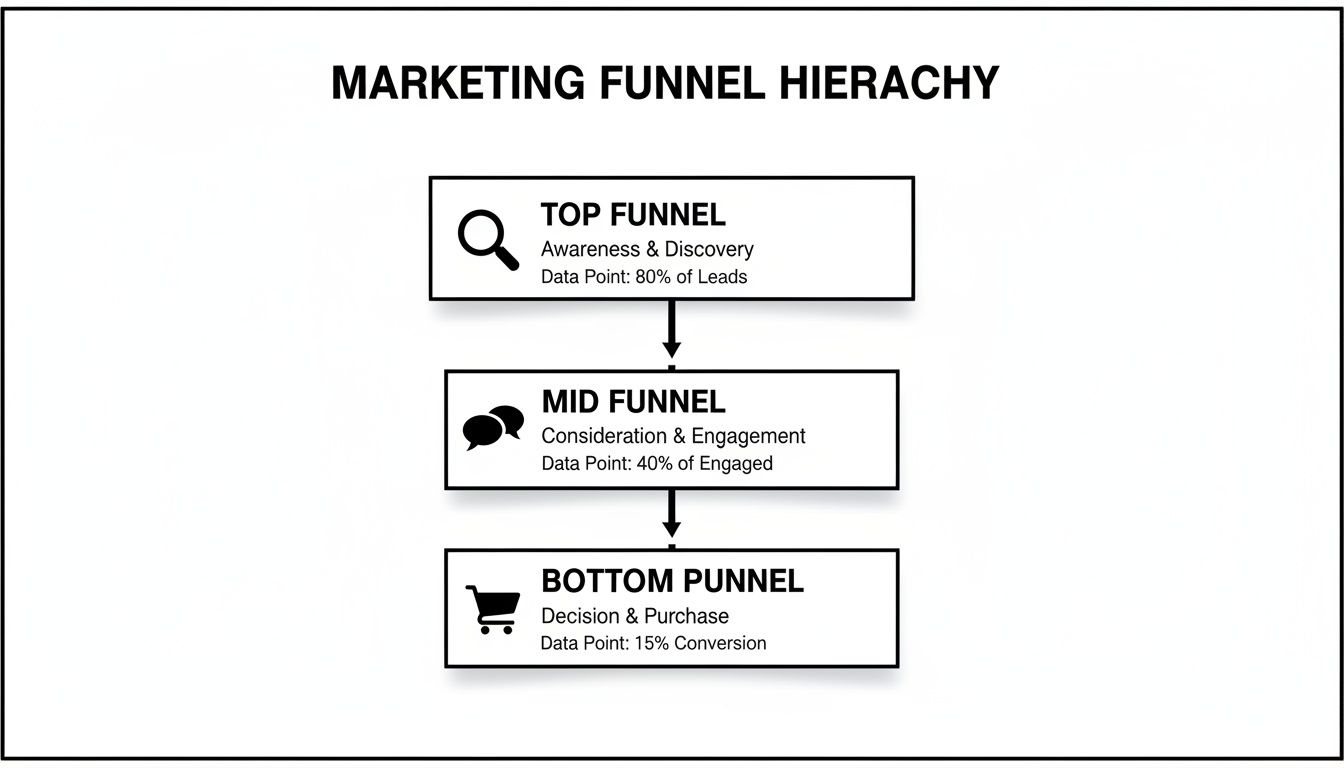
The top of the funnel casts a wide net. The mid-funnel is where the conversation gets personal, helping you qualify real interest before you push for the hard sell.
To help visualize this, here's a breakdown of how each stage functions.
The Ecommerce Marketing Funnel At a Glance
| Funnel Stage | Customer Mindset | Primary Goal | Example Channels and Tactics |
|---|---|---|---|
| Top-Funnel (ToFu) | "I have a problem or need and I'm exploring solutions." | Generate awareness and drive initial qualified traffic. | Social Media Ads (Broad), SEO & Blog Content, Influencer Marketing |
| Mid-Funnel (MoFu) | "I'm comparing options. Which brand or product is right for me?" | Educate, build trust, and nurture consideration. | Email Nurture Flows, Dynamic Retargeting Ads, Gated Content, Onsite Quizzes, Personalization |
| Bottom-Funnel (BoFu) | "I'm ready to buy. I just need a final nudge." | Drive conversions and close the sale. | Abandoned Cart Emails, Last-Chance Offers, Testimonial Ads |
This table clearly lays out the distinct jobs of each funnel stage. The middle is where you truly start building a relationship that drives revenue.
The Cost Of Ignoring The Middle
For any high-growth DTC brand, skipping the mid-funnel directly impacts your bottom line. You are burning through ad spend to attract users who show interest but never receive the follow-up needed to convert.
If you want a closer look at mapping out these customer paths, check out our guide to building high-converting ecommerce sales funnels. Ultimately, a strong mid-funnel strategy ensures your marketing budget doesn't just buy clicks; it builds customer relationships that generate long-term revenue.
To get more specific on converting those leads, understanding the mechanics of a lead magnet funnel and how to build effective ones can be a game-changer.
The Best Channels to Keep Mid-Funnel Shoppers Engaged
You got their attention. Your top-of-funnel ads and content did their job and brought a potential customer to your site. Now the real work begins. The goal is to prevent that expensive click from becoming just another bounced session. This is the heart of mid-funnel marketing: converting initial curiosity into measurable purchase intent.
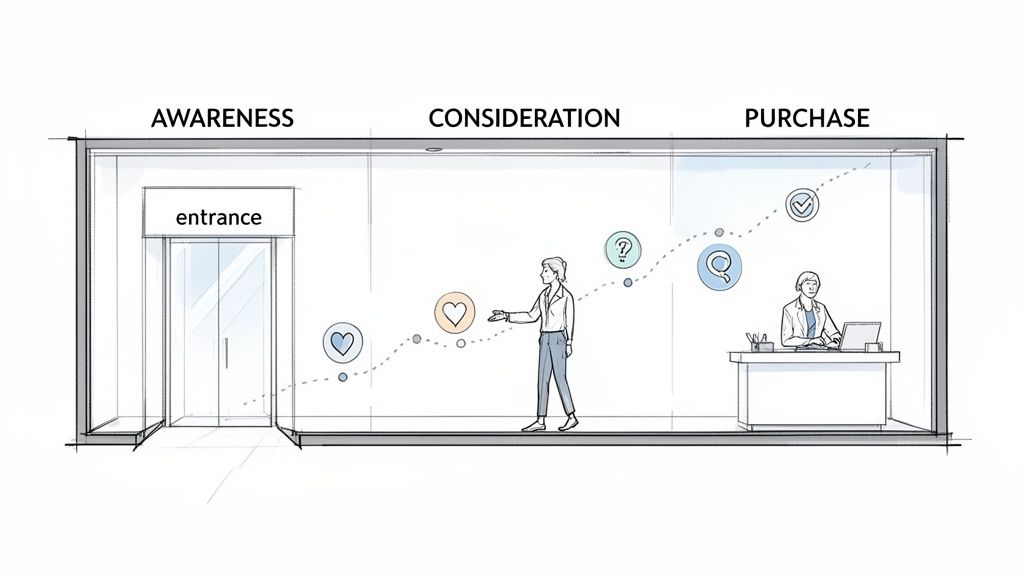
This isn’t the time for a generic, one-size-fits-all message. You need a strategic mix of channels that enable segmentation, personalization, and the delivery of genuine value. You are building a relationship here, proving you understand exactly what they need.
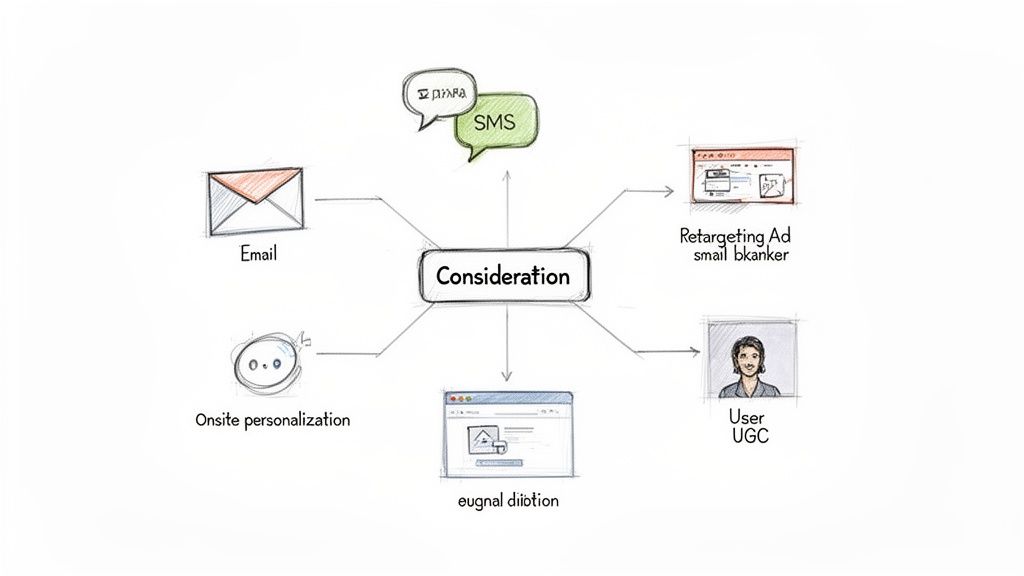
Advanced Email and SMS Nurturing
Email and SMS are your direct lines of communication, and you must earn the right to use them. Blasting your entire list with the same promotion is a bottom-funnel tactic that will alienate shoppers who are still considering their options. At this stage, it's all about segmentation.
Build automated flows triggered by specific user behaviors. For instance:
- Product Page Viewer Flow: Someone viewed a specific product three times but never added it to their cart. Don't send a discount yet. Instead, send an email sequence showcasing user-generated content (UGC) for that exact product. Follow it up with a helpful guide like, "How to Choose the Right [Product Category]."
- Cart Abandoner Flow: Here you can be more direct. The first message, whether SMS or email, should be a simple reminder. If they still don't purchase, the next message should address a common objection head-on. Highlight your easy return policy or "buy now, pay later" options. The third message can finally introduce a small, time-sensitive incentive like free shipping.
The secret is matching your message to their intent. A product viewer seeks education and social proof. A cart abandoner needs a final push to overcome hesitation.
Paid Retargeting With Dynamic Ads
Your potential customers are evaluating competitors. Paid social and search retargeting are your tools for staying on their radar. But a static ad with your logo is insufficient. Your retargeting must be as specific as their browsing history.
This is where dynamic product ads (DPAs) are non-negotiable. They automatically show people the exact products they viewed on your site, added to their cart, or browsed in a category. If someone spent five minutes looking at your Vitamin C serum, their Instagram feed should display that serum, not a generic brand ad.
Additionally, use your existing customer data to build powerful lookalike audiences. Create a lookalike from your highest-value segments, perhaps customers with an average order value over $150 or those who have purchased three or more times. This helps feed your top-of-funnel with new prospects who behave like your best mid-funnel converters.
Strategic Onsite Personalization
Your website should not be a static brochure. When a visitor returns, your site must adapt to what you already know about them. Onsite personalization creates that seamless, "they get me" experience that accelerates conversions.
Here are a few highly effective personalizations to implement:
- Custom Hero Banners: If a visitor clicked through from a Facebook ad promoting your new sneaker collection, greet them with a homepage hero banner featuring those exact sneakers.
- Segment-Specific Offers: For a returning visitor who hasn't purchased, show a subtle sticky bar at the top of the page with a "10% Off Your First Order" offer. For a logged-in VIP customer, that same banner could announce early access to an upcoming product drop.
These tailored experiences make shoppers feel seen. It validates their interest and guides them toward the products they are most likely to buy.
Value-Driven Content That Builds Confidence
Content is how you answer unspoken questions and build unshakable trust. This isn't about top-of-funnel blog posts. This is targeted, specific content designed to solve a problem or overcome an objection standing between them and the "buy" button.
Video is especially potent at this stage. Including video on product or landing pages can boost conversion rates by as much as 86%, according to Wyzowl, because it helps people visualize the product in their own lives.
Your mid-funnel content library must include:
- Buying Guides: A detailed guide comparing different product models, materials, or use cases.
- User-Generated Content (UGC): Ensure customer photos and reviews are prominent on your product pages. Nothing provides social proof more effectively.
- Case Studies or Before-and-Afters: Show, don't just tell. Prove your product delivers on its promises with tangible results.
When you integrate these tactics across email, paid ads, your website, and your content, you create a powerful system. It doesn't just remind shoppers you exist; it actively nurtures their interest, answers their questions, and makes your brand the only logical choice.
How To Know If Your Mid-Funnel Is Actually Working
It’s simple to see if your top-of-funnel ads are working; you look at impressions and clicks. The bottom of the funnel is even easier: you count sales. But the middle of the funnel is a different beast. Success here isn’t about the final transaction. It’s about spotting the signals that a shopper is getting serious.
You are looking for proof that a casual browser is warming up. This means you must stop obsessing over last-click conversions and start paying attention to the metrics that show you’re building trust and engagement. Are they opening your emails? Are they returning to your site for a second or third look? These are the real signs that your mid funnel marketing is doing its job.
Key Performance Indicators For The Middle Funnel
To understand what’s happening in the consideration stage, you need to add new KPIs to your dashboard. These numbers tell the story of a customer's journey before the purchase. Think of it less like tracking the final destination and more like watching the crucial pit stops along the way.
Here are the mid-funnel KPIs that every ecommerce brand should be watching:
-
Email/SMS Engagement: Go beyond open rates and focus on Click-Through Rates (CTR). An open is passive; a click on a link to a buying guide or a specific product feature shows active interest.
-
Add-to-Cart (ATC) Rate from Retargeting: Keep a close eye on the ATC rate coming specifically from your retargeting campaigns. This tells you if those reminder ads are persuading people to take the next step.
-
Time on Site for Returning Visitors: A first-time visitor might bounce. A returning visitor should stick around longer. If their session duration is increasing, it’s a strong sign that your content and personalization are hitting the mark.
-
Interaction with Onsite Personalization: If you are using a product quiz or a personalized banner, measure how many people are actually using it. A high interaction rate proves your tailored experiences are resonating.
The key difference between mid-funnel and lower-funnel KPIs is the focus. Mid-funnel metrics track interest and intent, while lower-funnel metrics track final actions.
| Metric Category | Mid Funnel KPI Example | Lower Funnel KPI Example |
|---|---|---|
| Engagement | Email Click-Through Rate (CTR) | Conversion Rate (CR) |
| Website Behavior | Add-to-Cart (ATC) Rate | Cart Abandonment Rate |
| Audience Growth | Email/SMS List Growth Rate | Customer Lifetime Value (CLV) |
| Content | Time on Product/Blog Pages | Revenue Per Visitor (RPV) |
Looking at these metrics side-by-side makes it clear: the middle of the funnel is all about building momentum for the final sale.
You Need To Move Beyond Last-Click Attribution
One of the biggest mistakes brands make is judging their mid-funnel channels using a last-click attribution model. A nurture email or a retargeting ad might not be the final click before a purchase, but that doesn’t mean it wasn’t essential. These touchpoints build the confidence and provide the information someone needs to finally convert.
Your mid funnel's job is to assist the conversion, not always to score the final goal. Judging a retargeting ad solely on last-click sales is like crediting only the goal-scorer and ignoring the midfielder who made the perfect pass.
Modern analytics tools like Google Analytics offer smarter attribution models. Look into options like "Position-Based" or "Time Decay" that give credit to touchpoints that happened earlier in the customer’s journey. This helps you see the whole field and understand how your mid-funnel plays are contributing to the win.
Turn Your Metrics Into Action
Tracking these KPIs isn’t enough; you must act on the data. A low CTR on a welcome email might mean your subject line is weak or the content isn't compelling. A low add-to-cart rate from retargeting ads could mean your creative is stale or the landing page feels disconnected from the ad.
As you analyze your mid-funnel performance, using proven CRO tactics to boost conversions is the next logical step to turn those insights into more revenue. The name of the game is continuous testing and refining.
If you’re ready to dive deeper into testing, our guide on multivariate testing vs. A/B testing can help you decide which method is right for your optimization goals. Every metric is a clue telling you exactly where you can improve the customer journey.
Creating a Seamless Ad-to-Site Experience
You’re pouring thousands into paid ads, getting high-intent clicks, and then dumping everyone on your generic homepage. This is one of the fastest ways to burn your marketing budget. When someone clicks your ad, they have a specific expectation. Meeting it instantly is what mid-funnel marketing is all about, and it’s the only way to turn an expensive click into a profitable customer.
A disconnected experience creates immediate friction. It forces the shopper to reorient themselves and hunt for the product they just saw. That is a massive conversion killer. The goal is to create a smooth, continuous path from the ad creative straight to a relevant, personalized experience on your site.
Matching Ad Creative to Landing Page Content
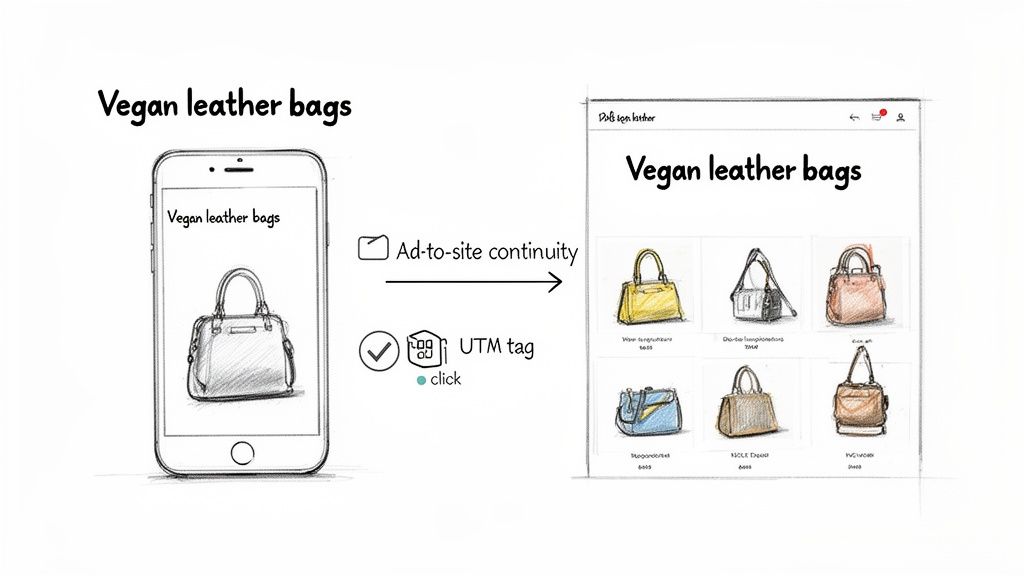
This is non-negotiable: your landing page must match your ad. If a user clicks an Instagram ad for "women's vegan leather tote bags," they must land on a page that immediately confirms they’re in the right place. Sending them to your homepage or a broad "All Bags" collection creates confusion and erodes trust.
Your landing page must mirror the ad's promise. Consider these elements:
- The Headline: The main heading on the page should echo the ad copy, such as, "Shop Our Best-Selling Vegan Leather Totes."
- The Visuals: The hero image must feature the same product or style from the ad. No surprises.
- The Offer: If your ad mentions a "20% Off" sale, that offer better be front and center on the landing page. Don't make them search for it.
- The Products: The collection should already be filtered to show only vegan leather tote bags.
Think of it this way: your ad made a promise. Your landing page is where you prove you can keep it. Breaking that promise within the first three seconds is a guaranteed way to lose the sale.
This isn’t just about aesthetics. It’s a core conversion strategy that respects the user’s intent and makes it incredibly easy for them to take the next step.
Using UTM Parameters for Personalization
How do you pull this off without building a hundred different landing pages? The secret is in your ad's URL. By using UTM parameters, you can pass key information from the ad click to your website, allowing you to change what the user sees on the fly.
UTMs are simple tags added to the end of a URL. A standard link might be yourstore.com/products/tote-bag.
A URL with UTMs carries much more information: yourstore.com/products/tote-bag?utm_source=instagram&utm_medium=cpc&utm_campaign=vegan-totes-fall23.
Using a Shopify personalization tool, you can set up rules that "read" these parameters. When the tool sees utm_campaign=vegan-totes-fall23, it can trigger specific changes on the page:
- Change the Hero Image: Swap the default lifestyle shot for one featuring the exact vegan tote from the ad.
- Update the Headline: Dynamically change the H1 to "Vegan Leather Totes."
- Display a Specific Banner: Show a promotional bar that repeats the offer from the Instagram campaign.
This technical setup ensures every dollar you spend on a specific campaign sends traffic to a perfectly matched, high-converting page.
The Ripple Effect on Lower-Funnel Metrics
This focus on the middle of the funnel doesn't just create a better first impression. It has a significant impact on your bottom-funnel results. It warms up your audience and builds brand recognition, making them far more likely to convert when they see your retargeting ads.
We read about this with Google Demand Gen campaigns, which are built for this exact purpose. While these campaigns didn't drive many direct purchases, they ignited branded search efforts. In the 45 days after launch, click-through rates on branded search terms shot up 10.1% and conversion rates soared by 53.7% compared to the previous period. The average customer acquisition cost on branded search also dropped by 5%.
You can dig into the full analysis of how mid-funnel campaigns accelerate results, but the takeaway is clear. A seamless mid-funnel journey doesn't just satisfy the initial click; it builds momentum that pays off big time at checkout.
Actionable Plays for High-Value Customer Segments
Theory is great, but execution pays the bills. Your mid-funnel marketing strategy needs specific, actionable plays you can implement today. We’ll walk through three segment-specific scenarios that tackle different stages of the consideration journey.
Think of these as mini playbooks you can adapt for your Shopify Plus store.
These plays are designed to turn passive browsers into active shoppers by delivering a personalized experience that proves you understand their needs. They combine onsite personalization, email nurturing, and smart retargeting to create a seamless journey from "maybe" to "must-have."
Play 1: The High-Intent, First-Time Visitor
This is a classic scenario for brands spending heavily on paid search. A potential customer types a specific, high-intent keyword into Google like "hypoallergenic baby lotion" and clicks your Shopping ad. They have told you exactly what they want.
Your job is to confirm they’re in the right place and make the next step a no-brainer.
-
The Segment: A first-time visitor arriving from a specific, product-focused Google Shopping ad. They have high purchase intent but zero brand familiarity.
-
The Strategy: Immediately validate their click with a hyper-relevant onsite experience. Use the UTM parameters from the ad to trigger a personalized hero banner that says, "The Gentlest Hypoallergenic Lotion for Your Baby's Skin." Just below that, feature a prominent section with glowing five-star reviews and photos from other parents. To seal the deal, add a sticky bar at the top of the page offering 10% off their first purchase.
-
Expected Outcome: This ad-to-site continuity dramatically reduces bounce rate. The social proof builds instant trust, and the first-time purchase offer creates a low-friction reason to buy now. You should see your add-to-cart rate from this segment jump significantly compared to traffic that lands on a generic page.
Play 2: The Returning Non-Purchaser
This visitor is interested but hesitant. They've been to your site a few times, looked at the same one or two products, but haven't pulled the trigger. Maybe they're comparison shopping, or they have unanswered questions about quality or fit. A generic brand retargeting ad won't cut it here; you need to address their specific hesitation.
-
The Segment: A returning visitor who has viewed a specific product page three or more times in the last 14 days without adding it to their cart.
-
The Strategy: Kick off a two-part email and retargeting sequence. Send the first email 24 hours after their last visit with a subject line like, "See What Other Customers Are Saying." Inside, feature the exact product they were looking at, followed by three of the most compelling customer reviews for that item. At the same time, your social retargeting ads should switch from standard product images to video testimonials or UGC showing that exact product in use.
-
Expected Outcome: This approach directly tackles purchase anxiety by leaning on social proof. Instead of a sales pitch, you’re offering helpful validation from real people. This builds confidence, overcomes objections, and gently nudges them from consideration to conversion.
Play 3: The High-Value VIP Customer
Your best customers deserve a better experience. This segment has already proven their loyalty and has your highest customer lifetime value (CLV). The goal here isn't just to lock in another sale; it's to reinforce their VIP status and deepen their brand connection. Sending generic marketing to this group is a massive missed opportunity.
-
The Segment: Logged-in customers who have made three or more purchases or have a total spend over a certain threshold, like $500.
-
The Strategy: Greet them with a completely personalized homepage. The main hero message should welcome them back by name. Instead of showing your usual best-sellers, the first product collection they see should be "New Arrivals" or an "Exclusive Early Access" collection just for them. Use a subtle, non-intrusive banner to highlight their loyalty perks, like free shipping on all orders or early access to upcoming sales.
Personalization for VIPs isn't about pushing for a quick sale. It's about acknowledging their value and making them feel like an insider. This is how you turn repeat buyers into lifelong brand advocates.
- Expected Outcome: This white-glove treatment strengthens the emotional bond with your brand, a powerful driver of long-term retention. It encourages more frequent purchases and makes it far more likely that these high-value customers will become your most vocal supporters.
Each of these plays moves beyond a one-size-fits-all approach. By segmenting your audience and tailoring your mid-funnel tactics, you create a far more effective and profitable customer journey.
Your Next Step: Implementing a Mid-Funnel Test
We’ve covered the what, why, and how of mid-funnel marketing. Now, it's time to turn theory into action.
Instead of a vague directive to “start personalizing,” here is your concrete first step: find your single biggest mid-funnel leak and run one simple test to plug it.
Fire up your analytics platform. The numbers will show you exactly where your funnel is bleeding profit.
Find Your Biggest Leak
You're looking for the most dramatic drop-off point between a customer's first visit and the final purchase. It’s likely happening in one of these classic problem areas:
- High Cart Abandonment Rate: People add products to their cart but leave before checking out. This is incredibly common; the Baymard Institute places the average cart abandonment rate at nearly 70%.
- Low Product Page Engagement: You get traffic to your product detail pages (PDPs), but visitors aren't clicking "add to cart."
- High Bounce Rates from Paid Traffic: You're paying for clicks, but those visitors take one look at your landing page and leave.
Once you’ve pinpointed your weakest link, design a focused experiment to fix it. This isn't guesswork; it's a strategic move with the best chance of delivering a measurable win.
The goal isn’t to overhaul your entire strategy overnight. It’s to make one smart, data-informed change that proves the value of a segmented experience and builds momentum for what comes next.
For example, if you discover that cart abandonment is your biggest issue, your next move is clear. Run a simple A/B test on your cart page. For the test group, add a dynamic message showing them exactly how close they are to qualifying for free shipping. This turns a vague concept into a tangible action and gives you real numbers to prove its impact.
Your Mid-Funnel Marketing Questions, Answered
Let's address a few of the most common questions ecommerce leaders ask when they start focusing on the middle of their funnel.
How Much of My Budget Should Go to the Mid-Funnel?
There isn’t a single magic number, but a balanced approach is crucial. If you've been pouring all your budget into top-of-funnel ads, you’ve probably noticed diminishing returns.
A good starting point is to analyze your customer journey data. Seeing tons of traffic but dismal "add to cart" rates? That's your cue to invest more in the middle. A solid benchmark is to allocate 20-30% of your marketing spend to tactics like retargeting and email nurture flows. The objective is to convert the expensive awareness you already bought into actual sales.
What's the Difference Between Mid-Funnel Marketing and CRO?
They are related but not the same thing. Think of Conversion Rate Optimization (CRO) as the broad practice of improving your website for everyone who visits. Mid-funnel marketing is a focused strategy for nurturing the specific shoppers who are stuck in the "consideration" phase.
While a general CRO test might involve changing your checkout button color for all visitors, a mid-funnel play is more targeted. For example, using an A/B test to see if showing user-generated photos to shoppers who clicked a social media ad increases add-to-cart rate is a classic mid-funnel tactic.
Can Small Ecommerce Brands Actually Do This?
Absolutely. You don't need a massive tech stack or an enterprise budget to get started. Small brands can implement effective mid-funnel strategies and see fantastic returns.
Start with your email marketing. Instead of blasting everyone with the same generic welcome series, create a few automated flows based on the product category a new subscriber first showed interest in. You can also use the built-in retargeting features on platforms like Meta or Google to show dynamic product ads to people who viewed specific items. Even creating a dedicated landing page for your top-performing ad campaign can make a huge difference.
Stop wasting ad spend on one-size-fits-all site experiences. At CONVERTIBLES, we build and manage personalization programs for Shopify Plus brands that turn more visitors into profitable customers. Book a call with our team to map your personalization strategy.