

Driving Profitable Growth with Ecommerce Sales Funnels

[ SUMMARIZE WITH AI ]
[ FREE CRO TEARDOWN ]
Find the 3 biggest revenue leaks on your store.
Every day a conversion leak goes unfixed, you're paying for traffic that doesn't buy. Get a 5-minute Loom through your PDP, cart, and checkout, with mockups of the fixes. No pitch.
Get My TeardownA sales funnel is the journey a customer takes from initial awareness to purchase. For seven, eight, and nine-figure brands, this isn't a single path. It's a network of precisely engineered, personalized experiences, each built for a specific customer segment, traffic source, and offer. A one-size-fits-all funnel is an archaic model that actively costs you money with every visitor.
Why Your Standard Funnel Is Leaking Revenue
Let's be direct: the traditional top, middle, and bottom-of-funnel model is obsolete for modern ecommerce. It’s built on the flawed assumption that every visitor is identical, desires the same product, and responds to the same message. This is precisely why your marketing budget seems to evaporate. The gap between an average funnel and an elite, personalized one is where millions in potential revenue are lost.
Treating a first-time visitor from a TikTok ad the same way you treat a loyal customer clicking through a VIP email is a fundamental error. Their intent and context are worlds apart. Yet, most brands direct them to the exact same homepage or product page. This disconnect between their motivation and your website's experience creates friction, stalls their buying journey, and inflates your customer acquisition costs.
The Real Cost of a Generic Approach
This isn't theory; it's backed by hard numbers. The average ecommerce conversion rate hovers at a dismal 2.5% to 3%. According to Littledata, the average for Shopify stores in May 2024 was even lower at 1.4%. For every 1,000 visitors, more than 980 leave without making a purchase. A generic funnel accepts this reality. A high-performance funnel identifies it as a massive opportunity for profit optimization.
The single biggest lever for scaling profitability is building distinct funnels for different customer segments, traffic sources, and offers. This isn't just about conversion rate optimization; it's about engineering a more profitable business model.
When you personalize the journey, you create a seamless, logical path from the ad to your site, reinforcing the exact message that prompted the click. This alignment maximizes your profit per visitor and establishes a foundation for sustainable growth. To stop the revenue leak, you must learn how to improve your ecommerce conversion rate with focused tactics. One of the biggest leaks occurs at checkout, making proven strategies to reduce cart abandonment an operational necessity.
If you're building your landing page on Shopify, the platform has the technical capability to handle deep segmentation and personalization required for advanced funnel strategies.
Platforms like Shopify provide the foundation to move beyond generic experiences and build funnels that drive real growth. The tools are available; the strategy is what separates top performers from the rest.
Mapping Your Four Critical Funnel Stages
Every high-performance ecommerce funnel is built on a clear, four-stage framework. This isn't marketing theory; it’s a practical blueprint for mapping customer intent to specific onsite actions. This framework helps you identify exactly where your current efforts fall short and where the real growth opportunities lie.
When you treat your funnel as a single path, you're building a system with mismatched parts, guaranteed to leak revenue at every turn.

This is the outcome of a one-size-fits-all approach. It creates friction and kills profits. For a deeper dive on diagnosing these issues, this no-code guide to sales funnel analysis is a valuable resource.
Let's break down each stage with the objectives, KPIs, and tactics that move the needle for eight and nine-figure brands.
The Awareness Stage
This is your first impression. The goal is not to make a sale. It is to get your brand in front of cold audiences and introduce them to a solution. Your objective is brand discovery and audience engagement, nothing more.
Traffic at this stage typically originates from top-of-funnel channels like TikTok, Instagram, or YouTube discovery ads, where buying intent is low. Success is measured not by conversion rate, but by the initial signals of interest.
- Key KPIs to Track: Ad Impressions and Reach, Click-Through Rate (CTR), Cost Per Mille (CPM), and on-site engagement signals like low bounce rates from these specific campaigns.
The Consideration Stage
They know you exist. Now they are in the consideration phase, actively comparing solutions, yours and your competitors. Your objective shifts to building trust and demonstrating undeniable value.
This is where you must differentiate your brand. A visitor who clicks a Google Ad for "best vegan leather handbags" must land on a page that speaks directly to that search. The experience must feel like a seamless continuation of their thought process. This message match is crucial for ad performance, Quality Score, and user experience.
This stage is the biggest leak in most funnels. Brands attract visitors but fail to provide a compelling reason to choose them over competitors. Personalization here is not a luxury, it's a necessity.
Your tactics must focus on education and social proof.
-
Actionable Tactics:
- Segmented Landing Pages: Build unique pages for major ad campaigns. If your Facebook ad emphasizes sustainability, that message must be the focal point of the landing page.
- Product Comparison Guides: Do not shy away from comparing your product to competitors. Guide the user transparently to see why your solution is superior.
- User-Generated Content (UGC): Integrate authentic customer reviews, photos, and videos prominently on your product pages to build instant credibility.
The Conversion Stage
At the bottom of the funnel, the prospect is ready to buy. Your objective is simple: remove all friction and drive the sale. Every element on your product pages, in the cart, and during checkout must be optimized for this singular goal.
Hesitation is the enemy. Any doubt about shipping costs, return policies, or payment security can kill a sale instantly. A sharp, time-sensitive offer shown only to a specific segment, like a first-time visitor from a high-value zip code, can provide the final push needed to complete the purchase.
- Key KPIs to Track: Conversion Rate (CR), Average Order Value (AOV), and Cart Abandonment Rate.
The Retention Stage
The funnel does not end at the transaction. The most profitable brands understand that the real financial upside is in repeat business. This final stage is about turning one-time buyers into loyal advocates and maximizing Lifetime Value (LTV).
A customer's post-purchase experience dictates whether they will return. This includes everything from shipping confirmation emails to how your support team resolves issues. Nurture this relationship with exclusive offers, loyalty programs, and personalized communication based on their purchase history.
Ecommerce Sales Funnel Stages KPIs and Tactics
This table provides a quick-reference breakdown of the objectives, metrics, and tactics for each funnel stage.
| Stage | Primary Objective | Key KPIs | Example Tactics |
|---|---|---|---|
| Awareness | Brand discovery and engagement with cold audiences | Impressions, Reach, CTR, CPM, On-Site Engagement | Social Media Ads (TikTok, IG), Influencer Marketing, Content Marketing (Blogs, Video) |
| Consideration | Build trust and demonstrate unique value | Landing Page CVR, Email Sign-ups, UGC Engagement | Segmented Landing Pages, Comparison Guides, Case Studies, Retargeting Ads |
| Conversion | Remove friction and drive the immediate sale | Conversion Rate, AOV, Cart Abandonment Rate | CRO on PDP/Checkout, Scarcity/Urgency Offers, Exit-Intent Pop-ups |
| Retention | Maximize LTV and create brand advocates | Customer LTV, Repeat Purchase Rate, Churn Rate | Post-Purchase Email Flows, Loyalty Programs, Personalized Replenishment Reminders |
Mapping these four stages provides the architectural plan for your ecommerce growth. It transforms a leaky, chaotic process into a strategic system built for profit.
How to Find Your Most Profitable Customer Segments
A primary mistake brands make is building generic sales funnels. They fail because they treat their best customers, those who purchase repeatedly, exactly the same as a visitor with no purchase intent.
To stop leaking profit, you must become surgical. Identify your most valuable customer groups and build funnels specifically for them. Forget vague personas, the answers are in your first-party data. Your Shopify or Google Analytics 4 account holds the key to identifying who truly drives your business forward.
Digging for Gold in Your Customer Data
This process begins with a deep dive into your data to find patterns that signal high value, not just high volume. Think of it as layering insights to create a clear picture of your ideal customer.
Your first stop is purchase history and lifetime value (LTV). These are foundational metrics for pinpointing customers who not only spend more per order but also return consistently.
- High AOV Customers: Who consistently spends more than your average shopper?
- Repeat Purchasers: Tag customers with two, three, or ten-plus orders.
- High LTV Cohorts: Group customers by their total historical spend. These are your VIPs.
Next, layer in acquisition channel data. Knowing where your best customers originate is as important as knowing who they are.
- Acquisition Source: Did they come from a Google brand search, a Meta retargeting campaign, or an affiliate link? Visitors from high-intent channels behave differently.
- Campaign/Ad Creative: Can you trace high-LTV customers back to specific campaigns or a single ad creative? This insight is invaluable for both ad strategy and landing page messaging.
Finally, enrich this profile with behavioral and demographic data.
- Location: Are your best customers concentrated in certain cities or regions?
- Device Type: Do desktop users spend more than mobile shoppers? This is more common than you might think.
- On-site Behavior: Do they browse specific product categories or engage with UGC?
Combining these data points transforms a broad audience into a laser-focused, high-value segment. For instance, you might discover that your most profitable group is "Repeat High AOV Purchasers from the NYC metro area who found you via Google Search and primarily shop on desktop."
This is an audience for whom you can build a highly effective, personalized ecommerce sales funnel.
How to Prioritize Segments for the Biggest Impact
You have identified several promising segments. You cannot build custom funnels for all of them simultaneously. You need a simple method for prioritizing your efforts to achieve the biggest win.
Rank each segment based on two criteria:
- Segment Size (Volume): How many people are in this group?
- Potential Revenue Lift (Value): How much higher is their AOV or LTV compared to your site average?
The sweet spot is a segment with both meaningful volume and a significant value gap. A tiny group of ultra-VIPs might not justify the initial effort, and a massive, low-value segment offers little upside. Pursue the groups where an improved experience can unlock the most revenue.
Industry benchmarks highlight this point. The food and beverage industry often sees conversion rates between 4.73% and 5.39%. Meanwhile, luxury and jewelry can struggle with rates as low as 0.82%. This disparity shows why a one-size-fits-all strategy is ineffective. You can see more industry-specific benchmarks here to understand where you stand.
Your job is not to make your website better for everyone. It is to make your website an unbeatable experience for your best customers.
This focused approach turns your website from a static catalog into a dynamic selling machine. By identifying and prioritizing your most profitable segments, you lay the groundwork to build personalized journeys that create loyal, high-value customers for life.
Designing Onsite Journeys That Convert
You've identified your most profitable customer segments. This is a crucial first step. The real impact comes when you use that insight to build specific, personalized experiences that guide those segments from interest to purchase. This is where you connect your ad creative, campaign messaging, and customer data to create a seamless path from the first click to checkout.
A generic website forces every visitor down the same path, ignoring their unique intent, origin, or purchase history. It is an inefficient approach that damages your conversion rates. In contrast, a well-designed onsite journey makes each high-value visitor feel the site was built specifically for them, building trust and removing friction at every step.
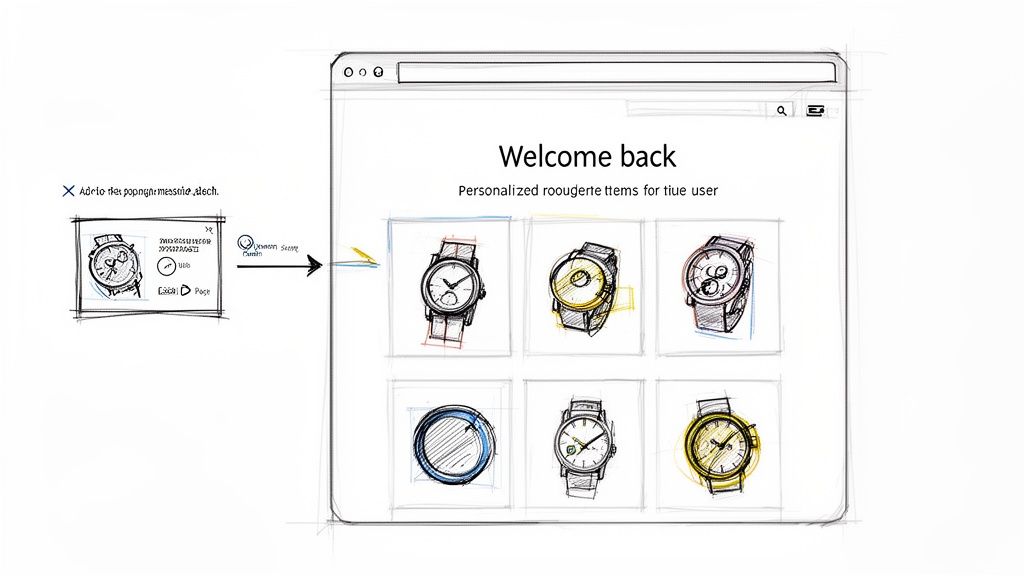
This is not guesswork. It is a strategic system for deploying different experiences to different groups. The objective is to create a more relevant and persuasive path to purchase for your most valuable audiences.
Aligning Landing Pages with Ad Creative
The most critical handoff in any paid acquisition funnel is between the ad and the landing page. If someone clicks an ad promising "50% Off Spring Styles," they must land on a page that immediately reflects that exact message. Any mismatch creates confusion, kills momentum, and wastes ad spend.
This concept is called message match. For example, if you're running separate Facebook campaigns targeting bargain hunters in California and luxury shoppers in New York, they should never see the same landing page.
- California Bargain Hunter: Their landing page hero image and headline must clearly state "50% Off Spring Styles." The products featured below should be pre-sorted to show sale items first.
- New York Luxury Shopper: Their landing page should feature high-end lifestyle photography and a headline like "Discover the New Luxury Collection." Products should be shown at full price.
Maintaining this continuity is non-negotiable for scaling profitably. It reassures visitors they are in the right place, validates their click, and directly impacts everything from ad Quality Scores to conversion rates.
Personalizing Collection and Product Pages
Once a visitor moves deeper into your site, personalization must extend beyond the landing page. How you present products on collection pages and detail them on product pages (PDPs) is a major opportunity to continue guiding the journey based on who they are.
A powerful tactic is dynamically sorting your collection pages. A first-time visitor from a top-of-funnel TikTok ad might see a collection sorted by "Best Sellers" to provide social proof and simplify their decision. A returning VIP customer could see that same collection sorted by "New Arrivals," as they are likely familiar with your core products.
This granular control extends to the PDP.
Think of your product page as your digital salesperson. A great salesperson does not use the same script for every customer. They listen, adapt, and tailor their message. Your PDPs should do the same.
For instance, you could show a price-sensitive segment a version of the PDP that features a "Buy Now, Pay Later" option like Afterpay more prominently. Another segment, perhaps identified as a high-LTV gift-giver, could see messaging that emphasizes product quality, craftsmanship, and premium gift-wrapping options. You can get a better sense of these principles in our deep dive on what website personalization is.
Testing Offers and Pricing for Specific Segments
This is where custom funnels become a true profit center. Instead of running a site-wide sale that damages margins, you can test surgical offers targeted only at the segments that need an incentive to buy. This requires more than a basic A/B testing tool.
For brands on Shopify Plus, a tool like Intelligems is essential for this level of advanced offer and price testing. It allows you to move beyond tweaking button colors and start testing the real economic levers of your business.
With a platform like this, you can design experiments to answer critical questions. You could test whether a "Free Shipping over $75" offer converts better for visitors from the Midwest than a "15% Off Your First Order" offer does for shoppers on the West Coast.
Here is a real-world test structure:
- Segment: First-time visitors from non-brand paid search campaigns.
- Hypothesis: This segment is deal-sensitive. A shipping offer will outperform a percentage-off discount by increasing AOV without hurting the conversion rate.
- Variation A (Control): Standard pricing, no offer.
- Variation B: Free shipping on all orders.
- Variation C: 10% off the entire order.
By running this experiment only for this specific audience, you gather clean data on what motivates them without disrupting the experience for loyal customers who will pay full price. This methodical approach transforms your website from a static storefront into a dynamic conversion engine.
Building Your Optimization Engine
A personalized ecommerce sales funnel is not a "set and forget" project. It is a living system that requires constant attention and refinement to perform at its peak. This is where you move from one-off A/B tests to building a true, data-driven optimization engine. It is the key difference between brands that see a temporary lift and those that achieve compounding, long-term profit growth.
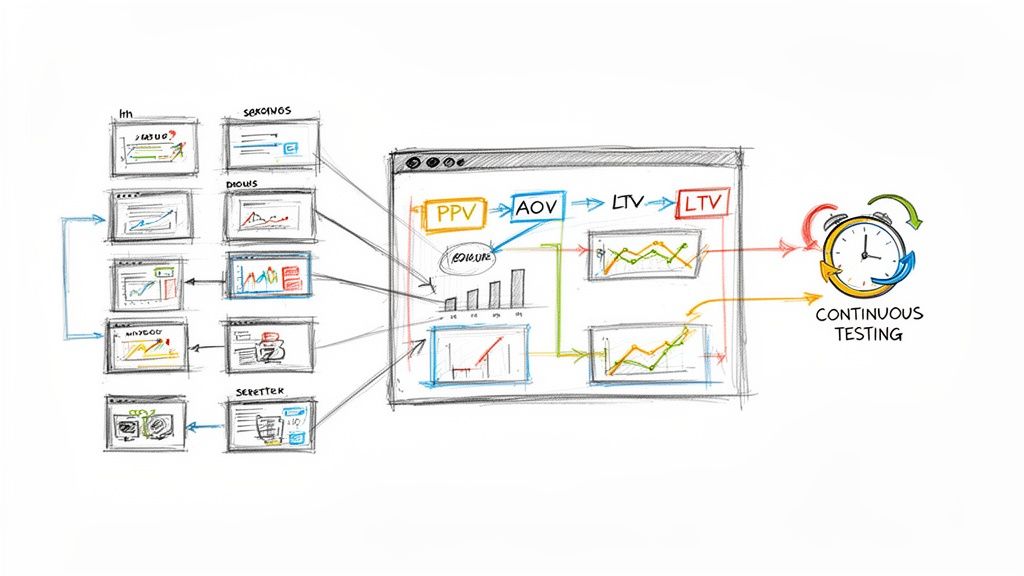
The goal is to weave testing into the fabric of your business, making it a core process rather than a sporadic tactic. Companies that master this see revenue grow up to 15% faster than their peers, according to McKinsey. While the average funnel conversion rate is around 2.35%, a finely tuned system can significantly outperform that benchmark.
Beyond Simple A/B Testing
For eight and nine-figure brands, the low-hanging fruit has been picked. Basic A/B tests, like changing a button color for all visitors, produce diminishing returns. The real gains come from testing multiple variables simultaneously, specifically for your most valuable customer segments. This is multivariate testing.
You stop asking, "Does button A or B work better?" and start asking much more profitable questions.
For example: "For first-time visitors from paid social, does a 15% discount paired with a headline about 'exclusivity' outperform a free shipping offer with a headline focused on 'fast delivery'?"
This is where you stop testing isolated elements and start testing entire experiences. You analyze the interplay between your offer, messaging, and page layout, all tailored to a specific audience.
This is more complex, but the insights are infinitely more powerful. Our guide on multivariate testing vs A/B testing breaks down the strategic differences you need to know.
Building a Testing Roadmap That Compounds
Random testing is a surefire way to waste time and get inconclusive results. You need a structured testing roadmap. This should be a living document that outlines your hypotheses, prioritizes tests based on potential impact, and tracks learnings.
Your roadmap should be built around answering critical business questions for each key segment:
- Offer Sensitivity: What truly moves the needle for our highest-LTV customers? A percentage off, a dollar amount, or free shipping? How can we motivate them without destroying margins?
- Messaging Resonance: For new visitors from Google Ads, does a message centered on product quality resonate better than one focused on social proof?
- Pricing Elasticity: Can we test a small price increase on our bestsellers for loyal repeat buyers and measure the precise impact on Profit Per Visitor?
When you structure tests this way, every result informs the next. A win is not just a win; it’s an insight that fuels a smarter hypothesis for the next round. This iterative cycle is how you build compounding returns.
Measuring What Truly Matters
Conversion rate is important, but it is not the whole story. An obsession with conversion rate alone can lead to dangerous decisions, like running deep discounts that attract low-value, one-time customers and crush profit margins.
A proper optimization engine must track a more sophisticated set of KPIs that paint a true picture of profitability.
- Profit Per Visitor (PPV): This should be your north star. It combines conversion rate, AOV, and margin to tell you exactly how much profit you generate from every person who lands on your site.
- Average Order Value (AOV): Are your tests encouraging customers to spend more? A test might slightly lower conversion rate but increase AOV enough to be a massive net positive.
- Customer Lifetime Value (LTV): This is the ultimate report card. Are the customers acquired through certain funnels returning to buy again? Tracking LTV by segment tells you if you're building a sustainable brand or a leaky bucket.
Focusing on these KPIs ensures your optimization efforts are directly tied to growing the bottom line. This is how you turn your testing program into a predictable engine for profitable scale.
Common Questions Answered
Even with a solid plan, building and scaling a high-performance sales funnel brings up questions. Here are answers to common queries from leadership teams at fast-growing brands.
How Long Until We See Results from a New Funnel?
While you might see small wins in days, a fully personalized sales funnel needs 60 to 90 days to prove its value with statistically significant data. The initial phase involves segment analysis, building custom experiences, and launching the first wave of tests.
You will likely notice early lifts in engagement or add-to-cart rates within the first 30 days. The real impact, compounding value and significant jumps in profit-per-visitor, comes after a full quarter of testing and refinement. Patience is critical.
What's the Real Difference Between a Sales Funnel and CRO?
This distinction is crucial. Traditional conversion rate optimization (CRO) typically focuses on isolated A/B tests applied to the entire website, like changing a button color for every visitor. It is a one-size-fits-all approach.
A modern sales funnel strategy is a holistic system designed around the entire customer journey. Instead of treating everyone the same, it uses personalization to create unique experiences for specific, high-value customer groups. It ensures message consistency from the initial ad click through checkout.
You are not just optimizing single elements for everyone; you are optimizing entire journeys for specific people.
What Are the Must-Have Tools for a Shopify Plus Funnel?
For any Shopify Plus brand serious about scaling, a modern tech stack is not optional. You need tools that integrate seamlessly to enable deep audience segmentation and deliver personalized onsite experiences.
Your core stack should include:
- Analytics: Google Analytics 4 is the baseline, but most high-growth brands rely on platforms like Triple Whale for a clearer picture of marketing performance and profitability.
- Personalization & Testing: This is your control center. A tool like Intelligems or ConvertFlow is non-negotiable for running multivariate tests and deploying personalized offers to the right segments.
- Email & SMS: Klaviyo is the gold standard due to its tight integration with Shopify, which unlocks powerful post-purchase funnels and segmented messaging.
- Customer Data Platform (CDP): As you grow, tools like Segment or Elevar become essential for unifying customer data from various sources, making your segmentation both accurate and powerful.
Should We Build Separate Funnels for Google Ads and Facebook Ads?
Yes, absolutely. This is fundamental to an advanced funnel strategy and critical for maximizing ROAS.
A person clicking a high-intent, branded search ad on Google is in a completely different mindset than someone who discovers your product while scrolling Facebook. Their motivations are different.
You must build distinct landing pages and offers that match the ad's message, creative, and the user's intent. For example, a funnel for a Google campaign targeting competitor keywords should feature a head-to-head comparison. A funnel for a TikTok influencer collaboration should lead with user-generated content and an exclusive offer for that creator's followers. It all comes down to message match.
Building high-performance, personalized sales funnels for Shopify Plus brands is how we help our clients scale profit per visitor, moving them beyond generic CRO. Discover how our strategic optimization programs can work for you.