

How Niche Ecommerce Stores Outperform Generalists

[ SUMMARIZE WITH AI ]
[ FREE CRO TEARDOWN ]
Find the 3 biggest revenue leaks on your store.
Every day a conversion leak goes unfixed, you're paying for traffic that doesn't buy. Get a 5-minute Loom through your PDP, cart, and checkout, with mockups of the fixes. No pitch.
Get My TeardownNiche ecommerce stores are precision-engineered for a specific, well-defined audience. Instead of being mediocre at a hundred things, they aim to be the absolute best at one. This sharp focus builds incredible customer loyalty and, more importantly, much healthier profit margins.
The Power of Focus in a Crowded Market
The "sell to everyone" mindset is a fast track to burning ad spend, watching conversion rates plummet, and surviving on razor-thin margins. In today's crowded direct-to-consumer world, specificity is your sharpest weapon. Going niche isn’t about thinking small, it's about being precise.
Generalist retailers are stuck in a race to the bottom, constantly fighting over price and volume. It’s an expensive battle that kills profitability. Niche stores, on the other hand, compete on expertise and a genuine connection with their customers.
They understand their audience's problems, their passions, and even their language. This deep understanding allows them to build personalized experiences from top to bottom, something mass-market giants can't execute at scale.
A More Capital-Efficient Growth Model
This targeted approach is a more capital-efficient way to build a business. It’s all about high lifetime value (LTV). Instead of spending a fortune on ads to attract lukewarm traffic, niche stores invest in turning a smaller, highly qualified audience into passionate brand advocates.
This is a huge advantage when fighting for attention. It's worth exploring how niche marketing can help solve consumer inundation to see just how effective this strategy can be.
Successful niche ecommerce stores are never built for a general audience, they're precision engineered for a specific persona. This focus dictates everything from product development and ad creative to site merchandising and post-purchase follow-up.
This precision represents a massive financial opportunity. The global niche e-commerce market was valued at USD 1.5 trillion in 2023 and is on track to hit USD 3.2 trillion by 2032. That’s a powerful 12% compound annual growth rate.
To give you a clearer picture, here’s a comparison of the two models for established brands.
Generalist vs. Niche Ecommerce at a Glance
| Attribute | Generalist Ecommerce | Niche Ecommerce |
|---|---|---|
| Target Audience | Broad, diverse, "everyone" | Specific, defined persona |
| Competition | High, primarily on price & ads | Lower, based on expertise & quality |
| Marketing Spend | Very high to reach the masses | Lower, more efficient & targeted |
| Profit Margins | Thinner, volume-dependent | Healthier, value-driven pricing |
| Customer Loyalty | Low, transactional relationships | High, community & brand advocates |
| Product Strategy | Wide catalog, many categories | Curated, specialized selection |
This table shows how a niche strategy trades sheer volume for deeper customer connections and better financial efficiency, a smart move for any brand looking to build a lasting presence.
How to Dominate Your Niche
For scaling ecommerce leaders, the goal isn’t just to find a niche, it's to completely own it. This is where advanced personalization and conversion rate optimization (CRO) become your most important tools.
By tailoring every touchpoint, you turn a strong market position into a profitable, defensible moat around your business. You can dive deeper into core tactics with our guide on ecommerce merchandising best practices.
The takeaway is simple: stop trying to be everything to everyone. Start winning with the customers who truly matter.
How to Find and Validate a Profitable Niche
Finding a profitable niche isn't about chasing the latest TikTok trend. It’s about uncovering an underserved group of people and using data to prove they're ready to buy.
For established brands, the most valuable clues are already in your possession. Your next big growth opportunity is likely hiding in your existing customer list.
The process starts by analyzing your own data. You're hunting for micro-segments, which are small, distinct groups of your absolute best customers. These are the people who not only spend more but also return repeatedly.
Uncover Your Hidden Niche in Your Customer Data
Stop thinking about your customer base as one giant entity. The real magic happens when you find the common threads that connect your top-tier buyers. High-LTV customers aren't a random accident, they share specific traits and motivations you can build an entire niche around.
Start by pulling a list of your top 5% of customers by lifetime value. Now, what do they have in common?
- What are they buying? Look for patterns. A skincare brand might realize its biggest spenders only buy products for sensitive, acne-prone skin. That's a niche.
- Who are they? Think beyond basic demographics. A performance apparel brand could discover its most loyal fans are all training for serious endurance events like marathons or triathlons.
- Where did they come from? Check the acquisition source. Did they all click through from a specific influencer or a particular ad campaign? This tells you exactly what kind of message grabs their attention.
Once you have a crystal-clear picture of this top-tier group, you’ve found your hypothetical niche. This is your starting point. A huge part of this process is deeply identifying a target audience, and this internal data gives you the perfect head start.
Use Small-Budget Ad Tests to Validate Demand
With a solid niche idea, the next step is to test it in the wild without betting the farm. Paid social ads are your low-risk laboratory for this. The goal isn't immediate ROAS, it's to see if people actually care.
Here’s a simple framework to validate your idea:
- Craft Niche-Specific Ads: Write ad copy and create visuals that speak directly to this group's unique problems and desires. If you’re targeting those endurance athletes, forget generic "get fit" messages. Talk about durability, anti-chafing tech, and sweat-wicking fabrics.
- Build a Lookalike Audience: Take your list of top 5% customers and upload it to your ad platform. Create a lookalike audience to find new people who are just like your best buyers.
- Run a Small-Budget Campaign: You don’t need to spend a fortune. Launch a campaign with a modest budget, like $50 to $100 per day. Send that traffic to a dedicated landing page or a curated product collection that perfectly matches the message in your ads.
- Measure What Matters: Look beyond sales for a moment. Are people clicking? Are they adding products to their cart? High click-through rates (CTR) and add-to-cart rates, even with few sales, are strong green flags. It proves your message is resonating.
You're looking for proof of concept. You're testing for a spark. If a small, laser-focused audience gets excited about what you're offering, you've found a strong signal that a much larger opportunity exists.
Check Trend Data to Confirm Your Hypothesis
Finally, perform a reality check. See if what you've learned from your data and ad tests aligns with wider market trends. This provides the last layer of confidence before you go all-in.
Tools like Google Trends are perfect for this.
Search for keywords related to your niche. For instance, if your micro-segment is focused on sustainable kids' clothing, check search interest for terms like "organic cotton baby clothes," "non-toxic kids' pajamas," or "eco-friendly children's wear."
A steady upward trend in search volume confirms your internal discovery is part of a growing market demand. This transforms niche hunting from a guessing game into a smart, data-driven strategy for unlocking new growth.
Analyzing High-Growth Niche Markets
Theory is useful, but seeing a niche store dominate is what makes the opportunity real. The most successful ones aren't just selling products, they're built on a deep, almost intuitive understanding of their customers' mindset and offer something a generalist store simply can't.
Let's break down a few booming examples to see how it's done.
First, here’s a simple way to think about the process of finding and proving out a profitable niche.
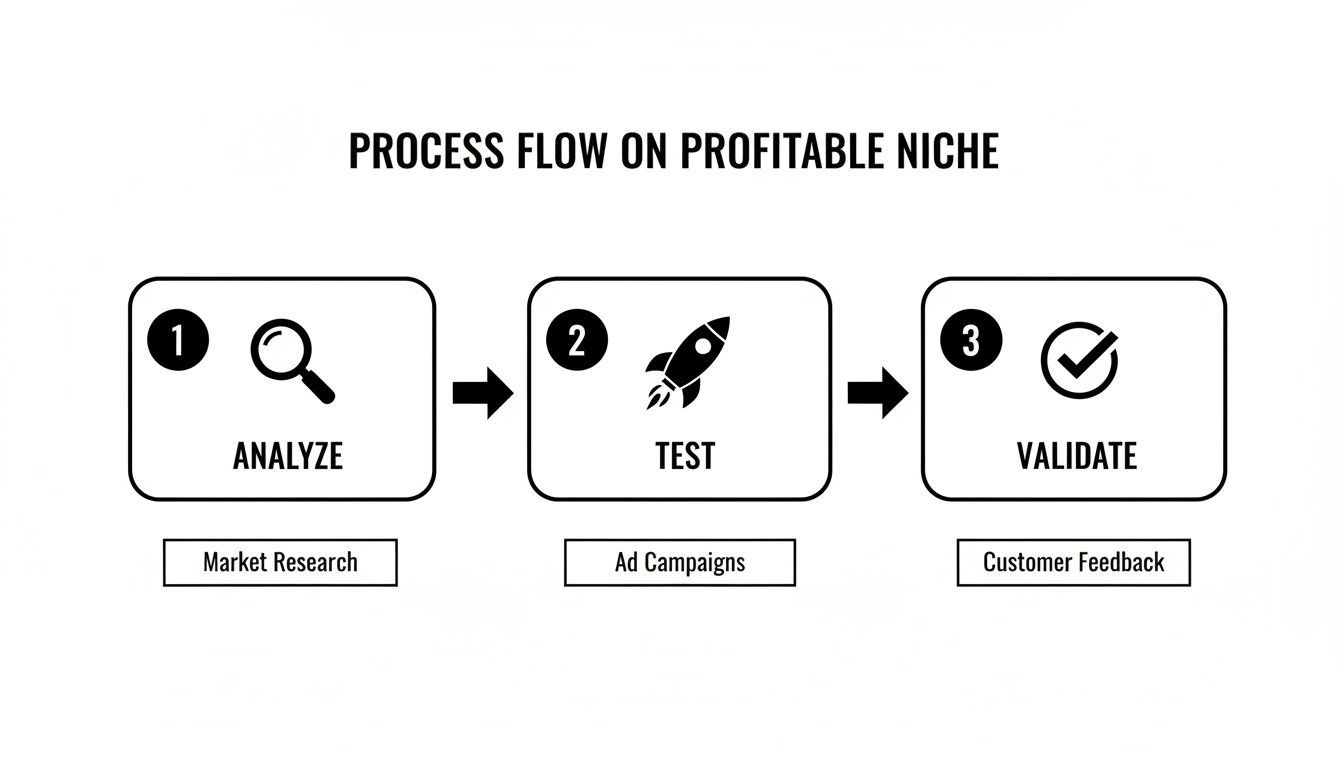
This boils it down to the essentials: start with smart analysis, move to real-world testing to see if people will buy, and then validate the idea before you go all-in.
These markets aren't just passing trends, they're tied to huge shifts in consumer values. We're talking about explosive growth in pet supplies (projected to hit $350 billion by 2027), vegan products (a $61.35 billion market by 2028), and the resale market, which is on track to double to $367 billion by 2029. You can dig into more data on top ecommerce niches to see just how big these opportunities are.
Sustainable Pet Supplies: A Values-Driven Niche
The pet industry is already a giant, but the real opportunity lies in a sub-niche fueled by a powerful idea: pet humanization. Owners, especially Millennials and Gen Z, see their pets as part of the family. They're happy to spend more on products that reflect their own values, with sustainability being a top priority.
This isn't about selling dog food, it's about selling peace of mind. A brand in this space wins by obsessing over what this specific customer truly cares about.
- Product: Think biodegradable waste bags, toys made from ethically sourced materials, and organic, grain-free food.
- Customer Psychology: The buyer is eco-conscious and health-obsessed. They are actively looking for ways to reduce their carbon footprint while ensuring their pet is as healthy as possible.
- Personalization Play: Imagine you segment customers who've bought organic treats before. You could target them with an email and on-site banners about a new line of supplements made from sustainably farmed ingredients. The key is to frame the message around shared values, not just product features.
Plant-Based Wellness Products: An Identity-Based Niche
Going plant-based is about more than just diet, it's an identity. When someone buys vegan skincare, they aren't just picking up a moisturizer, they're making a statement about their ethics and lifestyle. That creates an incredibly loyal customer base for a niche brand.
A large beauty brand might offer a few "vegan-friendly" options, but a niche store lives this identity. Every product, blog post, and social media ad reinforces that this is the place for the plant-based community.
A niche ecommerce store wins by being the obvious choice for a specific group of people. When a vegan skincare enthusiast lands on your site, they should immediately feel like they're home, seeing their values reflected in every product and piece of copy.
Here’s how you could put this into action:
- Segment by Concern: Use a quiz or look at purchase history to group customers. Are they mainly worried about "anti-aging" or "acne-prone skin"?
- Tailor the Journey: If someone clicks an ad for "cruelty-free acne solutions," they should land on a page that only shows those products. The headline and copy should speak directly to that specific problem.
- Personalize Offers: Offer a free sample of a new vegan collagen-alternative serum to customers who have previously bought anti-aging products. It's a hyper-relevant upsell that feels helpful, not pushy.
The High-End Resale Market: An Aspiration-Driven Niche
The resale market is a fascinating mix of aspiration, value, and sustainability. A niche store specializing in authenticated, pre-owned luxury handbags isn’t just selling a bag, it's selling access to a dream for a more attainable price. The entire business is built on one thing: trust.
Buying a four-figure handbag on a giant, faceless marketplace is a gamble. A niche store wins by becoming the trusted expert. This demands a perfect customer experience, from iron-clad authenticity guarantees and detailed condition reports to flawless photography.
Personalization here is about understanding a customer's taste and what they're looking for. If a user keeps looking at bags from a certain designer, your site should automatically show them new arrivals from that same brand the next time they visit. This makes the experience feel curated and personal, which is crucial for closing the deal on high-ticket items.
Building Your Niche Store on the Right Foundation
Finding a profitable niche is a huge strategic win. But your ability to dominate that niche comes down to your technical foundation. For growing DTC brands, this is no place to cut corners. A generic, restrictive platform will eventually suffocate your ability to deliver the sophisticated personalization needed to win.
This is exactly why so many ambitious niche brands build on Shopify Plus. It has the flexibility and raw power to move beyond basic CRO and create the hyper-specific customer journeys that define a niche leader. Without the right tech stack, your brilliant niche strategy remains stuck on the whiteboard.
Why Your Platform Dictates Your Niche Strategy
A powerful platform isn't just about keeping your site online, it’s about creating the custom experiences that make your store the only choice for your target audience. Think of it like this: a standard platform gives you a pre-built house. Shopify Plus, on the other hand, gives you the architectural plans and high-end tools to build a custom dream home perfectly suited to its residents.
This is essential for pulling off the advanced tactics that boost profit per visitor.
- Segment-Specific Pricing: You can offer exclusive deals or bundles to your best customers without needing complex, clunky workarounds.
- Personalized Checkouts: Imagine dynamically changing shipping options, payment methods, or adding targeted upsells based on what’s in a customer's cart.
- Dynamic On-Site Content: You can show different hero banners or product recommendations to visitors based on the specific ad they clicked or their past purchases.
These aren't just minor tweaks, they fundamentally change the user experience and make a customer feel truly understood. This deep level of customization is only possible when your platform gives you control of the engine room.
Leveraging Shopify Plus for Niche Dominance
Shopify Plus offers a specific toolkit designed for the granular control that niche stores thrive on. Features like exclusive APIs and custom Shopify apps are what power truly one-of-a-kind shopping experiences, allowing you to write your own business logic directly into your store.
For instance, with Shopify Flow, a brand selling gear to endurance athletes could automatically apply a "team discount" for customers with a specific tag. Or they could offer free expedited shipping on large orders, but only for repeat buyers. These are the small, deliberate details that build fierce loyalty and create a protective moat around your business.
The platform's influence is hard to miss. Shopify powers a staggering number of successful stores, holding 21% of the global ecommerce market share with over four million active sites. Its particular strength in North America, a region that accounts for 20% of global ecommerce revenue, makes it the de facto choice for DTC brands serious about growth. You can see more on global ecommerce platform distribution to get a feel for the landscape.
The right ecommerce platform doesn't just support your business, it accelerates your niche strategy. It turns your unique customer insights into tangible, revenue-driving experiences that generalist competitors simply can't replicate.
Ultimately, your platform choice directly impacts your conversion rate. The freedom to test and roll out highly tailored experiences is the core of any strong optimization program. The foundation you choose has to match your ambition, giving you the tools you need not just for today, but for wherever you plan to scale tomorrow. For a deeper look at how this foundation connects to conversions, check out our guide on store design and layout optimization.
Personalization Strategies for Niche Dominance
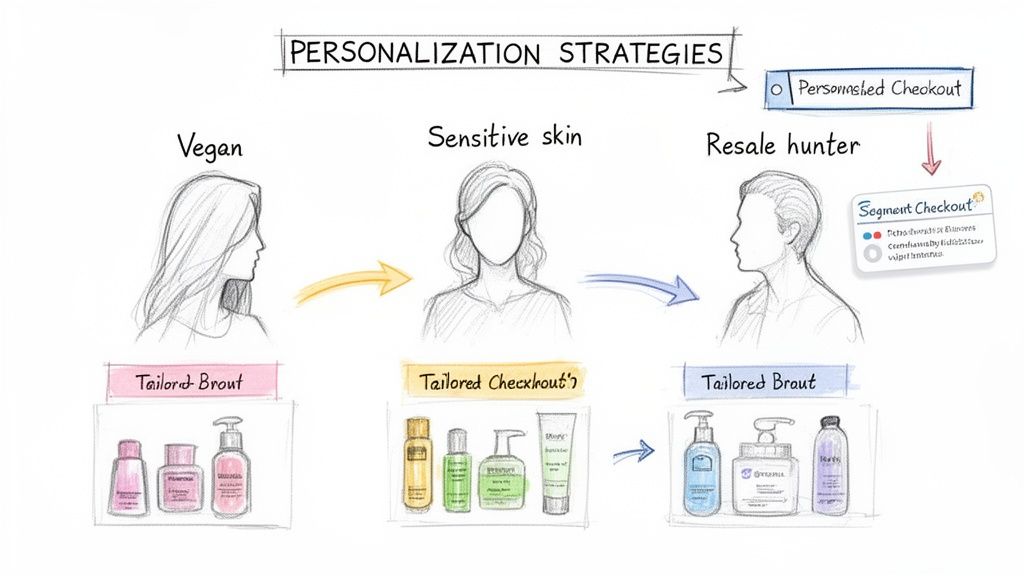
If you're running an ambitious niche store, generic CRO playbooks are a dead end. When you've worked hard to attract a specific audience, blasting the same one-size-fits-all offer to everyone who lands on your site is a good way to kill your brand and burn through ad spend.
Real dominance in a niche comes from precise, segment-driven personalization. The goal is to make every high-value customer feel like you built the store just for them. It’s about moving past surface-level tricks and building a system that turns your deep audience knowledge into more profit per visitor.
Master Ads-to-Site Continuity
One of the quickest ways to torpedo your conversion rates is a clunky, disjointed customer journey. When someone clicks a hyper-specific ad, they have a clear expectation. They want the landing page to be a seamless continuation of that promise. Any mismatch creates instant friction and doubt.
Let’s say a niche skincare brand is running two different ad campaigns: one targeting people searching for "vegan anti-aging" and another for those with "acne-prone sensitive skin."
-
The Disjointed Experience: Both ads dump visitors onto the same generic homepage with a rotating banner of bestsellers. The user is immediately confused and has to start hunting for the product that caught their eye in the first place. Most will just leave.
-
The Personalized Experience: The "vegan anti-aging" ad leads to a landing page with the headline, "Discover Our Plant-Based Age Defense Collection." The hero image shows the right products, and the copy echoes the vegan and cruelty-free message from the ad. It feels right.
This one-to-one mapping from ad to landing page validates the user’s click and smoothly guides them toward making a purchase. It’s a foundational play that builds trust from the very first second.
Map Experiences to High-Value Segments
Your best customers are not all the same. Within your niche, you have distinct sub-groups with different reasons for buying, different spending habits, and different lifetime values. A smart personalization strategy groups these people into actionable segments and then builds unique site experiences for each one.
Start by digging into your first-party data to identify these key segments. Look for patterns like:
- High LTV Customers: Visitors who have spent over a certain amount, like $500, in the past year.
- Subscription Members: Logged-in users who are active subscribers.
- First-Time Visitors from High-Intent Channels: New users coming from specific, high-performing Google Ads campaigns.
Once you know who they are, you can start mapping out a unique journey for each. This is more than just swapping out a headline, it's about thinking through what each segment truly needs to see to convert. You can dive deeper into these concepts in our complete guide on what website personalization is.
A common mistake is treating personalization as a one-off tactic. For niche ecommerce stores, it must be an operational program, a system for systematically identifying segments, deploying tailored experiences, and then rigorously testing and optimizing everything over time.
Deploy Actionable Personalization Plays
With your segments clearly defined, it's time to put specific, high-impact personalization tactics into action. The trick is to directly connect the tactic to what a segment needs and what you want to achieve as a business.
For a niche store that sells sustainable home goods, this might look like:
- Personalized Shipping Thresholds: Show a free shipping bar at $75 for new visitors, but for your logged-in VIPs, drop that to $50 to reward their loyalty and nudge them toward another purchase.
- Segment-Specific Offers: Ditch the generic "10% off" pop-up. Instead, show a "Free Gift with Purchase" offer only to visitors who have previously bought from your highest-margin category. We have an amazing case study on this concept.
- Curated Product Recommendations: For a customer who has only ever bought kitchen products, use that valuable homepage real estate to showcase "New Arrivals for the Sustainable Kitchen," not random items from the bedroom or bathroom categories.
Here’s a simple table that breaks down a few more actionable plays.
Actionable Personalization Plays for Niche Stores
This table provides a snapshot of how you can link specific tactics to the right audience to move the needle on key metrics.
| Personalization Tactic | Target Segment | Key Metric Impact |
|---|---|---|
| Dynamic Offer Bar | High AOV Shoppers | Increase Average Order Value (AOV) |
| Geotargeted Messaging | Visitors from specific cities | Improve Conversion Rate (CVR) |
| Lifecycle Stage Banners | Repeat Customers (3+ orders) | Boost Lifetime Value (LTV) |
Each of these tactics shows you understand the customer’s context and helps guide them toward a specific action.
By systematically rolling out and testing these personalized experiences, you build a powerful competitive advantage that generalist retailers can't touch. Your store stops being a static product catalog and becomes a dynamic, responsive conversion engine.
Your Next Steps: From Niche Player to Market Leader
Being a niche player isn't about thinking small, it's about being incredibly precise. You've done the hard work of finding a profitable niche, but that's just the starting line. The race that takes you from a niche player to a market leader is won through relentless personalization and conversion optimization.
We've walked through how to find your high-value customer segments, confirm they want what you're selling, and start mapping out experiences just for them. The lesson is clear: generic CRO is a waste of time and money for a specialized brand. Your best customers are looking for more than a one-size-fits-all website, they want a store that gets them, speaks their language, and knows what they need before they do.
Putting Your Strategy Into Action
True niche dominance isn't just a strategy, it's an operational rhythm. It’s about creating a system where you constantly test and improve experiences for each specific customer group. Every personalized offer, dynamic content block, and smooth transition from ad to site builds a deeper moat around your business. This is how you transform a focused audience into a loyal community that big-box retailers can't touch.
The big takeaway? Stop trying to please every visitor and start building an experience for your best customer. This simple shift is what separates the breakout niche ecommerce stores from everyone else.
It's time to ditch the generic playbook. Your next move is to build a structured personalization program that focuses squarely on your most important customer segments. This is how you turn deep customer knowledge into real, measurable profit per visitor and create a brand that’s impossible to compete with in its space.
This is your roadmap to sustainable, profitable growth. It takes the right strategy, tools, and a genuine commitment to understanding what makes your best customers tick. Your audience is out there, waiting for an experience that proves you understand them better than anyone else. Go deliver it.
Frequently Asked Questions
How do I find a profitable ecommerce niche?
Start with your existing customer data. Identify your top 5% of customers by lifetime value and find what they have in common. Validate demand with Google Trends and small-budget paid ads at $50-100 per day. A profitable niche has passionate buyers willing to pay premium prices, not just high search volume.
Can a niche store compete with Amazon and big retailers?
Yes, and that is the entire point. Niche stores compete on expertise, community, and personalized experiences rather than price or selection. Generalists spread thin across thousands of SKUs while niche stores build deep trust with a focused audience. The niche ecommerce market is projected to reach $3.2 trillion by 2032.
What platform should I use for a niche ecommerce store?
Shopify Plus is the strongest option for niche stores that want to personalize. It enables segment-specific pricing, personalized checkouts, and dynamic content. Platform choice directly impacts your ability to deliver tailored experiences that set niche stores apart from generalists.
How do niche stores maintain higher margins than generalists?
Niche stores benefit from lower customer acquisition costs due to less competition, higher loyalty and repeat purchase rates, and the ability to charge premium prices through specialized expertise. Identity-based positioning creates communities where customers buy based on belonging, not just price comparison.
We work on tactics like these daily, book a call to get 3 custom (tailored for your business), researched personalization ideas to get you started.