

7 High-Converting Popup Examples for DTC Brands (2026)

[ SUMMARIZE WITH AI ]
[ FREE CRO TEARDOWN ]
Find the 3 biggest revenue leaks on your store.
Every day a conversion leak goes unfixed, you're paying for traffic that doesn't buy. Get a 5-minute Loom through your PDP, cart, and checkout, with mockups of the fixes. No pitch.
Get My TeardownThe generic '10% off' welcome popup is a relic. For ecommerce brands scaling past $3M, it’s a lazy tactic that erodes margins and trains customers to expect discounts. Effective popups aren't just for capturing emails, they're precision-engineered tools for segmentation, personalization, and increasing profit per visitor.
This isn't another gallery of pretty designs. It’s a strategic breakdown of high-performing pop up examples from platforms like Kaching, Wisepops, and ConvertFlow. We will dissect the 'why' behind each one, covering the specific triggers, segmentation rules, and conversion optimization principles that make them work. You will learn how to move from a site-wide annoyance to a personalized experience that actively contributes to your bottom line.
Each entry in this listicle includes a detailed analysis of replicable strategies, not one-off successes. We are focusing on a playbook for using popups to solve real business problems, from reducing cart abandonment to increasing average order value. Let's analyze what top-tier brands are actually doing to drive revenue with their onsite messaging.
1. Kaching Upsell & Email Popup
Kaching Upsell & Email Popup is a Shopify-native popup platform built for one job: turning onsite attention into revenue. Rather than treating popups as a lead-capture afterthought, it puts fully automated upsell, cross-sell and frequently-bought-together popups directly into the buying journey, alongside classic discount and email-capture campaigns. For DTC brands, that means the same popup layer that grows the list also grows average order value.
This revenue-first framing is the key differentiator. Where most popup tools stop at the signup, Kaching triggers offers at the moments purchase intent peaks, add to cart and exit intent among them, and can attach warranties, gift wrap or shipping protection to the order in a click. It is the difference between a popup that collects an email and a popup that pays for itself on the first session.
Why It's a Top Choice for Pop-Up Examples
Kaching earns the top spot for three main reasons: its revenue-first popup types, its native Shopify depth, and how fast campaigns go live.
- Revenue-First Popup Types: Upsells, cross-sells, frequently bought together, product recommendations, and order add-ons like warranties, gift wrap and shipping protection. Discount and email-capture popups are built in, so list growth and AOV growth run from a single tool.
- Native Shopify Depth: Built exclusively for Shopify by Kaching Bundles & Upsells, it pulls product data straight from the store and slots offers into the purchase flow without interrupting it. Merchants rate it 4.9 out of 5 across 128 reviews.
- Fast, Targeted Launches: Fully automated popups go live in minutes, with triggers like add to cart and exit intent plus advanced filters, targeting options and design tools to match your brand.
For brands deciding which incentive to lead with, the same testing discipline applies here as with any tool on this list: our case study comparing dollar-off vs. percentage-off pop-up offers is a useful starting point before you pick a default.
Pricing & Key Features
Kaching Upsell & Email Popup has a free plan available, with a free trial as you scale into paid tiers.
- Pros: Setup speed is the standout, popups launch in minutes with no code, and the upsell popup types make the revenue impact measurable from the first session. The 4.9 rating across 128 reviews reflects how little friction merchants hit.
- Cons: Shopify-only, so multi-platform brands will need something else outside their Shopify stores. It is a focused popup tool rather than a full personalization suite, which is the point, but heavy experimenters may want a broader testing platform alongside it.
Website: https://apps.shopify.com/popup-upsell
2. Wisepops
Wisepops is an onsite messaging platform that extends beyond traditional popups to include notification bars, embedded forms, and an integrated onsite notification feed. It empowers brands to create a multi-format communication strategy directly on their site, combining lead capture with AI-powered product recommendations and web push notifications. This makes it a great choice for ecommerce brands that want a unified system for all their onsite messaging.
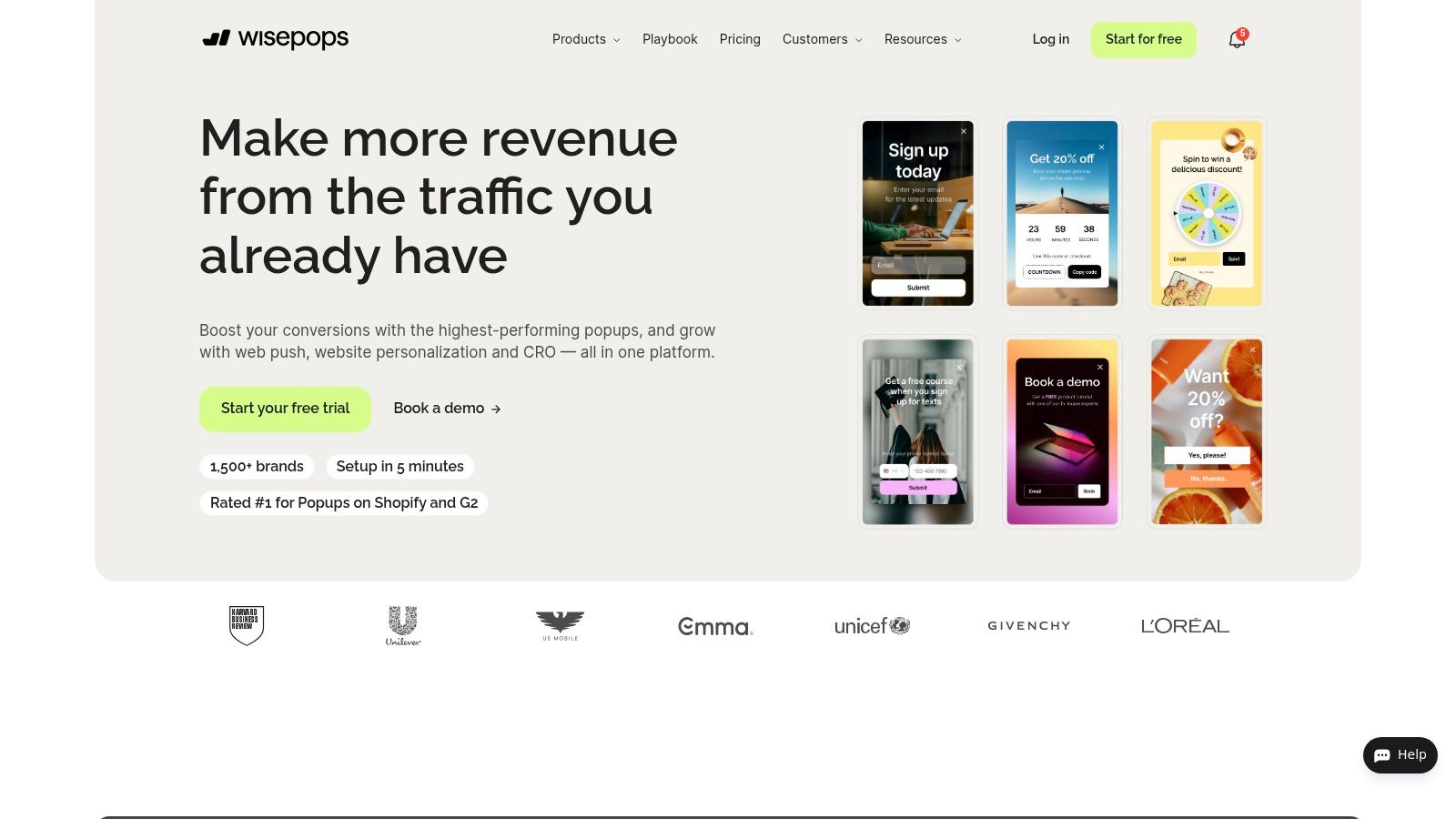
The platform is designed for growing Shopify brands, with clear traffic-based pricing tiers available directly through the Shopify App Store. This simplifies billing and allows for predictable scaling. The inclusion of an onsite feed, similar to a social media notification center, provides a non-intrusive way to share promotions, new arrivals, and updates with engaged visitors who might otherwise close a popup.
Why It's a Top Choice for Pop-Up Examples
Wisepops secures its place on this list due to its multi-channel onsite approach, strong Shopify integration, and mature feature set. These elements combine to create a versatile tool for driving conversions and engagement.
- Omnichannel Onsite Messaging: By combining popups, bars, an onsite feed, and web push notifications, Wisepops allows brands to reach customers through multiple touchpoints without leaving the website. This unified approach ensures message consistency and prevents channel fatigue.
- AI Product Recommendations: The platform can intelligently suggest products within popups based on visitor behavior or cart contents. This feature is powerful for creating targeted upsell and cross-sell campaigns that feel personalized and relevant to the shopper.
- Shopify-Centric Design: From its deep integration that pulls in customer data to its convenient Shopify app billing, Wisepops is built with the needs of Shopify merchants in mind. This streamlines setup and management for busy ecommerce teams.
For brands testing different types of incentives, Wisepops provides a robust A/B testing framework. You can explore a detailed analysis of how to approach this in our case study on free gifts vs. discount pop-up offers.
Pricing & Key Features
Wisepops offers traffic-based plans that start at a higher entry point but provide a comprehensive suite of tools. The pricing is transparent and scales with your store's pageviews, often managed directly through Shopify.
- Pros: The platform consolidates multiple onsite marketing tools into one, creating a cohesive user experience. The Shopify app billing and clear traffic tiers make it easy for scaling brands to manage costs.
- Cons: The entry-level pricing can be higher than tools that focus exclusively on popups. Brands should verify the current pricing grid before making long-term commitments, as it is subject to change.
Website: https://wisepops.com
3. ConvertFlow
ConvertFlow is a full-funnel onsite conversion platform that empowers brands to create personalized popups, sticky bars, quizzes, and landing pages. It’s designed for conversion-focused teams and agencies that need to move beyond simple lead capture. The platform's strength lies in its extensive library of "playbooks," which are pre-built funnel templates that provide a strategic starting point for sophisticated campaigns.
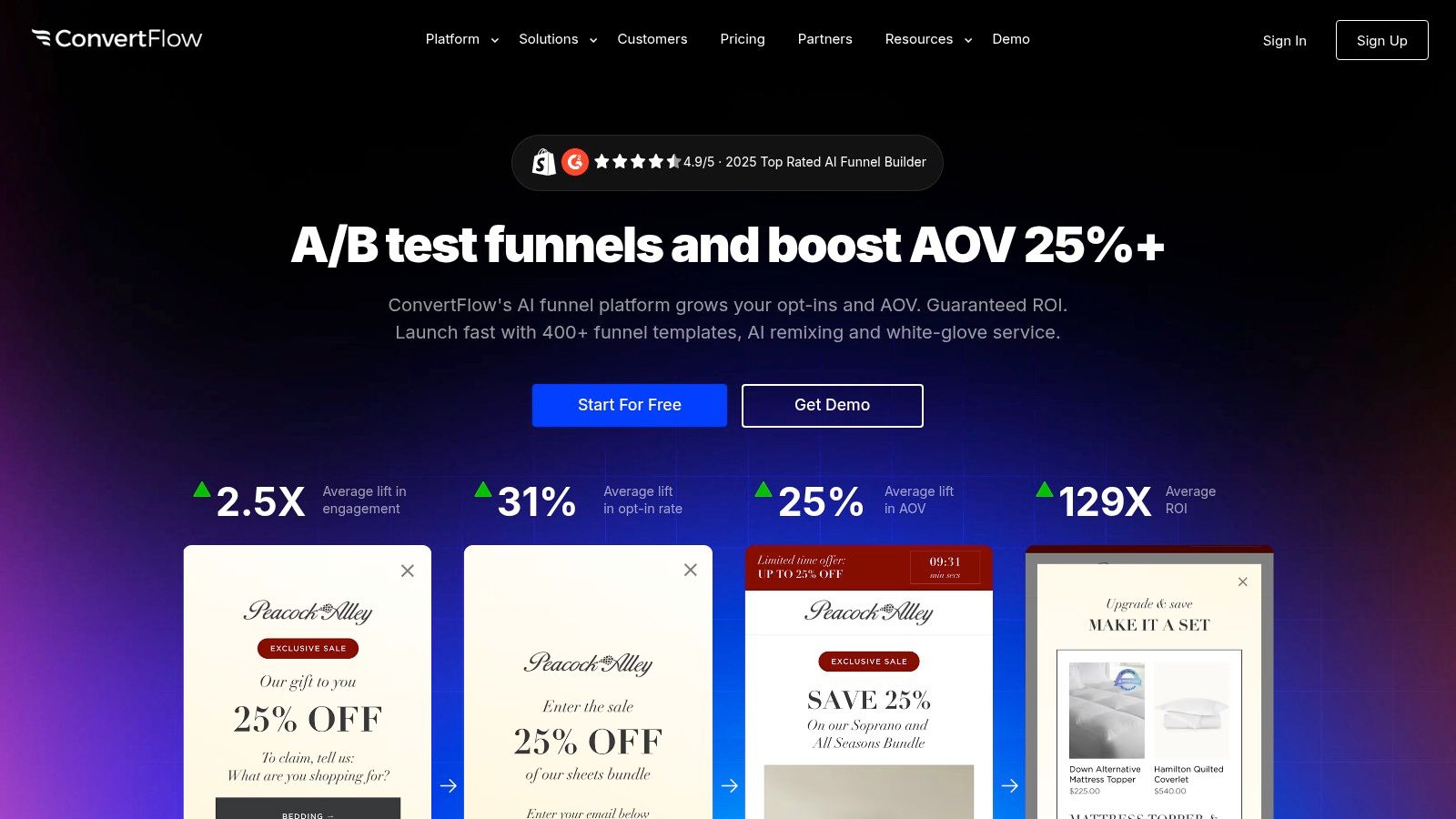
This playbook-driven approach helps ecommerce teams launch proven campaigns quickly, such as product recommendation quizzes or segmented welcome offers. ConvertFlow also provides detailed revenue attribution and integrates with Google Analytics 4, allowing teams to measure the direct sales impact of their onsite marketing efforts. This focus on analytics and multi-step funnels makes it a powerful tool for brands investing heavily in conversion rate optimization.
Why It's a Top Choice for Pop-Up Examples
ConvertFlow makes this list because it consolidates multiple conversion tools into one platform, offers a massive template library, and provides robust integrations for data-driven teams.
- All-in-One Funnel Builder: ConvertFlow can replace several disparate tools, including popup builders, quiz software, and landing page creators. This consolidation simplifies the tech stack and centralizes reporting, giving a clearer view of how different onsite campaigns contribute to revenue.
- Extensive Template Playbooks: With over 400 funnel templates, including numerous pop up examples, users can find a proven starting point for nearly any goal. These playbooks are more than just designs, they are strategic sequences designed to guide visitors through a conversion journey.
- Powerful Segmentation and Quizzes: The platform excels at creating multi-step forms and quizzes that segment audiences in real-time. This allows brands to capture zero-party data and deliver highly personalized offers and product recommendations, a key strategy detailed in these ecommerce personalization examples.
- Agency and Multi-Site Management: ConvertFlow is built with features that support agencies or brands managing multiple storefronts. You can manage campaigns across different websites from a single account, streamlining workflow and reporting.
Pricing & Key Features
ConvertFlow’s pricing is usage-based, tied to "funnel views" rather than pageviews, which can be more cost-effective for high-traffic sites. It offers a free plan to get started, with paid plans scaling based on funnel view volume and feature access.
- Pros: The platform’s ability to replace multiple tools provides significant value and simplifies reporting. The template library and playbooks dramatically shorten the time it takes to launch effective, multi-step campaigns.
- Cons: The pricing model can become expensive for brands with many sites or extremely high funnel view volumes. The platform's broad feature set has a steeper learning curve compared to simpler popup-only tools.
Website: https://www.convertflow.com
4. Justuno
Justuno is a comprehensive conversion and personalization platform favored by high-growth Shopify Plus brands. It moves beyond basic popups to offer a suite of tools including targeted on-site messaging, AI-powered product recommendations, and advanced audience segmentation. The platform is engineered for growth teams that require deep control over the user journey, allowing them to build complex, multi-step campaigns that adapt to user behavior in real-time.
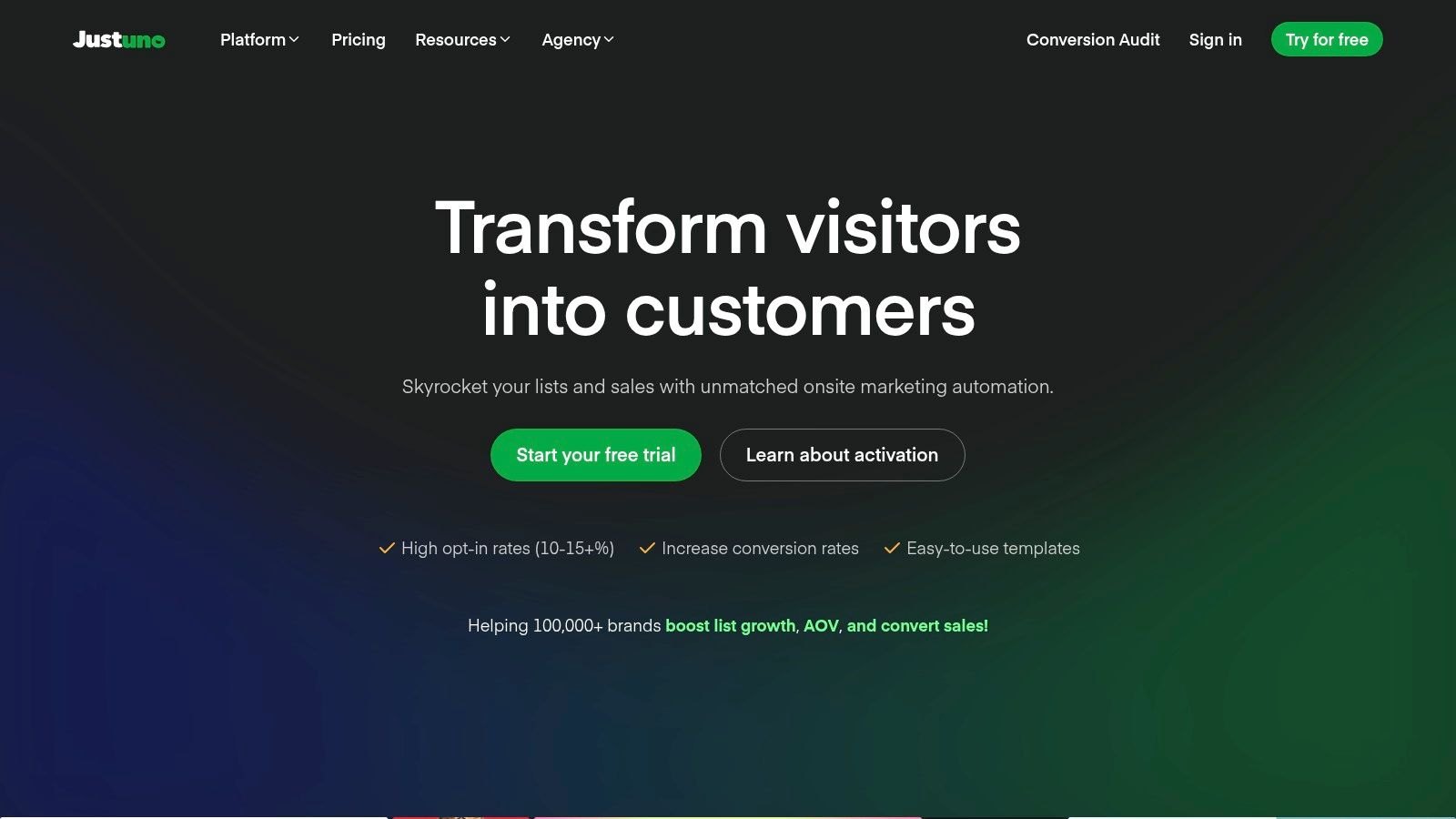
Its core strength lies in its powerful rules engine, which gives marketers granular control over when, where, and to whom a message is shown. This makes it ideal for implementing sophisticated strategies like segmenting visitors from specific paid ad campaigns, showing unique offers to loyalty program members, or triggering urgency-based banners based on cart contents. Justuno is built for teams that view on-site optimization as a primary revenue channel, not just a simple lead capture tool.
Why It's a Top Choice for Pop-Up Examples
Justuno makes this list because of its advanced segmentation capabilities, robust testing framework, and its focus on enterprise-level control. It's a platform built for scaling conversion optimization efforts.
- Advanced Segmentation and Triggers: Justuno's rules engine is one of the most powerful on the market. You can create segments based on hundreds of data points, including traffic source, geolocation, order history, Shopify customer tags, and on-site behavior. This allows for the creation of truly personalized pop up examples that resonate with specific audience cohorts.
- Multivariate Testing: While A/B testing is standard, Justuno offers multivariate testing, allowing you to test multiple variations of several elements simultaneously. This helps you identify the most effective combination of headline, copy, image, and offer much faster than sequential A/B tests.
- AI Product Recommendations: The platform integrates AI to power intelligent cross-sells and upsells within popups and on-site banners. It can suggest relevant products based on browsing history or what’s currently in a visitor’s cart, helping to increase average order value directly from the messaging layer.
For brands that need to prove ROI from their optimization efforts, Justuno provides the deep analytics and reporting required to tie campaigns directly to revenue, AOV, and other key ecommerce KPIs.
Pricing & Key Features
Justuno's pricing is based on unique monthly visitor traffic, starting with a free plan for sites with under 2,000 visitors. Paid plans scale from there, though specific pricing tiers are not public and require you to install the app or speak with their team.
- Pros: The platform is built for growth teams needing sophisticated segmentation, testing, and reporting. Higher-tier plans include access to dedicated conversion strategists, and the flexible seat management is ideal for larger marketing teams.
- Cons: The lack of transparent pricing can be a hurdle for initial evaluation. The sheer depth of features can be overwhelming for small teams looking for a simple list-growth solution.
Website: https://www.justuno.com
5. Privy
Privy is a Shopify-first marketing platform specializing in popups, email, and SMS designed for rapid deployment. It's particularly attractive to merchants who want powerful list growth tools without committing to an entire email service provider (ESP) stack. Its dedicated "Pop-ups & Displays" plan allows brands to access a wide range of templates and advanced targeting features, making it a flexible entry point for conversion optimization.
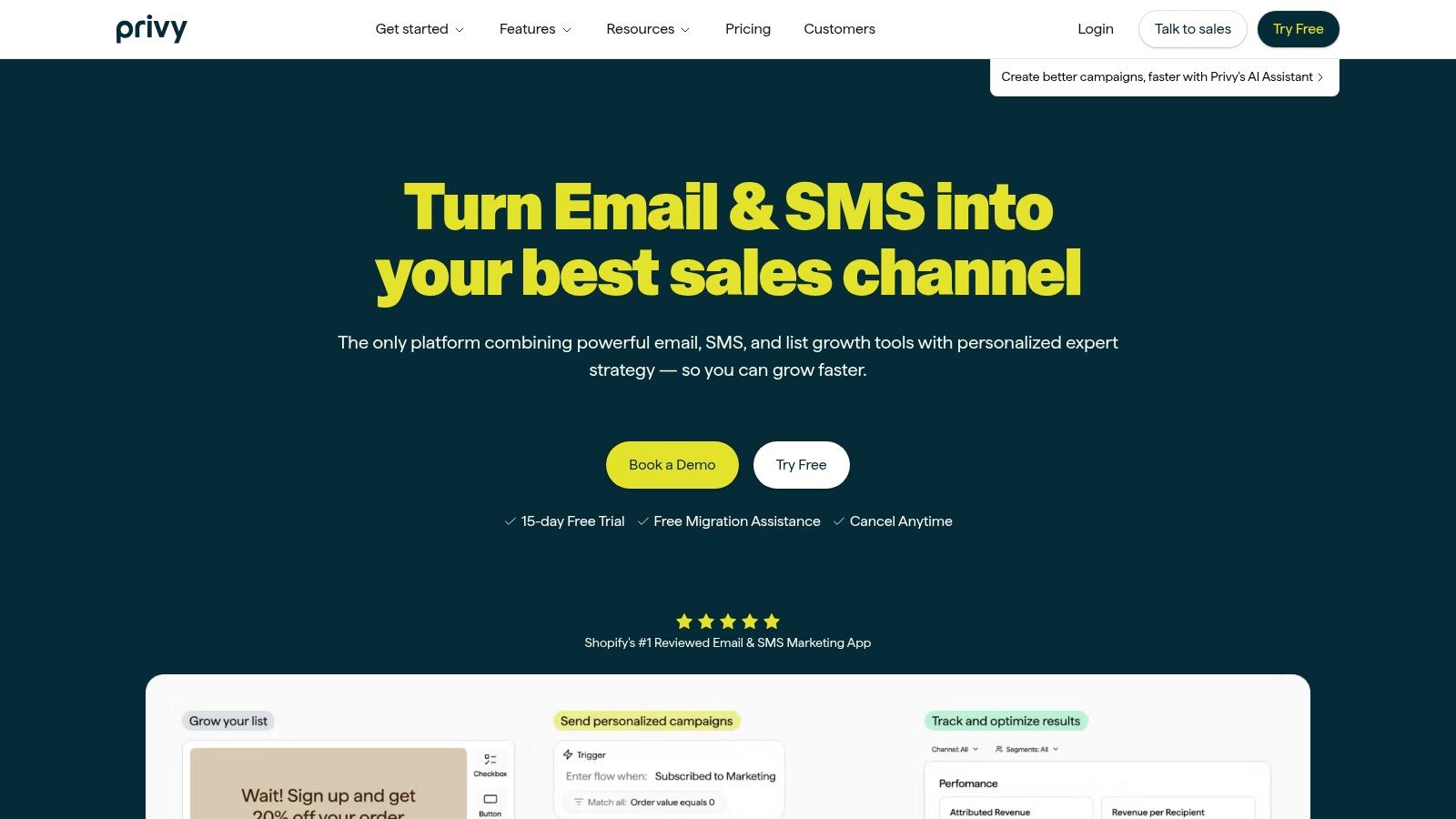
The platform is purpose-built for the Shopify ecosystem, ensuring that contact synchronization and reporting are seamless. This tight integration allows for more sophisticated popup triggers based on cart contents, visit history, and other Shopify-specific data. Privy excels at providing high-impact, gamified experiences like spin-to-win wheels that are proven to engage visitors and capture leads effectively. According to one Sleeknote analysis, gamified popups can see conversion rates as high as 13.9%.
Why It's a Top Choice for Pop-Up Examples
Privy secures its place on this list due to its Shopify-centric design, flexible plan structure, and its focus on engaging, interactive popup formats. These elements make it an excellent choice for brands looking for quick wins and scalable growth.
- Flexible Plan Tracks: Unlike many all-in-one solutions, Privy lets you start with just popups. This is ideal for brands that are happy with their current ESP but want to upgrade their on-site lead capture strategy. You can later scale into their email and SMS products if needed.
- Engaging Formats: Privy is well-known for its gamified and multi-step forms. Features like spin-to-win wheels, cart saver popups, and lead-capture quizzes provide more engaging ways to collect emails and phone numbers than a standard static form. These interactive pop up examples often lead to higher conversion rates.
- Deep Shopify Integration: As a dedicated Shopify app, Privy offers synchronized contacts, coupon code generation, and detailed reporting that ties directly back to your store's performance. You can trigger popups based on specific cart conditions, like the number of items or total value, to present highly relevant offers like free shipping or a last-minute discount.
For brands looking to implement more advanced capture methods, Privy's A/B testing capabilities allow you to test different offers, copy, and designs to find out what resonates most with your audience. This data-driven approach is critical for optimizing conversion rates.
Pricing & Key Features
Privy offers a 15-day free trial and separate pricing tiers for its Pop-ups & Displays, Email, and Email + SMS plans. The popup-only plan is priced based on mailable contacts, making it an affordable starting point for list growth.
- Pros: The purpose-built Shopify app ensures reliable integration and synchronized data. The ability to purchase a popup-only plan provides flexibility, and the platform is known for being user-friendly and quick to set up.
- Cons: The pop-up-only tier lacks some of the deeper automation and segmentation capabilities found in their full email suite. Legacy accounts billed through Shopify may see separate base and usage charges, which can be confusing.
Website: https://www.privy.com
6. OptinMonster
OptinMonster is one of the original and most well-known popup and lead generation tools on the market. It provides a comprehensive suite of features designed to help businesses of all sizes grow their email lists, reduce cart abandonment, and increase sales. The platform is recognized for its powerful targeting and trigger options, including its signature Exit-Intent technology, which detects when a user is about to leave a site and presents a targeted campaign at the perfect moment.
While many tools focus heavily on ecommerce templates, OptinMonster has built a reputation on its robust behavioral automation and segmentation engine. This allows DTC brands to move beyond simple welcome popups and create highly specific campaigns based on visitor actions, traffic source, and even their physical location. Its extensive library of educational resources also provides countless pop up examples and strategies, making it a valuable resource for teams looking to master conversion optimization.
Why It's a Top Choice for Pop-Up Examples
OptinMonster earns its place for its mature and reliable feature set, especially its advanced targeting rules and extensive integration ecosystem. It provides the foundational tools needed for sophisticated personalization campaigns.
- Advanced Behavioral Targeting: OptinMonster’s Exit-Intent® technology is a standout feature, giving brands a final opportunity to convert abandoning visitors. This can be combined with other rules like page-level targeting, device-based targeting, and geolocation to create incredibly specific offers, such as a free shipping popup shown only to mobile users in a certain country who are about to exit the checkout page.
- Massive Template and Integration Library: With a large collection of pre-built templates and a drag-and-drop builder, launching a campaign is fast. More importantly, it integrates with a huge number of email marketing services, CRMs, and other marketing platforms, ensuring it fits seamlessly into almost any existing tech stack.
- Revenue Attribution & Analytics: The platform provides clear revenue attribution, allowing marketers to see exactly how much income each popup campaign is generating. This direct link to ROI is critical for DTC brands that need to justify marketing spend and optimize campaign performance based on concrete financial data.
For teams focused on capturing high-quality leads, OptinMonster's multi-step forms and content locking features offer creative ways to engage visitors and collect valuable information beyond just an email address.
Pricing & Key Features
OptinMonster’s pricing is based on a tiered subscription model, with plans differentiated by feature access and the number of pageviews included. Plans are billed annually, offering a discount over monthly payments.
- Pros: The powerful and proven Exit-Intent technology is a major advantage for reducing site abandonment. Its wide range of integrations and detailed educational content make it accessible for teams of all skill levels.
- Cons: Some of the most valuable features, like advanced targeting and A/B testing, are reserved for higher-tier plans. The interface, while powerful, can feel less modern compared to newer competitors.
Website: https://optinmonster.com
7. GoodUX by Appcues
GoodUX by Appcues is not a popup builder but rather a curated gallery of high-quality, real-world user experiences. It serves as a visual inspiration library, showcasing modals, slideouts, tooltips, and onboarding flows built with Appcues. For ecommerce brands and marketers, it's an invaluable resource for benchmarking effective design patterns, copy, and timing before committing to building their own campaigns. The platform helps teams see what polished, in-product communication looks like in practice.
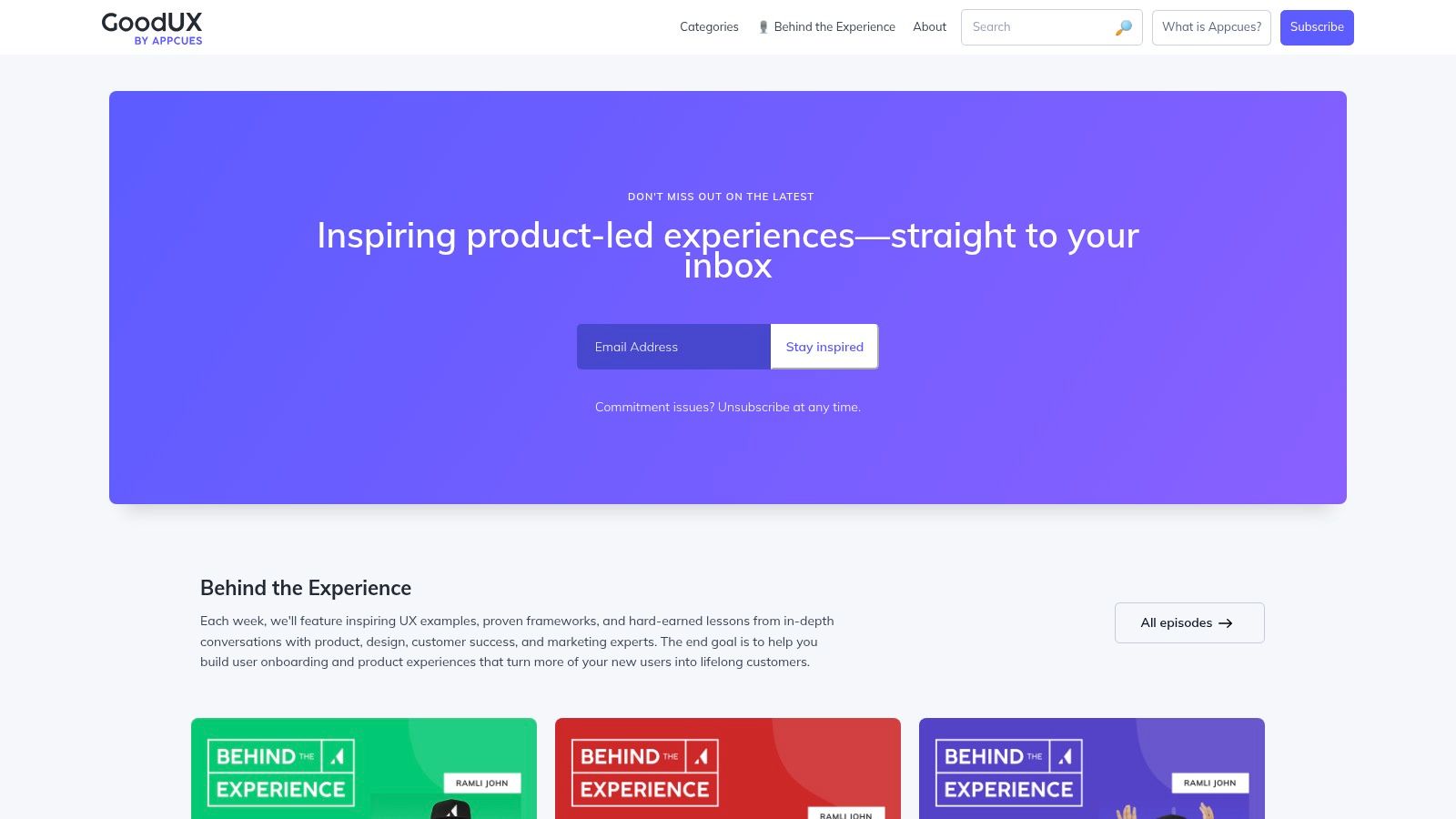
While Appcues is primarily known for SaaS user onboarding, the principles and pop up examples showcased in GoodUX are highly transferable to ecommerce. The gallery provides a clear look at how to guide users, make announcements, and prompt specific actions without disrupting the shopping experience. It's less about direct lead capture and more about enhancing the user journey through clear, contextual messaging, which is crucial for building brand loyalty and increasing customer lifetime value.
Why It's a Top Choice for Pop-Up Examples
GoodUX secures its place on this list by being a pure-play inspiration and strategy resource. It allows marketing teams to align on best practices before a single line of code is written or a campaign is built.
- Benchmark Against Proven Designs: The gallery provides a fast way to evaluate your own popup copy, layouts, and user flow against what other successful brands are implementing. You can see examples for new feature announcements, upgrade prompts, and feedback requests.
- Bridge Design and Development: Each example is backed by detailed documentation from Appcues on how to build, style, and target similar experiences. This helps align designers, copywriters, and developers, reducing friction and speeding up the implementation process.
- Inspiration Across the Funnel: While not strictly ecommerce-focused, the use cases for onboarding, announcements, and gathering user feedback are directly applicable. You can find inspiration for everything from welcoming a new loyalty program member to announcing a site-wide sale.
For DTC brands looking to move beyond simple discount popups, GoodUX provides a look into more sophisticated, experience-driven interactions that can significantly improve user engagement and retention.
Pricing & Key Features
GoodUX is a completely free resource gallery. It is designed to showcase the capabilities of the Appcues platform, which is a paid product, but the gallery itself is open for anyone to use for inspiration and research.
- Pros: It’s a fast, free way to see what high-quality popups and modals look like in the wild. The connection to detailed "how-to" documentation provides an actionable path from inspiration to execution. It’s an excellent tool for team alignment.
- Cons: The gallery is for learning and inspiration only, you still need a tool like Appcues, Kaching, or another platform to implement the ideas. Many examples are from SaaS companies, so you will need to filter and adapt the concepts for an ecommerce context.
Website: https://goodux.appcues.com
Top 7 Pop-up Tools Comparison
| Product | Implementation complexity | Resource requirements | Expected outcomes | Ideal use cases | Key advantages |
|---|---|---|---|---|---|
| Kaching Upsell & Email Popup | Low, no-code, launches in minutes | Minimal; native Shopify app; free plan available | Higher AOV from upsell popups, list growth from discount popups | Shopify DTC stores monetizing product pages while capturing emails | Revenue-first popup types, 4.9 rating (128 reviews), add-to-cart and exit-intent triggers |
| Wisepops | Moderate, multi-format setup (popups, feed, push) | Moderate setup and coordination; traffic-based tiers | Omnichannel onsite engagement and AI-driven product suggestions | Brands wanting multi-format onsite communications and inspiration | Combines popups + onsite feed + web push; AI recommendations |
| ConvertFlow | Moderate–High, full-funnel personalization and integrations | Higher onboarding and data integration effort; multi-site management | Unified funnels, segmentation, and revenue attribution | CRO teams, agencies or multi-site ecommerce operations | Replaces several tools with reporting playbooks and attribution |
| Justuno | Moderate–High, advanced workflows and testing | Moderate to high (traffic-based tiers; install required for pricing) | Sophisticated segmentation, higher-conversion targeted campaigns | Growth teams and Shopify Plus brands needing deep targeting | Advanced segmentation, multivariate testing, strategist support |
| Privy | Low, Shopify-first, quick-to-launch popups | Low; clear entry pricing and popup-only plan options | Rapid list growth and synchronized contacts (email/SMS capture) | Shopify merchants who want popup-only or simple messaging suites | Clear pricing/trials, deep Shopify sync, popup-only track available |
| OptinMonster | Low–Moderate, mature builder with many targeting options | Low dev effort; impressions-based billing; extensive templates | Proven popup performance with precise targeting and analytics | Sites seeking established popup patterns and educational resources | Very large template library, exit/geolocation targeting, strong education |
| GoodUX (Appcues) | Low, inspiration gallery (not an implementation tool) | Minimal for browsing; implementation requires Appcues or other tools | Better design decisions and faster concept validation | Designers, copywriters and developers seeking real-world examples | Curated real examples with how-to documentation and best practices |
Your Next Move: Turn Popups into Profit Engines
We've explored a wide range of high-performing pop up examples, moving from basic email captures to sophisticated, behavior-driven campaigns. The core lesson is clear, the most effective popups are not disruptive ads, they are timely, personalized value exchanges. They feel less like an interruption and more like a helpful store associate appearing at the perfect moment.
The difference between a generic popup that converts at a meager 1-2% and a precision-engineered campaign that achieves 8% or higher lies in strategy, not just design. As we've seen through the examples powered by tools like Kaching, Wisepops, and ConvertFlow, success comes from a deep understanding of the customer journey. It's about deploying the right message, to the right person, at exactly the right time.
Key Takeaways for Immediate Action
The strategic jump from a generic site-wide offer to a segmented, personalized experience is the single most important change you can make to your onsite conversion strategy. Here are the critical takeaways to implement now:
- Segmentation is Non-Negotiable: Stop showing the same popup to every visitor. At a minimum, segment by traffic source (e.g., paid social vs. organic search), visitor status (new vs. returning), and on-site behavior (e.g., viewed specific product category, items in cart).
- Context is King: The trigger is just as important as the offer. An exit-intent popup on a cart page should address potential checkout friction, like shipping costs, while a welcome popup for a first-time visitor from a Facebook ad should reinforce the value proposition they just saw.
- Go Beyond the Discount: While discounts are effective, they aren't your only tool. Test valuable content (guides, quizzes), early access to new products, free shipping thresholds, or entry into a giveaway. Align the offer with your brand's value and the customer's intent.
- Continuity Creates Confidence: Ensure your popup's messaging and creative aligns perfectly with the upstream ad or channel the visitor came from. This ads-to-site continuity reduces bounce rates and builds immediate trust, showing the visitor they've landed in the right place.
Your First Step: The High-Impact Audit
Don't try to implement everything at once. Instead, perform a simple audit to identify your biggest opportunity for immediate impact.
- Analyze Your Data: Dive into your analytics. Where is your biggest drop-off point? Is it new visitors bouncing from the homepage? Or is it users abandoning carts worth over $150? Your data will reveal your most critical intervention point.
- Choose Your Target: Based on your analysis, select one high-value segment to target first. For example, "new visitors from paid search who have viewed at least two product pages but have not added to cart."
- Select a Model: Revisit the pop up examples in this article. Find one that directly addresses your chosen challenge. Whether it's a social proof popup from Justuno or a multi-step quiz from ConvertFlow, use it as your template.
- Deploy and Test: Build and launch your test. Monitor performance against your baseline and form a hypothesis for your next A/B test. Could a different headline or a more compelling image increase sign-ups? Always be iterating.
The tools we've covered, from Privy to OptinMonster, provide the technical foundation to execute these strategies. Your role is to bring the strategic vision, using these platforms not just to build popups, but to engineer personalized conversion experiences. By focusing on one high-impact segment at a time, you can turn your popups from a necessary evil into a powerful engine for profit and customer engagement.
Frequently Asked Questions
Do popups hurt SEO or Google rankings?
Google penalizes intrusive interstitials on mobile that block content immediately on page load. The fix is simple: trigger popups on a time delay or scroll depth, use exit-intent triggers, and ensure popups are easy to dismiss. Popups triggered after user engagement don't trigger penalties.
What is a good conversion rate for an ecommerce popup?
Generic popups convert at 1-2%. Well-targeted, segment-specific popups regularly achieve 5-8% or higher. Gamified popups like spin-to-win wheels can convert as high as 13.9%. The difference comes down to relevance: matching the offer to the visitor's intent and lifecycle stage.
Should I show the same popup to new and returning visitors?
No. New visitors need trust-building offers like welcome discounts or free shipping. Returning customers already trust your brand, so they respond better to loyalty rewards, early access, or personalized product recommendations. Showing a first-order discount to a repeat buyer wastes margin.
When is the best time to trigger a popup?
For welcome offers, trigger after 5-10 seconds or 25-50% scroll depth to let visitors engage with your content first. For exit-intent popups, trigger when the cursor moves toward the browser close button. Avoid triggering popups immediately on page load, as this creates a poor user experience and can hurt mobile rankings.
At CONVERTIBLES, we transform this entire process from a series of one-off tests into a comprehensive personalization program. We use our expertise to build visual roadmaps that identify and capture high-value segments, deploying onsite experiences like these pop up examples to increase your profit per visitor. If you're ready to move beyond generic CRO and implement a strategic, high-touch optimization partnership, let's talk.