

How to Build a Website Testimonials Page That Converts and Drives Revenue

[ SUMMARIZE WITH AI ]
[ FREE CRO TEARDOWN ]
Find the 3 biggest revenue leaks on your store.
Every day a conversion leak goes unfixed, you're paying for traffic that doesn't buy. Get a 5-minute Loom through your PDP, cart, and checkout, with mockups of the fixes. No pitch.
Get My TeardownA testimonials page is more than a trophy case for nice quotes. For a high-growth ecommerce brand, it's a strategic asset. Think of it as a dedicated conversion tool, engineered to showcase real customer results and build the trust required to turn paid traffic into profit.
Why Your Testimonials Page is a Critical Conversion Asset
If you’re spending six or seven figures a year on ads, every click has a cost. Your testimonials page is not a "nice-to-have", it's a core component of your conversion rate optimization strategy, essential for maximizing return on ad spend (ROAS).
When a potential customer clicks your ad, they land on your site with justifiable skepticism. They’ve seen marketing promises before, they need proof that your product delivers before they're willing to buy.
This is where social proof does the heavy lifting. A well-executed website testimonials page uses the authentic voices of satisfied customers to dismantle that skepticism and validate your brand's claims. It directly addresses purchase anxiety and answers the one question every visitor has: "Can I trust this product to solve my problem?"
The Hard Numbers Behind Social Proof
The impact of social proof isn't theoretical, it's measurable revenue. Modern consumers are researchers. According to a 2023 study from PowerReviews, an astounding 99% of consumers consult reviews when shopping online. The effect on your bottom line is direct. Displaying reviews can increase conversion rates by up to 270% in some cases.
For a brand generating $10M in annual revenue, a conversion lift of just 5% from a better testimonials strategy can translate into an additional $500,000. It's that powerful.
Your testimonials page is your digital focus group. It provides undeniable evidence that your product solves a real problem for real people, making it the ultimate tool for pushing on-the-fence customers to convert.
Cutting Through the Noise in a Crowded Market
In the direct-to-consumer world, credibility is currency. Customer success stories build a powerful narrative that differentiates you from competitors. They signal brand momentum and help cultivate a community. To understand the full scope, it's worth knowing the benefits of a strong online reputation.
Neglecting this page forces potential customers to make a purchase decision based solely on your marketing copy. You're leaving money on the table.
The takeaway is simple: a dedicated, well-designed website testimonials page is a high-leverage investment. It works 24/7 to validate your brand, lower customer acquisition costs, and increase the lifetime value of the traffic you're already paying for. Treat it like the revenue-driver it is.
How to Source Testimonials That Actually Sell
The best testimonials are not found, they are engineered. Sitting back and waiting for reviews to trickle in is a strategy for generic, uninspired feedback that does nothing to drive sales. To build a library of testimonials that actively sell your products, you need a repeatable system.
This isn't about collecting five-star ratings. The objective is to capture genuine customer stories that dismantle common objections, highlight unique product benefits, and resonate with your ideal customer profiles.
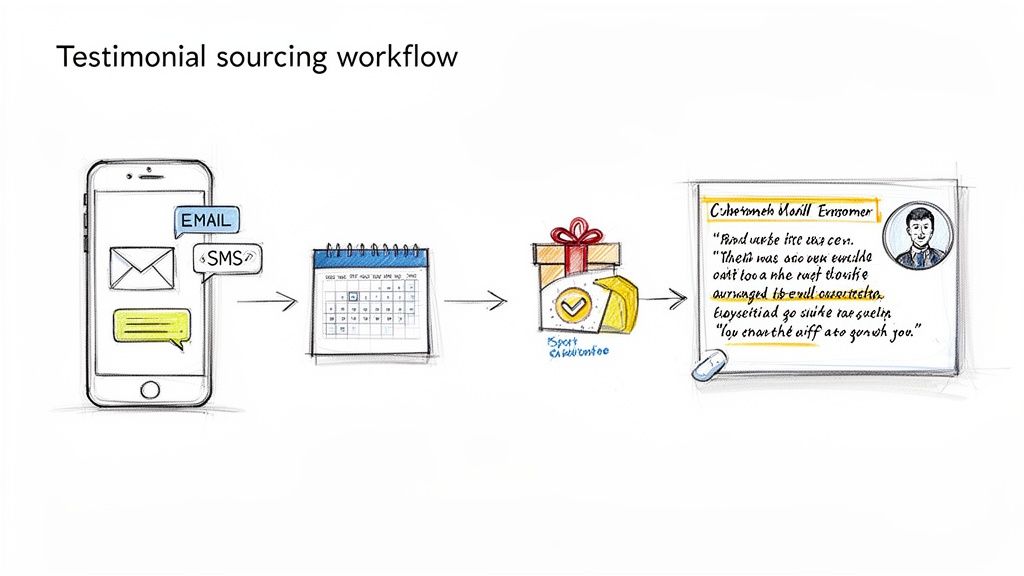
Automate Your Collection Funnel
Your post-purchase flow is the most fertile ground for sourcing high-quality testimonials. A customer's excitement is highest right after they've received their order, and your product's value is top of mind. This is the optimal moment to request their story.
Implement automated email and SMS flows that trigger at specific intervals post-delivery. Do not rely on a single "leave a review" email, build a multi-step sequence.
- 7 days post-delivery: Send an initial request focused on first impressions. Keep it simple and mobile-friendly.
- 21 days post-delivery: Follow up with a more detailed request. Ask specific, guiding questions about how they use the product and the results they've seen.
- 60 days post-delivery: For repeat customers, inquire about long-term benefits or product durability. This is where you uncover your most compelling stories of brand loyalty.
By staggering requests, you capture feedback at different stages of the customer lifecycle, yielding a richer variety of stories for your website testimonials page.
Find Your Advocates in Customer Support
Your support team is sitting on a testimonial goldmine. Every resolved ticket that results in a happy customer is a potential testimonial. Train your agents to identify these moments of high satisfaction.
Instead of just closing a ticket, empower them to send a personal follow-up. A simple, human touch works best:
"I'm so glad we were able to get that sorted out for you! We love hearing from customers like you. Would you be open to sharing a few words about your experience? It would mean a lot to our team."
This personal approach often elicits the most authentic and heartfelt testimonials. These customers have seen your brand deliver when it matters, turning a potential negative experience into a story of exceptional service.
Incentivize Smartly Without Sacrificing Authenticity
Incentives can significantly increase submission rates, but they must be handled with care. Never offer a reward for a positive review, that's a quick way to destroy customer trust. The correct approach is to reward customers for the act of sharing their honest feedback.
Here’s a proven framework:
- Offer a modest reward: A 10% discount on their next purchase or a $15 gift card is sufficient to show appreciation for their time without feeling like a bribe.
- Focus on participation: Frame the incentive as a "thank you" for sharing their thoughts, not for providing positive feedback.
- Run targeted campaigns: For high-effort content like video testimonials, a larger incentive (e.g., a $50 gift card) is appropriate. Be transparent that you're compensating them for the extra effort involved.
The key is to reward the effort, not the opinion. A BigCommerce study found that 72% of customers say positive testimonials increase their trust. Maintaining that trust requires ethical sourcing. An authentic, balanced collection of feedback will always convert better than a wall of suspiciously perfect praise.
Designing a Page That Builds Instant Trust
A poorly designed website testimonials page can destroy trust faster than a 404 error. This page isn't a repository for quotes, it's a carefully crafted experience designed to prove to high-intent shoppers that your brand is legitimate. Every design choice either builds confidence or erodes it.
The layout is your foundation. A generic, single-column feed of text feels lazy and outdated. The goal is to present your social proof in a way that allows visitors to easily scan and discover stories that are relevant to them.
Choose Layouts That Guide Discovery
Your visitors are busy. Your design must help them find the proof they're looking for without friction. Two layout patterns consistently perform well for ecommerce brands.
-
Filterable Grids: This is the standard for any brand with a significant volume of testimonials. It allows you to organize reviews by product, customer concern (e.g., "Fights Frizz"), persona (e.g., "For Sensitive Skin"), or media type. A shopper can instantly filter down to the exact review that overcomes their specific hesitation.
-
Masonry Layouts: If you have a healthy mix of content like short quotes, long-form stories, customer photos, and videos, a masonry layout is excellent. It creates a dynamic, visually engaging experience that breaks up monotony and encourages exploration.
Your brand's aesthetic should inform your choice, but functionality must be the priority. For a deeper look at creating a cohesive site experience, review our guide on Shopify Plus store design and layout.
Prioritize Authenticity with Visual Cues
Before a visitor reads a single word, they make a snap judgment based on visual cues. Anonymous, text-only quotes look inauthentic to savvy consumers. You must show them that real people love your products.
Attribute every testimonial to a real person. Adding a first name, last initial, and location (e.g., "Sarah K., Austin, TX") immediately adds a layer of credibility. If you can include their photo, do it. One A/B test found that using a real photo instead of a generic icon increased conversions by 48%.
Pro Tip: Use visual hierarchy to your advantage. Make star ratings, customer photos, and bold pull-quotes the most prominent elements. This allows a visitor to scan the page and get an immediate sense of overwhelming positive sentiment in seconds.
Visuals like star ratings are a cognitive shortcut, instantly communicating customer satisfaction. Placing an aggregate rating at the top of the page sets a positive tone. Also, consider your language. Instead of a generic "Testimonials" heading, explore powerful synonyms for 'testimonial' like "Success Stories" or "Rave Reviews" to better match your brand's voice.
Design for the Mobile Majority
Most of your traffic, particularly from paid social ads, comes from mobile devices. A website testimonials page that is not optimized for mobile is a wasted investment. This doesn't just mean responsive design, it means a mobile-first approach.
On a smartphone, scannability is paramount. Use expandable "read more" toggles for longer reviews to avoid overwhelming users with a wall of text. For video testimonials or image galleries, implement a swipeable carousel that feels native and engaging.
Ensure buttons and filters are large enough for easy tapping. Always test the page on multiple devices to confirm fast load times and smooth performance. Your mobile testimonials page must feel like an integral part of the shopping journey, not a clunky detour.
Weaving Social Proof into the Entire Buyer Journey
Your website testimonials page is a powerful destination, but its contents shouldn't be confined there. The most effective brands treat social proof as a strategic element woven throughout the entire customer journey. Simply having testimonials is not enough, you must deploy them at the specific moments when a customer experiences friction or doubt.
If you force visitors to hunt for validation, you've already lost. By embedding relevant social proof at key touchpoints, you proactively address their concerns and provide the confidence they need to move forward. This transforms static quotes into active conversion tools.
This diagram illustrates how layout, visuals, and authenticity combine to create a trustworthy experience.
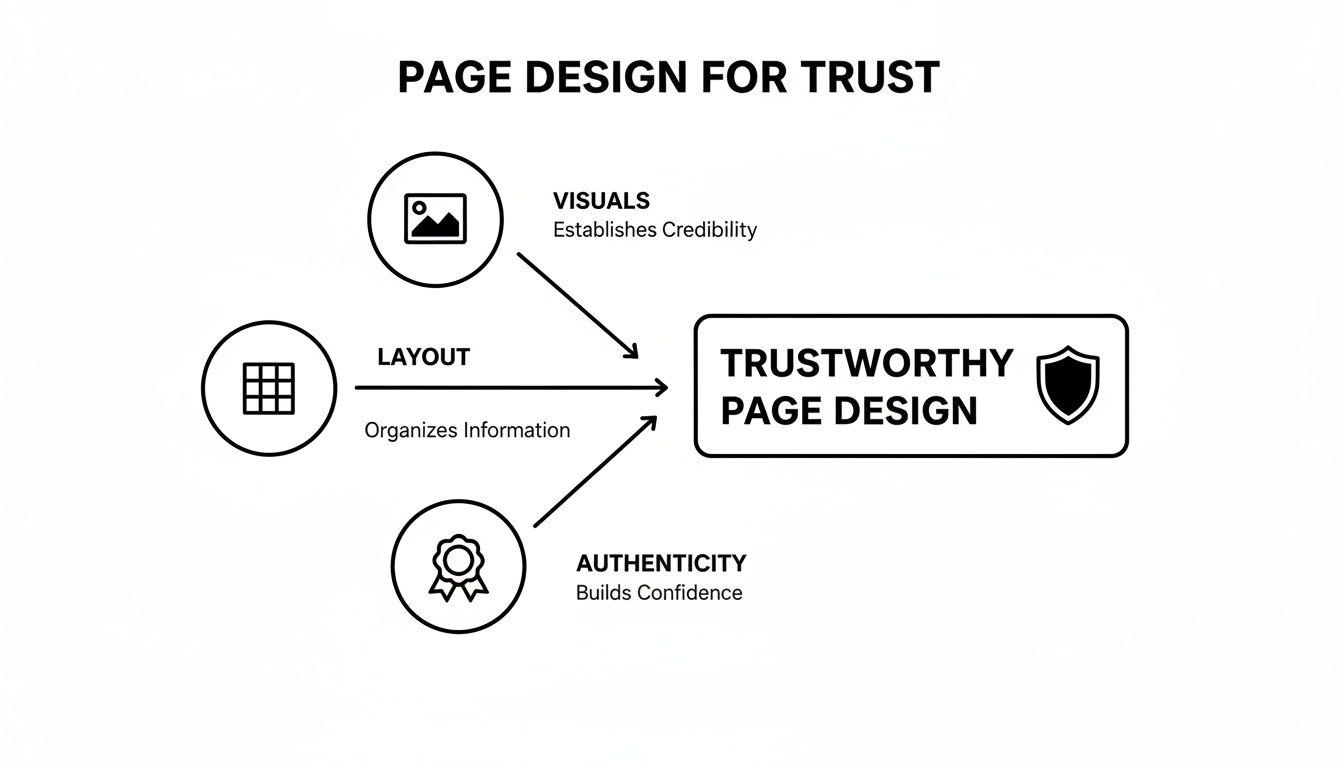
Trust is not built by a single element. It is the cumulative effect of multiple, credible moments where great design and authentic proof converge.
Product Pages: The Point of Maximum Hesitation
The product detail page (PDP) is where purchases are won or lost. This is where a customer's skepticism is highest. A generic, site-wide testimonial is ineffective here. You need specific proof that speaks directly to that product.
Position these reviews directly below the "add to cart" button or above the product description. Ensure they address common product-specific objections.
- Apparel: Use quotes that praise the fit, fabric feel, or sizing accuracy.
- Skincare: Feature testimonials from customers with specific skin types ("finally cleared my oily skin!") or ingredient concerns.
- Home Goods: Select reviews that speak to durability, ease of assembly, or how the product looks in a real home.
This strategic placement provides instant reassurance and makes the purchase decision feel safer. An effective tactic is using visual social proof, like embedding user-generated Instagram content on the PDP. We detail this strategy in our case study on integrating Instagram Stories as social proof.
Landing Pages: Bridging the Ad-to-Site Gap
For brands spending heavily on paid acquisition, the landing page determines ROAS. The goal is to create a seamless, trust-building path from the ad to the checkout. The best method is to display testimonials that mirror the exact message or creative from the ad campaign.
If your TikTok ad features a creator's review, that same video should be prominently featured on the landing page. This consistency signals to the visitor that they're in the right place and validates the ad's promise, immediately lowering their defense mechanisms.
Don't make them search for proof. Your landing page is your only chance to convince a cold visitor you’re legitimate. Social proof should be one of the first elements they see, not an afterthought.
Cart and Checkout: Reducing Last-Minute Abandonment
Cart abandonment is a silent killer of ecommerce revenue. When a customer reaches the checkout, they are confronted with shipping costs, taxes, and the finality of the purchase. It's a high-anxiety moment where the smallest doubt can cause them to leave.
A concise, reassuring testimonial can be incredibly effective here. Place a short, powerful quote directly in the cart or on the checkout page.
- "Best customer service I've ever experienced."
- "My order arrived in two days, beautifully packaged."
- "Worth every penny, the quality is incredible."
These snippets act as a final confidence boost, calming last-minute jitters and reinforcing their purchase decision. This isn't just theory. Simply adding customer reviews to product pages can lift sales by as much as 18%.
When you stop treating testimonials as static content and start using them as dynamic conversion tools, you build a more persuasive journey that guides customers from discovery to purchase.
Personalizing and Testing Your Social Proof
Showing the same generic testimonials to every visitor is a massive missed opportunity. Your customers are not a monolith, so your social proof shouldn't be either. The real conversion lift comes from personalizing the proof to match the visitor's context and intent.
This approach transforms your website testimonials page from a static asset into a dynamic conversion engine. It’s not just about showing five-star reviews, it’s about showing the right five-star review to the right person at the right time.
Dynamic Social Proof Based on Visitor Context
Imagine a user clicks through from a TikTok ad featuring a UGC-style video review. Instead of greeting them with a wall of formal text quotes, show them a curated collection of your best video testimonials from other TikTok users. This immediately reinforces the ad's message and creates a seamless, high-trust experience.
This level of personalization is achievable for Shopify Plus brands. Here are several high-impact ways to segment testimonials:
- Traffic Source: If a visitor arrives from an Instagram ad, feature UGC from Instagram. If they clicked a link in a Forbes article, highlight reviews from other notable publications. This validates their click and confirms they are in the right place.
- Geographic Location: A shopper in Los Angeles will connect more with a review from "Sarah K., Santa Monica" than "John D., London." Use geo-IP targeting to surface local testimonials first, making the social proof feel significantly more relevant.
- Browsing Behavior: If a visitor has been viewing products for sensitive skin, your page should dynamically feature reviews from customers who solved that exact problem.
The goal is to close the gap between a visitor’s problem and your product’s solution. Personalized testimonials do this instantly by showing them someone just like them who has already found success.
Running High-Impact A/B Tests
Once your foundation is solid, begin optimizing. Treat your testimonials page as a living experiment where you constantly test what resonates most with your audience. Skip minor tweaks like button colors and focus on major changes that can produce meaningful results.
Before you start, it's critical to understand your testing options. We've created a detailed guide comparing multivariate testing vs A/B testing that will help you select the right methodology.
To get started, here is a table of practical A/B tests that deliver results for DTC brands.
A/B Test Ideas for Your Testimonials Page
| Test Idea | Hypothesis | Primary KPI |
|---|---|---|
| Video vs. Text Testimonials | Placing a compelling video testimonial at the top of the page will build trust faster than a text quote, leading to a higher conversion rate. | Conversion Rate |
| Long-Form Stories vs. Short Quotes | A filterable grid of short, scannable quotes will see more interaction and drive more product page click-throughs than a few long-form case studies. | Click-Through Rate to PDPs |
| CTA Placement | Moving the primary CTA ("Shop Best Sellers") from the bottom of the page to a sticky header will increase its visibility and lead to more people adding to their cart. | Add-to-Cart Rate |
| Headline Variation | Changing the headline from "What Our Customers Say" to "Real Results from [Customer Persona]" will feel more relevant and increase how long people stay on the page. | Average Session Duration |
These are starting points for your own experiments. The key is to form a strong hypothesis and track the right metric to validate it.
Measuring What Matters
The only way to know if your tests are successful is to measure their impact on revenue-driving metrics. It’s easy to get lost in vanity metrics like page views, which don't tell the whole story.
Instead, focus on these three key performance indicators:
- Add-to-Cart Rate: Are your testimonials effectively convincing people to take the next step?
- Conversion Rate: This is the ultimate measure. Does the new version get more visitors to complete a purchase?
- Average Order Value (AOV): Do certain types of testimonials (e.g., those highlighting product bundles) encourage shoppers to spend more?
By continuously personalizing your social proof and running disciplined A/B tests, you transform your website testimonials page from a simple collection of quotes into a powerful, data-driven engine that directly grows your bottom line.
Take the Next Step
Building a high-converting website testimonials page is not a one-off project, it's a core part of an ongoing conversion optimization strategy. Start by implementing a systematic process for sourcing high-quality reviews. Then, strategically deploy that social proof at key friction points in the buyer's journey. Finally, commit to a cycle of personalizing, testing, and measuring to continuously improve performance.
Frequently Asked Questions
How do I get customers to leave testimonials?
Automate collection at three touchpoints: 7 days post-delivery for initial reactions, 21 days for usage feedback, and 60 days for long-term results. Incentivize participation with 10% discounts or $15 gift cards. For video testimonials, offer $50. Ask specific, leading questions rather than generic review requests.
What makes a testimonial page convert better than scattered reviews?
A dedicated page with filterable grids, real attribution (names, locations, photos), and aggregate ratings at the top builds concentrated trust. Real customer photos increase conversions by 48%. The page should also distribute key testimonials strategically across product pages, checkout, and landing pages.
Should I use video or text testimonials?
Both, and you should A/B test which performs better for your audience. Video testimonials build stronger emotional connection and trust but require more effort to collect. Text testimonials are easier to scan and filter. The best testimonial pages mix both formats and let visitors choose their preferred format.
Where else should I place testimonials besides the testimonials page?
Place relevant testimonials below the add-to-cart button on product pages (18% sales lift), match testimonials to ad creative on landing pages, and add reassuring quotes at checkout to reduce abandonment. Social proof should appear at every point where a customer might hesitate.
We work on tactics like these daily, book a call to get 3 custom (tailored for your business), researched personalization ideas to get you started.