

A Practitioner's Guide to Ecommerce Conversion Rate Optimization Services

[ SUMMARIZE WITH AI ]
[ FREE CRO TEARDOWN ]
Find the 3 biggest revenue leaks on your store.
Every day a conversion leak goes unfixed, you're paying for traffic that doesn't buy. Get a 5-minute Loom through your PDP, cart, and checkout, with mockups of the fixes. No pitch.
Get My TeardownEcommerce conversion rate optimization (CRO) is the disciplined practice of increasing the percentage of website visitors who make a purchase. It’s not about guesswork or chasing fleeting trends. For established DTC brands, it’s a systematic process of understanding user behavior to remove friction and build a more persuasive, profitable shopping experience. Instead of simply buying more traffic, CRO services focus on maximizing the value of the visitors you already have.
Why a Small Conversion Rate Lift Creates Massive Profit
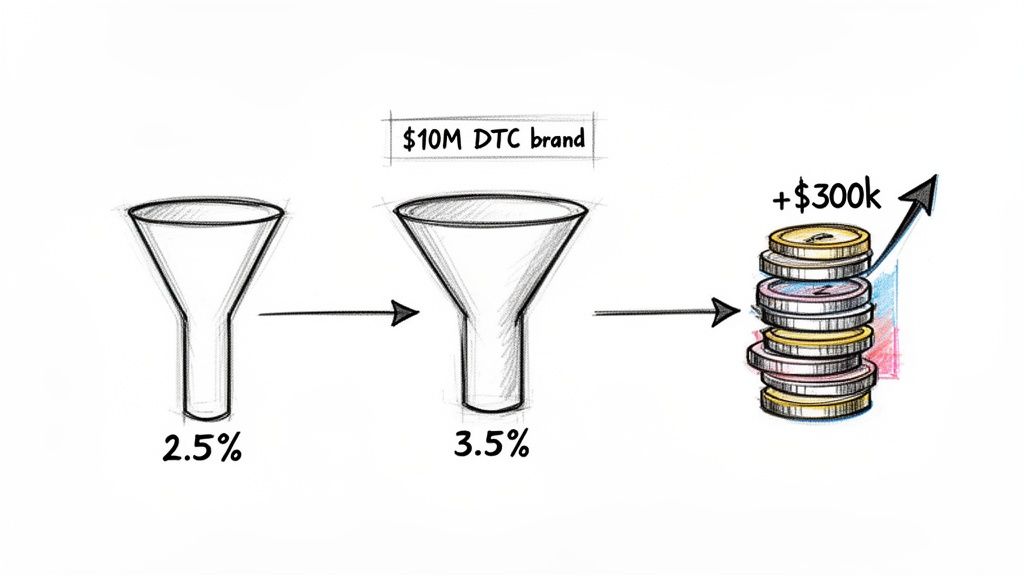
Many seven and eight-figure DTC brands operate with a conversion rate that seems acceptable. Industry benchmarks often hover around 2.5% to 3.0%, so falling within that range can create a false sense of security.
But "average" is a dangerous benchmark. It often means you have a leaky bucket, forcing you to overspend on acquisition to compensate for an underperforming website. Every paid click is devalued by a confusing checkout flow, a slow-loading product page, or a generic user experience that fails to connect with high-intent buyers.
This is where the leverage of incremental improvements becomes a powerful growth engine.
The Financial Impact of Incremental Gains
Let's ground this in real numbers. Consider a DTC brand generating $10 million in annual revenue with a 2.5% conversion rate. What happens if a structured CRO program increases that rate by just one percentage point to 3.5%?
The math is simple, but the outcome is transformative.
- Before: At 2.5%, 400 visitors generate 10 sales.
- After: At 3.5%, the same 400 visitors generate 14 sales.
That’s a 40% increase in sales from the exact same traffic. For the $10M brand, this translates into an additional $4 million in top-line revenue, scaling the business to $14 million annually without spending another dollar on customer acquisition.
This reframes the primary growth question from, "How do we get more traffic?" to "How do we convert more of the traffic we already have?"
From Expense to Investment
Viewing CRO through this lens transforms it from a marketing expense into a high-return investment. While a full 1% lift is significant, even a 0.25% improvement for a $10M store adds an extra $1 million in annual revenue.
The objective is to stop leaving money on the table. Every piece of friction removed from the checkout, every personalized offer shown to a specific customer segment, and every A/B test that validates a superior design contributes directly to the bottom line.
If you're ready to dig in further, you can explore proven strategies for conversion growth that form the foundation for scaling your brand profitably.
What a Modern CRO Service Actually Delivers
Let's cut through the jargon. When you engage a firm for ecommerce conversion rate optimization services, you are not just hiring a tactician to change button colors. A professional CRO program is a disciplined, data-driven process designed to understand your customers' motivations and translate those insights into measurable revenue growth.
For a Shopify Plus brand in the $3M to $200M range, this is a strategic partnership. The service provider operates on a continuous cycle of research, hypothesis, testing, and implementation. The singular goal is profitable, sustainable growth.
The Foundation: A Comprehensive Conversion Audit
Every effective optimization strategy begins with a deep diagnostic. This is not a cursory glance at your Google Analytics dashboard. A proper conversion audit is a forensic investigation of your entire customer journey, blending quantitative data with qualitative human feedback to uncover the most significant opportunities.
A thorough audit investigates:
- Analytics Data: Pinpointing specific drop-off points in your funnel, from landing pages to checkout steps.
- Heatmaps & Session Recordings: Observing how real users click, scroll, and encounter friction. This provides the "why" behind the quantitative data.
- Customer Surveys & Feedback: Directly asking customers about their experience to understand their pain points and what nearly prevented a purchase.
- Technical Performance: Identifying and rectifying silent conversion killers like slow load times, mobile rendering issues, and browser-specific bugs.
This initial research provides the evidence-based foundation for a strategic testing roadmap, ensuring every experiment is designed to solve a real problem.
From Insights to Action: The Testing and Personalization Engine
With a clear understanding of where friction exists, the execution phase begins. A modern CRO service builds a robust experimentation engine that delivers compounding wins over time.
The objective isn’t to find a single "silver bullet." It is to build a system of continuous improvement where each validated learning informs the next, creating a more profitable customer experience month after month.
This engine relies on two core components. Strategic A/B testing is the workhorse, used to validate high-impact ideas like a redesigned product page layout or a simplified checkout flow. For example, testing a single-page checkout against a multi-step process can reveal a clear preference among your specific audience.
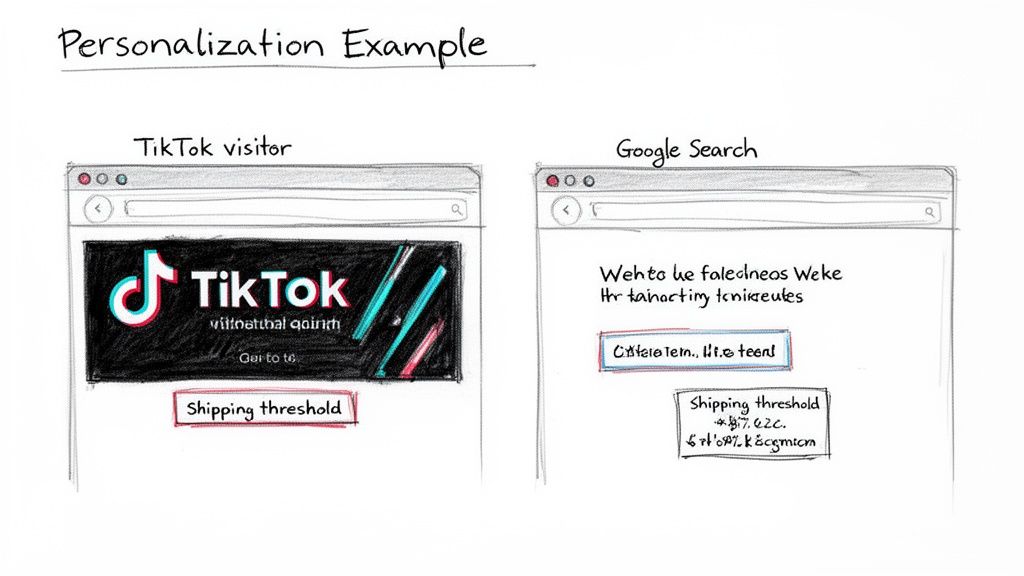
However, top-tier services extend beyond this with personalization strategies. This involves showing the right content to the right user at the right time. Your CRO partner might deploy a different homepage hero for a visitor arriving from a TikTok ad versus one who clicked a high-intent Google Search ad. This is about matching the message to the user's context and mindset.
For some great examples of strategies a CRO service might use, this practical guide on improving ecommerce conversion rates has some excellent ideas, especially for fashion brands.
Implementation and Ongoing Strategy
Finally, a true CRO partner does not simply deliver a report and walk away. They are deeply involved in implementation, collaborating with your development team to ensure winning variations are deployed correctly and efficiently. This can range from providing detailed technical specifications to directly assisting with code.
This creates a continuous loop. Insights from a winning test fuel the next round of hypotheses and experiments. This ongoing cycle is what distinguishes a one-off project from a true optimization program that drives sustainable growth. If you want to get into the nitty-gritty of this process, check out our guide on how to improve your ecommerce conversion rate.
Sorting Through the Different Types of CRO Services
When you begin searching for an ecommerce CRO partner, you will find that services vary widely. Offerings range from basic A/B testing to comprehensive site personalization, and the ideal fit depends on your brand's scale, budget, and strategic objectives.
Most CRO programs can be broken down into three core functions: auditing to identify problems, testing potential solutions, and providing support to implement those solutions.
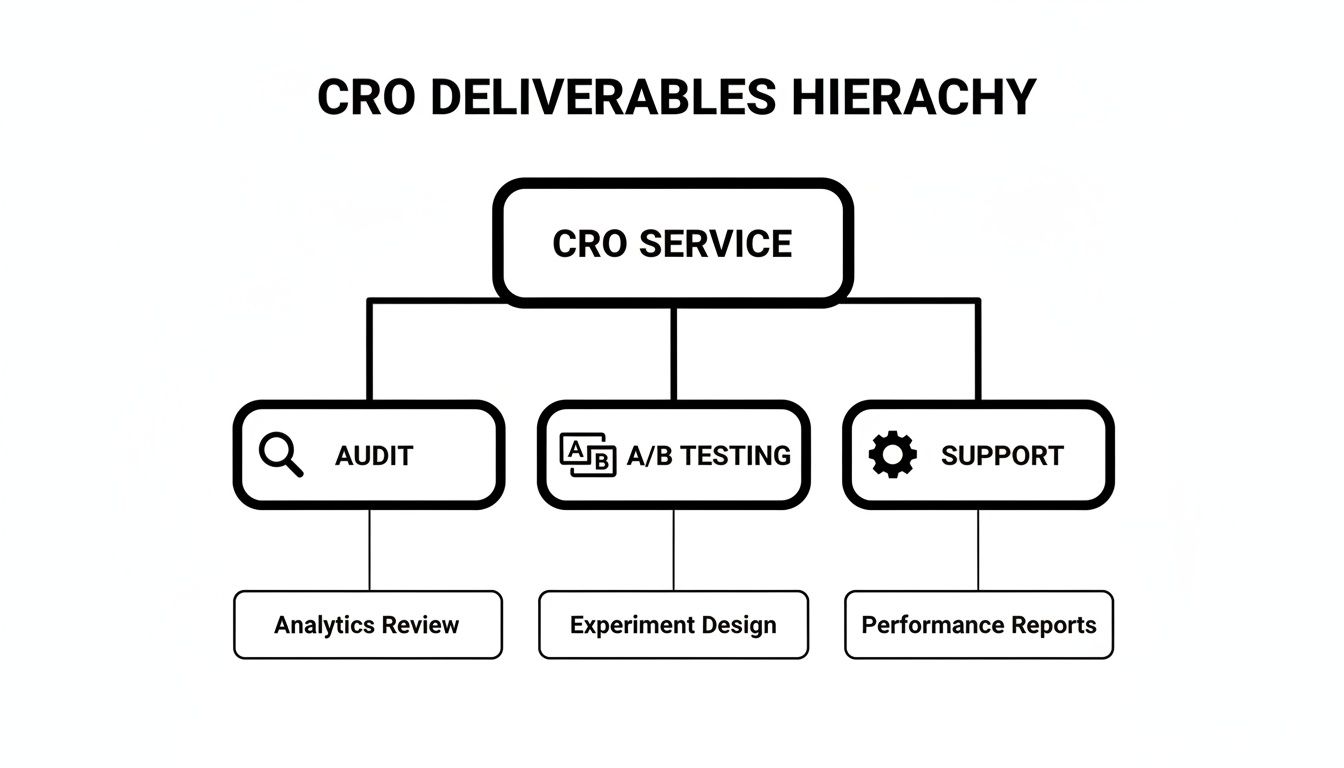
Think of it as a continuous cycle: diagnose the problem (audit), test the solution (A/B testing), and implement the cure (support).
Here are the three main types of providers you will encounter.
Tier 1: The Tool-Focused Consultant
This is the entry point for CRO. These are typically solo consultants or small teams focused on executing tests using common A/B testing software.
Their scope is often limited to surface-level changes: testing button colors, headlines, or minor layout adjustments. While this can be a good introduction, these tests often lack deep customer insight and may not address core user experience issues.
- Pricing: Typically by the hour ($100–$250/hr) or a small project fee.
- Best For: Brands under $3M in annual revenue who are just beginning to explore CRO and want to understand the basics without a significant financial commitment.
Tier 2: The Project-Based Agency
This tier includes agencies that offer CRO as a defined project, usually lasting three to six months. The engagement typically begins with an in-depth site audit that produces a structured roadmap of experiments.
This approach is more strategic, utilizing tools like heatmaps and user recordings to develop more impactful test hypotheses. The agency manages the entire testing process from start to finish.
The primary limitation is the fixed duration. Once the project concludes, the optimization momentum stops, and the responsibility shifts back to your internal team.
Tier 3: The Comprehensive Personalization Partner
At the highest level are strategic partners who move beyond conventional A/B testing into full-funnel personalization. The objective is not to find the single best version of a page for everyone, but to create a dynamic site experience that adapts to individual user segments.
A true personalization partner thinks bigger. Instead of asking, "Does a red or green button perform better?" they ask, "How can we show a different homepage to a first-time visitor from a TikTok ad versus a loyal customer who clicked through from our VIP email list?"
The focus shifts from simply testing elements to building a smarter, more profitable store. The goal is to maximize profit-per-visitor by delivering the most relevant message and offer to the right person at the right time.
These partners manage the entire process, from deep customer segmentation and data analysis to designing complex experiments and working directly with your developers on implementation. To get a better sense of the different experiments involved, check out our guide on multivariate testing vs. A/B testing. This approach creates a system of continuous improvement that delivers compounding returns.
- Pricing: Expect a monthly retainer, typically starting in the $8,000–$15,000+ range, reflecting the deep strategic work and hands-on partnership.
- Best For: Ambitious DTC brands with $3M–$200M in revenue who have outgrown basic CRO and are ready to invest in a profit-driven optimization engine.
Comparing CRO Service Models for DTC Brands
This table breaks down the differences between common CRO service models to help you identify the best fit for your brand's stage and goals.
| Service Model | Typical Scope | Pricing Model | Best For |
|---|---|---|---|
| Tool-Focused Consultant | Basic A/B testing of surface-level elements (e.g., buttons, headlines). | Hourly Rate or Small Project Fee | Brands under $3M annually, new to CRO. |
| Project-Based Agency | Comprehensive site audit followed by a structured 3-6 month testing roadmap. | Fixed Project Fee or Short-Term Retainer | Brands looking for a strategic, but time-boxed, CRO push. |
| Personalization Partner | Continuous, full-funnel optimization, segmentation, and personalization. | Monthly Retainer ($8k–$15k+) | Established brands ($3M+) ready for a long-term profit optimization program. |
Choosing the right partner requires an honest assessment of your current position and future ambitions. A consultant can provide a starting point, but a true partner can help you build a durable competitive advantage.
Setting Realistic CRO Goals and Benchmarks
Before committing to a CRO program, it is crucial to define what success looks like. While doubling your conversion rate overnight is unrealistic, sustainable growth is built on ambitious, data-driven goals. Without clear targets, you are operating without a map.
The key is to move beyond generic "industry averages" and focus on the performance metrics of top-tier DTC brands. Understanding the difference between "good" and "elite" performance provides you and your CRO partner with a tangible target.
Defining Good vs. Elite Performance
While conversion rates vary by industry and average order value, established benchmarks exist. Achieving a 3.2% conversion rate is a significant milestone, placing a brand in the top 20% of performers. It indicates that many elements of your user experience are already effective.
However, the purpose of investing in a premium CRO service is not just to be "good," but to become a category leader.
Elite performance, characteristic of the top 5% of DTC brands, typically begins at a 4.8% conversion rate or higher. Reaching this level signifies a customer journey that is so optimized and persuasive that it converts visitors at an exceptional rate. You can explore more data behind these figures in these recent conversion rate optimization statistics.
These benchmarks provide essential context. If your store currently converts at 2.1%, a strategic initial goal would be to reach the 3.2% mark and join the top quintile of brands.
Calculating the Real Revenue Impact
Understanding the benchmarks is one part of the equation; translating them into bottom-line impact is what builds the business case for CRO.
Consider a DTC brand with the following metrics:
- Monthly Visitors: 200,000
- Average Order Value (AOV): $150
- Current Conversion Rate: 2.5%
This brand currently generates $750,000 in monthly revenue (200,000 visitors x 2.5% CR x $150 AOV).
Now, assume a well-executed CRO program lifts the conversion rate from 2.5% to the "good" benchmark of 3.2%, an absolute increase of 0.7%.
The new calculation is:
- New Monthly Revenue: 200,000 visitors x 3.2% CR x $150 AOV = $960,000
That 0.7% lift generates an additional $210,000 in monthly revenue, equating to over $2.5 million in new annual revenue without any additional ad spend. This demonstrates how a high-impact optimization program functions as a profit multiplier for your brand.
Using Personalization to Drive Conversions
A one-size-fits-all website has a performance ceiling. Even with conventional A/B testing, you are optimizing for the average visitor, a user who does not actually exist. For ambitious DTC brands, significant profit growth comes from moving beyond this generic model to embrace personalization.
Personalization is not merely adding a first name to an email. It is the practice of creating dynamic, unique site experiences that adapt based on who is visiting. The strategic question shifts from, "What works best for everyone?" to "What works best for this specific user, right now?"
The underlying principle is that not all traffic is equal. A visitor arriving from a high-intent Google Search for a specific product is in a different psychological state than someone who casually clicked a link in a TikTok video. Presenting both users with the same generic homepage is a significant missed opportunity.
How Personalization Works in Practice
A true personalization program, a core component of modern ecommerce conversion rate optimization services, involves building distinct customer journeys for different user segments based on their origin, on-site behavior, and purchase history.
Here are a few practical examples:
- Traffic Source Segmentation: A user clicking from a TikTok ad could be directed to a landing page featuring the same creator or product from the video. In contrast, a user from a Google Ad for "vegan leather bags" would see a homepage hero exclusively showcasing your vegan leather collection, immediately validating their click.
- New vs. Returning Visitors: A first-time visitor might be greeted with a prominent "15% Off Your First Order" offer to secure the initial conversion. A loyal returning customer, however, might see a banner highlighting new arrivals or a reminder of their loyalty points balance, encouraging a repeat purchase.
- Lifecycle Stage Targeting: For a segment of VIP customers who have spent over $500, you can replace the standard "Free Shipping Over $75" offer with an exclusive "Free Expedited Shipping On All Orders" message. This small adjustment rewards their loyalty and reinforces their value to the brand.
These are not superficial changes. They are strategic adjustments designed to align with the user's context and intent, dramatically increasing the likelihood of conversion.
The core principle is that a more relevant experience is a more profitable experience. When customers feel understood by a brand, their trust increases, and so does their propensity to buy.
The Technology That Makes It Possible
Previously, this level of dynamic content was accessible only to large enterprises. Today, modern technology brings this capability to platforms like Shopify Plus. Advanced CRO agencies use sophisticated software to identify valuable customer segments, create tailored experiences, and deploy them in real-time without burdening your development team.
This technology stack enables rapid testing and implementation of different offers, messaging, and page layouts for specific audiences. You can dive deeper into the strategy behind this in our guide on what website personalization is and how it fuels growth.
For brands investing heavily in paid media, this is a game-changer. It ensures the promise made in an ad is immediately fulfilled on the landing page, creating a frictionless and persuasive path from click to conversion. This alignment between ad spend and the on-site experience is where personalization delivers its most significant ROI.
Your Checklist for Choosing the Right CRO Partner
Selecting an ecommerce CRO partner is a critical business decision. The right agency functions as a profit-generating engine. The wrong one can exhaust your budget with inconclusive tests.
Use this checklist to differentiate a true strategic partner from a mere testing technician during your evaluation process. These questions are designed to cut through the sales pitch and reveal their actual methodology for growing your business.
Strategic Alignment and Methodology
First, assess their core philosophy. A great partner does more than run A/B tests; they build a comprehensive strategy tied directly to your business objectives. They should be as focused on your customer segments and profit drivers as you are.
Ask them directly:
- How do you connect the on-site experience with our paid media campaigns? A strong answer will demonstrate an understanding of the entire customer journey, from ad to landing page. They should discuss creating tailored experiences for traffic from different channels, like TikTok versus Google Ads.
- What is your process for identifying and prioritizing our most valuable customer segments? A top-tier agency will describe a data-driven process of analyzing your customer data to find high-LTV cohorts or other key groups. A generic answer about "all visitors" is a red flag.
- Can you walk me through how you build a testing roadmap? Their process should be rooted in data. It must begin with a deep audit, customer journey mapping, and analytics, not just "best practices" or gut feelings.
You are looking for a partner who thinks like a business owner, focused on how each experiment increases profit-per-visitor, not just the conversion rate on a single page.
Technical Expertise and Platform Knowledge
An excellent strategy is ineffective if it cannot be executed flawlessly. Your CRO partner must have deep, hands-on experience with your ecommerce platform, especially if you operate on Shopify Plus.
Drill down on their technical capabilities:
- What is your team’s experience with the Shopify Plus ecosystem? They should be able to discuss specific apps, theme limitations, and how they manage integrations without negatively impacting site speed.
- How do you ensure your experiments do not harm our site speed or SEO? A competent team will have a clear process for performance testing. According to research from Google, a one-second delay in mobile load time can impact conversion rates by up to 20%.
- What does your quality assurance (QA) process look like before a test goes live? They must describe a rigorous protocol for testing across multiple devices and browsers to ensure data integrity.
Operations and Communication
Finally, understand how the partnership will function on a day-to-day basis. Look for transparency, clear communication, and a collaborative approach. This will determine if they will operate as an extension of your team or just another vendor.
Clarify their operational model:
- What is the cadence for communication and reporting? They should have a defined schedule, such as bi-weekly strategy calls and access to a real-time results dashboard.
- Who will be my day-to-day contact, and what is their background? Ensure you will be working with a seasoned strategist, not a junior account manager.
- How do you handle a losing test? An experienced agency views a "losing" test as a valuable learning opportunity that informs the next hypothesis. They should have a clear process for analyzing the results and iterating, not dismissing it as a failure.
Common Questions Answered
For brand owners and marketing leaders, practical questions are paramount before investing in a new growth strategy. Here are direct answers to the most common questions about ecommerce conversion optimization.
What’s a Realistic ROI from CRO?
The honest answer depends on your starting point, including current conversion rate and traffic volume. However, for a growing DTC brand, a well-structured CRO program should deliver a 3x to 5x return on investment at a minimum.
Consider this: a single winning experiment that increases your conversion rate by 0.2% could generate over $80,000 in new annual revenue for a $10M brand. With advanced personalization programs targeting high-value customer segments, it is not uncommon to see returns exceeding 10x the investment.
How Long Before We Actually See Results?
Quick wins, typically from technical fixes and obvious UX issues identified during the initial audit, can often be implemented within the first 30 days.
However, the significant, needle-moving results from strategic A/B testing generally begin to materialize within 90 days. The initial 4 to 6 weeks are dedicated to deep data analysis, audits, and building a strategic testing roadmap. After this foundational work, the first major experiments are launched, and you will see validated revenue gains compound month over month.
It is critical to understand that CRO is not a one-time project; it is an ongoing process. Customer behavior evolves, new competitors emerge, and your acquisition channels are constantly changing. A continuous program allows you to adapt and consistently uncover new growth opportunities.
Is This an Ongoing Thing?
Yes. The most successful brands treat CRO as a core business function, continuously testing, learning, and refining the customer journey. A one-off project may address immediate issues, but an ongoing partnership is what builds compounding growth and a long-term competitive advantage.
This continuous improvement cycle is how you not only outperform competitors but also ensure you are maximizing the profitability of every visitor you acquire.
Ready to move beyond guesswork and build a data-driven optimization engine that grows your bottom line? At CONVERTIBLES, we help Shopify Plus brands implement personalization strategies that drive real revenue. Schedule a strategy call with us today to discuss your growth objectives.