

A Practitioner's Guide to Improving Customer Lifetime Value

[ SUMMARIZE WITH AI ]
[ FREE CRO TEARDOWN ]
Find the 3 biggest revenue leaks on your store.
Every day a conversion leak goes unfixed, you're paying for traffic that doesn't buy. Get a 5-minute Loom through your PDP, cart, and checkout, with mockups of the fixes. No pitch.
Get My TeardownImproving customer lifetime value isn't about random tactics; it's about building a deliberate system that turns one-time buyers into your most profitable customers. For DTC brands operating between $3M and $200M, this is where sustainable growth originates. The focus must shift to what happens after the first purchase and how to personalize the entire journey from there.
From Generic Optimization to a Profit-Driven Engine
Many brands fall into the trap of treating conversion optimization as a one-size-fits-all game. They A/B test a button color or a headline, hoping for a magic lift across the entire site. This approach hits a revenue ceiling, fast.
Why? It ignores the most critical variable: the customer. A new visitor from a TikTok ad has a completely different intent than a five-time buyer who re-stocks every three months. Lumping them together guarantees mediocre results.
Real CLV/LTV growth comes from moving away from generic, site-wide changes and embracing segment-specific personalization. This means creating different versions of your store, your offers, your messaging, your entire experience, that speak directly to a customer’s intent, lifecycle stage, and purchase history. This is how you build a system for compounding profit.
The Four Pillars of a Modern CLV Strategy
A robust CLV program is an ongoing process built on four interconnected pillars. It's a flywheel that gains momentum with each rotation.
This table breaks down how each pillar works, moving from foundational data analysis to tactical execution and measurement.
| Pillar | Objective | Key Actions | Primary Metric |
|---|---|---|---|
| Precise Segmentation | Identify your most valuable customer cohorts. | Analyze RFM (Recency, Frequency, Monetary) data, survey responses, and buying behavior to map out high-value segments. | CLV per Segment |
| Ad-to-Site Continuity | Create a seamless journey from ad to purchase. | Align ad creative and messaging with the landing page and onsite experience for each specific segment. | Conversion Rate (by segment) |
| Targeted Personalization | Deliver relevant experiences to each segment. | Design unique offers, product recommendations, and messaging for high-value cohorts. | Average Order Value (AOV) |
| Rigorous Testing | Validate what actually drives growth. | Run controlled experiments (A/B tests) to measure the impact of personalization on key business metrics. | Revenue per Visitor (RPV) |
Each pillar builds on the last, creating a powerful, repeatable loop for growth.
This entire process is about creating a feedback loop: you segment, you personalize, you test, and you learn. Then you repeat the process, getting smarter each time.
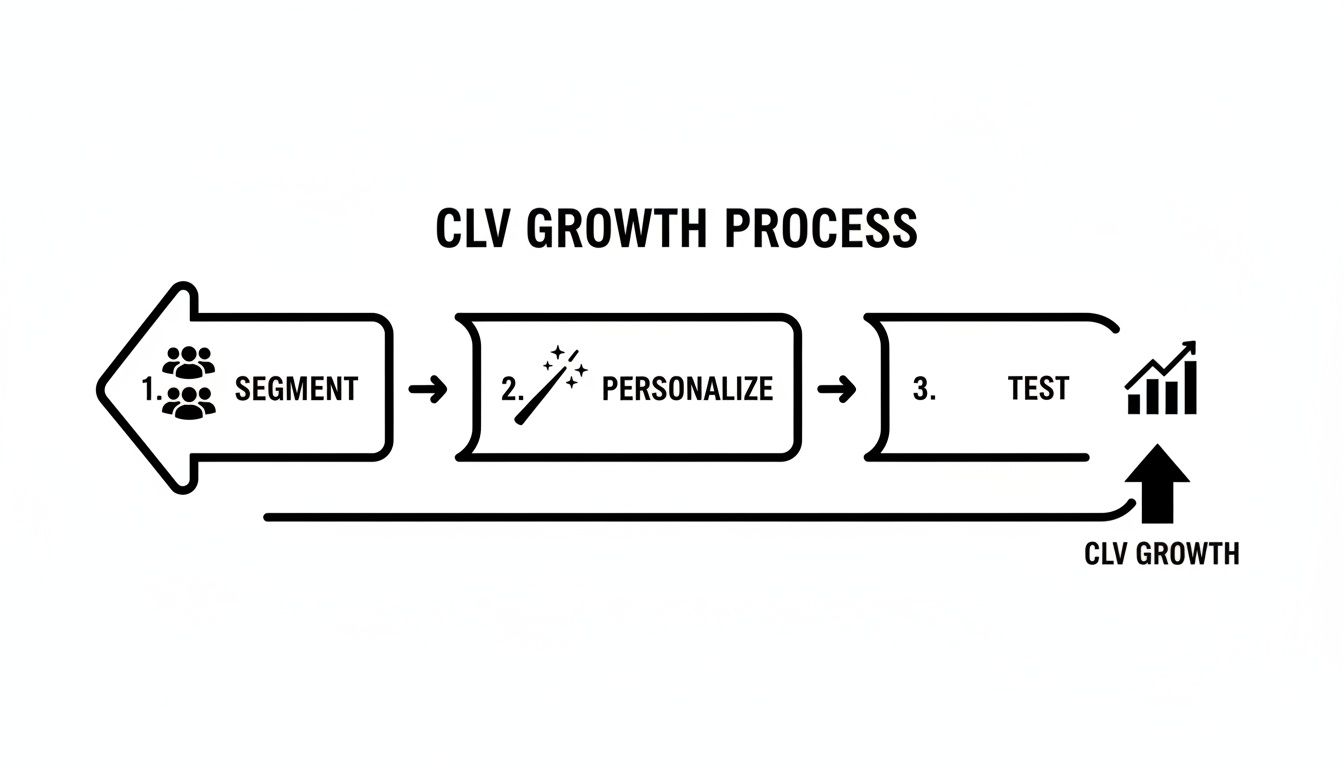
The goal here is to hit the 3:1 CLV-to-CAC ratio, a benchmark signaling a truly sustainable and profitable business. Personalizing the onsite experience is one of the most powerful levers you have to achieve it.
This isn't just about flashy tech. Something as fundamental as great customer service, a key part of a personalized experience, makes 93% of customers more likely to make a repeat purchase, according to HubSpot Research.
If you're ready to dig deeper, a good resource is to explore a complete small business playbook on increasing customer lifetime value.
Pinpoint the Customer Segments That Actually Drive Profit
If you're treating every customer the same, you're leaving money on the table. The fastest way to boost CLV is to identify your best customers and build experiences specifically for them. Forget generic personas; we're talking about digging into your data to map out real, targetable groups.
Everything you need to get started is in your first-party data. Tools like Shopify and Klaviyo are packed with customer information. It’s time to stop guessing and start looking for concrete patterns in how people buy from you.
Your Starting Point: RFM Analysis
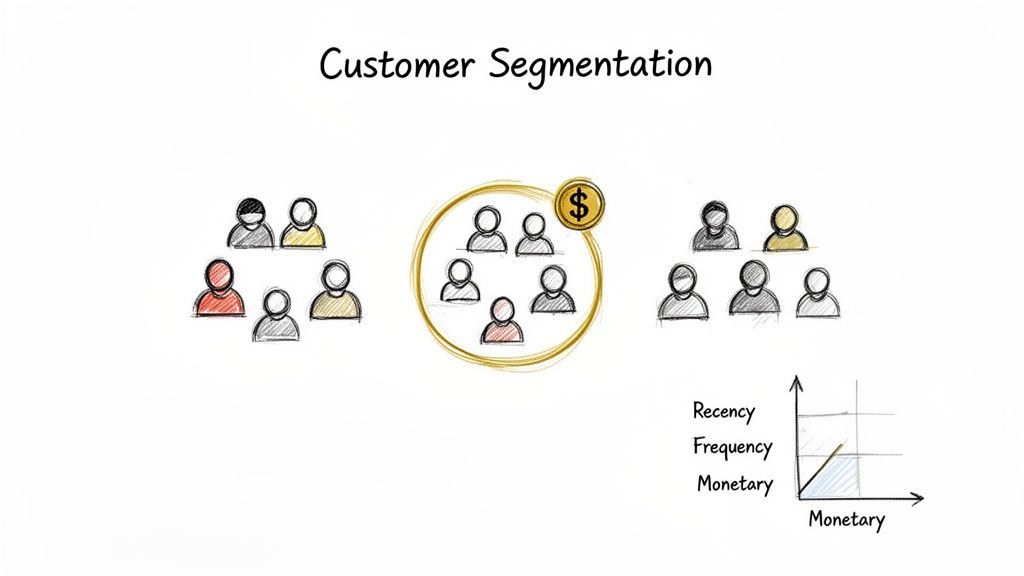
The classic RFM (Recency, Frequency, Monetary) model is the best place to begin. It's straightforward and incredibly effective for brands serious about CLV. RFM breaks down customer value by asking three simple questions:
- Recency: When was their last purchase?
- Frequency: How many times have they bought from you?
- Monetary: What’s their total spend?
By scoring customers on these three attributes, you can instantly see the difference between your VIPs, your one-and-done buyers, and those about to churn. A customer who bought last week (high Recency), has five orders (high Frequency), and has spent over $500 (high Monetary) is worlds away from someone who made a single $30 purchase six months ago. These are the people you build your strategy around.
Go Deeper with Product Affinity and Acquisition Source
RFM tells you who your best customers are, but adding product affinity and acquisition data tells you what they buy and why. This is where your segmentation strategy becomes powerful enough to directly impact conversion rates. The goal is to create small, specific segments that tell a clear story.
For example, you might find a group of customers who all came from a specific Google Ads campaign for "organic cotton sheets" and consistently have a 25% higher AOV than your site average. That’s a goldmine. It tells you this group is primed to spend more on premium items.
Or maybe you spot a segment of repeat buyers for a specific supplement who all found you through organic search. Their behavior practically screams "replenishment." You would never show these two groups the same homepage or send them the same email. For a documented example of how a homepage rebuild can speak directly to a premium-brand cohort, see our story-led homepage that lifted a premium brand $130K/month.
Build Your Core Segments
You'll likely uncover dozens of segments. Start with three to five core groups that represent your biggest growth opportunities.
Here are a few high-impact segments we see work time and time again:
- High AOV First-Time Buyers: Customers whose first purchase is in your top 20%. These people showed up ready to spend, so lean into that.
- Repeat Product Purchasers: Anyone who has bought the same product or from the same category three or more times. They’re your perfect audience for a subscription offer or a simple replenishment reminder.
- High-Intent, Low-Conversion Visitors: These are the people who browse multiple products and even add items to their cart but never check out. They’re on the fence and often just need a nudge, like a personalized offer or social proof, to get them across the finish line.
- Loyalty Program Members vs. Non-Members: Run a CLV comparison between these two. The results will either prove your loyalty program's ROI or show you exactly where you need to improve it.
Once you’ve defined these segments and built them out in your analytics and marketing tools, they become the foundation for everything. You're no longer throwing marketing ideas at the wall; you're creating precise, targeted experiences for the people who keep your business profitable.
Design Seamless Journeys from First Click to Checkout
A disjointed experience between your ad and your website is a silent profit killer. We've all been there: you click an ad for a specific product, only to be dumped on a generic homepage. That disconnect is deadly.
When someone clicks your ad, they have a specific expectation. Meeting that expectation instantly is the only way to keep their interest and guide them smoothly toward a purchase. This is the heart of ad-to-site continuity.
When you fail to connect these dots, you create friction. A user sees a Facebook ad for "vegan leather boots," clicks through, and lands on your main shoe collection page. Now they must start their search all over again. That moment of frustration is often all it takes for them to bounce, killing a potential high-value relationship before it starts.
Fixing this isn't guesswork. It's about engineering a frictionless path that makes buying from you feel intuitive. Getting this right not only boosts initial conversion rates but also sets the stage for repeat business, which is how you truly grow lifetime value.
Align Ad Creative with the Landing Page Experience
The handoff from ad to page happens in about three seconds. Your landing page must visually and textually match the ad that brought them there. This is a simple gut check for the user; it reassures them they’re in the right place.
Here’s what absolutely must line up:
- Headline Continuity: If your ad headline screams "20% Off All Winter Jackets," your landing page hero section must echo that exact offer. Don't make people hunt for it.
- Visual Consistency: Use the same product shot, model, or creative style from the ad on the landing page. It creates immediate familiarity and trust.
- Offer Parity: The discount or unique selling proposition from the ad needs to be front and center. No bait-and-switch.
A crucial part of designing a seamless customer journey from the first click to checkout involves optimizing the initial experience. For more insights on improving the customer onboarding process, it's vital to streamline these early interactions.
Personalize Onsite Elements Based on Ad Source
Real ad-to-site continuity goes beyond just matching headlines. The big wins come from personalizing the entire page experience based on where the traffic came from and what you know about that audience.
Imagine someone clicks a Google Ad for "performance running shoes." Instead of just dropping them on a standard product page, you can build a much more relevant experience on the fly.
For example:
- Personalized Hero Image: Show a hero banner of a runner, reinforcing the "performance" context of their search.
- Dynamic Collection Sorting: Automatically sort the product grid to show your best-selling running shoes first.
- Segment-Specific Social Proof: Feature reviews from customers who specifically mention running or athletics.
This level of personalization tells the shopper you understand their specific needs. It’s the difference between a generic department store and a specialty shop with a curated selection. When you create that relevance, you don't just increase the odds of a first sale; you start building the trust that fuels long-term loyalty.
Connect the Journey to Key Business Metrics
This isn't just about making things look nice. Every personalization tactic should be tied directly to a business goal. For those high-AOV segments we discussed, the goal might be to increase their initial basket size. For a customer who came from a discount-focused ad, the goal is a quick conversion, followed by an immediate introduction to your loyalty program.
Implementing these personalized journeys also gives you a powerful tool for boosting one of the most important metrics for profitability. You can find practical, step-by-step strategies in our comprehensive guide on how to increase average order value.
The key is to use the data from your ad platform to inform the onsite experience. UTM parameters are your best friend here. By passing info about the campaign, ad creative, and target audience through UTMs, you can use personalization tools to trigger these unique onsite experiences automatically.
By designing these seamless, personalized journeys, you stop treating all your traffic the same. You acknowledge the user's intent from the very first click and carry it all the way through to checkout. This creates a powerful system for turning new visitors into valuable customers from day one.
Turn First-Time Buyers Into Lifelong Fans With Smart Retention Tactics
Getting a customer is the opening act. The real, sustainable growth for brands in the $3M-$200M range comes from what happens after that first purchase. Your job is to ensure there’s a second, a third, and a fourth.
This is where you build your retention engine: a system that turns one-off transactions into genuine, long-term relationships. Forget generic email blasts. We're talking about specific, proven tactics that move the needle on purchase frequency and customer longevity, the two pillars of a high CLV.

Go Beyond Basic Points-for-Discounts Programs
Most loyalty programs are just glorified discount clubs. Customers rack up points, get a few bucks off their next order, and that's it. It’s a massive missed opportunity to build a real emotional connection.
True loyalty isn't just transactional. The best programs offer experiential rewards and a sense of exclusivity that money can't buy.
- Early Access to New Products: Give your top-tier members a 24-hour head start on new drops. It costs you nothing but makes them feel like true insiders.
- Exclusive Content: Think guides, tutorials, or behind-the-scenes videos that are only available to members. This adds value beyond the products themselves.
- Meaningful Tiers: Structure your program with clear levels (like Bronze, Silver, Gold) that unlock genuinely better perks. This gamifies the experience and gives customers a reason to consolidate their spending with you.
The goal is to make customers feel valued for their loyalty, not just their wallet. That's how you build a brand that people stick with for years.
Implement Smart Subscription and Replenishment Flows
If you sell consumables, subscriptions are the holy grail of CLV. But a rigid, "set it and forget it" model is a recipe for churn. The best subscription programs build in flexibility and feel like a service, not a trap.
Take a supplement brand. Instead of forcing everyone into a 30-day auto-ship, they could use purchase data to send smart, personalized reminders. If you know a customer typically reorders every 40 days, a simple "reorder now" email sent around day 35 is far more effective and less intrusive.
The key is to make the customer feel in control. Offering one-click options to skip a shipment, swap products, or push back a delivery date reduces the friction that causes cancellations. It's proactive management that turns a subscription into a convenience.
This logic extends to the post-purchase experience. The moment an order is confirmed is your golden opportunity to start teeing up the next one. Customize the order confirmation page with relevant cross-sells. Someone bought a coffee maker? Show them your best-selling beans and a high-end grinder, perhaps with a small, 48-hour-only discount to nudge them along.
For a deeper dive into making these experiences feel personal and relevant, check out our guide on what is website personalization. It gets into the nitty-gritty of using data to create these powerful touchpoints.
Use Post-Purchase Surveys to Fuel Future Sales
Want to know what a customer is going to buy next? Ask them. Post-purchase surveys are one of the most powerful and underused tools for boosting CLV.
But don't send a generic "How did we do?" survey. Get strategic. A couple of weeks after their product arrives, send a simple, one-question automated email.
- For a skincare brand: "What's your #1 skincare goal right now? A) Fighting fine lines, B) Clearing up acne, or C) Boosting hydration."
- For a fashion brand: "What's on your shopping list for next season? A) A casual weekend look, B) New work outfits, or C) Something for a special occasion."
Their answer is zero-party data you can immediately use to drop them into a new marketing segment. If they chose "Fighting fine lines," your emails and site experience should start highlighting your anti-aging products. This simple tactic closes the loop, turning direct feedback into a personalized roadmap for their next purchase.
Run a Testing Program That Delivers Measurable Wins
Great ideas are just ideas. They become valuable only once proven with real customer data. A powerful CLV strategy is built on a foundation of rigorous testing, not guesswork. This is where you shift from theory to tangible profit by building a personalization testing program that delivers consistent, measurable growth.
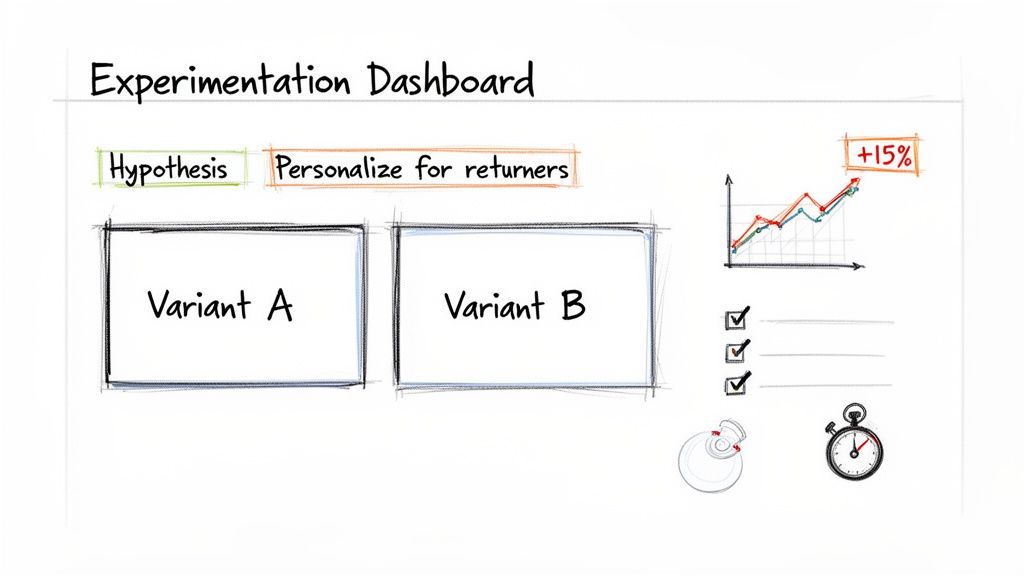
Every good test starts with a clear, specific hypothesis. You're not just throwing spaghetti at the wall. You're making an educated guess that can be proven or disproven with data.
A strong hypothesis isn't vague. It sounds something like this: “Personalizing the homepage hero for returning customers with products from their most-viewed category will increase the add-to-cart rate by 15%.” It's specific, measurable, and tied directly to a business outcome.
Building Your Testing Roadmap
Your testing roadmap should flow directly from your segmentation work. Prioritize experiments based on which segments will have the biggest impact on your bottom line. Always start with your high-value cohorts.
Here’s how to approach building a testing cadence:
- Start with High-Impact Segments: Go after your VIPs or High AOV First-Time Buyers first. A win with this group delivers an outsized return on effort.
- Focus on Key Pages: Concentrate your tests on high-traffic, high-impact pages like the homepage, collection pages, and product detail pages (PDPs). A small lift on these pages can create a massive ripple effect.
- Prioritize by Effort vs. Impact: Score every test idea on a simple scale. A high-impact, low-effort test, like changing a headline for a specific segment, should always jump to the front of the line.
Following a disciplined process like this, launching a few personalized experiences each month, creates a powerful compounding effect. Every validated learning builds on the last, systematically increasing your profit per visitor.
Interpreting Results and Scaling Winners
Once a test concludes, the real work begins. You must interpret the results correctly to make confident decisions. Look beyond the primary conversion metric and dig into secondary numbers like Average Order Value (AOV) and Revenue Per Visitor (RPV). Sometimes a test won't move the needle on conversion rate but will significantly boost AOV, making it a huge win.
When you have a statistically significant winner, don't just celebrate; scale it. Roll out the winning experience to 100% of that target audience and immediately start planning your next iteration. Ask, "What did we learn, and how can we apply that insight to another segment or part of the site?"
For brands on Shopify Plus, this means mapping those high-value segments and consistently testing two to four personalized experiences every month. We've seen this approach generate $60K-$110K in revenue from a single winning test for larger brands. While standard benchmarks might show a $375 CLV from a $50 AOV and a 2.5 purchase frequency over three years, layering in long-term loyalty can push that number far higher, crushing your customer acquisition costs. A 2023 report by Ordergroove found that the lifetime value for subscribers was 4-8x higher than for non-subscribers, showcasing the immense power of retention.
Diving into different testing methodologies is also key. For brands that want to test multiple changes at once, it's worth understanding the difference between multivariate testing vs. A/B testing to pick the right tool for the job. This ensures your program is not just consistent but also sophisticated enough to uncover complex user preferences and drive real growth.
Your First Step to Higher Customer Lifetime Value
All this theory is great, but it's useless without action. We've walked through the framework: mapping segments, personalizing the journey, building retention, and testing assumptions. Now it’s time to stop strategizing and start doing.
Don't let analysis paralysis creep in. Your immediate next step is simple: dive into your own customer data.
Pull your sales data from Shopify and your communication data from Klaviyo for the past 12 months. The mission here is to uncover your top three most valuable customer segments, based not on what you think they'll do, but on their actual purchase behavior.
This single exercise is the true starting point for systematically improving customer lifetime value.
Once you know exactly who your best customers are, the ones who buy repeatedly and spend the most, you can finally build the kinds of experiences that make them stick around. Pick one segment, run one test, and build momentum from that first small win.
Got Questions About CLV? We've Got Answers.
We get a lot of questions from DTC operators about how to actually move the needle on customer lifetime value. Here are a few of the most common ones we hear.
What’s a “Good” Customer Lifetime Value, Anyway?
This is the big one, but there’s no single magic number. A good CLV for a mattress company will be wildly different from a coffee subscription brand.
Instead of chasing a specific dollar amount, focus on the ratio of CLV to your Customer Acquisition Cost (CAC). This tells you how healthy and scalable your business really is.
For a growth-focused ecommerce brand, the gold standard is a 3:1 ratio. This means for every dollar you put into acquiring a customer, you get $3 back in gross profit over their entire relationship with you.
If your ratio is dipping below that, it’s a red flag. You might be paying too much to get customers in the door, or you’re struggling to keep them coming back.
How Do You Actually Calculate CLV?
You don't need a data scientist to get a baseline understanding. The simplest, most practical formula looks like this:
CLV = (Average Purchase Value x Average Purchase Frequency) x Average Customer Lifespan
Let's make that real. Say you dig into your store's data and find:
- The average customer drops $85 per order.
- They come back to buy 2.5 times a year.
- They typically stick around as an active customer for about 3 years.
Plug those numbers in: ($85 x 2.5) x 3 = $637.50.
Just like that, you have a benchmark. This $637.50 is your starting line, the number you'll work to improve with better retention and personalization efforts.
So, How Does Personalization Fit into All This?
This is where it gets interesting. Personalization isn't just about adding a first name to an email; it's a powerful lever that directly boosts every single part of that CLV formula.
When you tailor the experience, customers feel seen and understood. That relevance makes them more likely to buy, spend more, and stick around longer.
Think about it:
- Dynamically sorting a collection page based on someone's past browsing can bump up their Average Purchase Value because you're putting their favorite products front and center.
- Sending a perfectly timed replenishment reminder for a product they bought 30 days ago is a direct shot at improving their Purchase Frequency.
Each of these small, targeted experiences builds on the last. It’s how you turn a transactional, one-time buyer into a loyal, high-value fan who keeps contributing to your bottom line.
At CONVERTIBLES, we don't just talk about these strategies; we build and manage the personalization programs that make them a reality. We partner with Shopify Plus brands to create segment-specific experiences that drive real, measurable profit.
Ready to increase your profit per visitor? Let's talk.