

Customization and Personalization: A Profit Guide for Ecommerce (2026)

[ SUMMARIZE WITH AI ]
[ FREE CRO TEARDOWN ]
Find the 3 biggest revenue leaks on your store.
Every day a conversion leak goes unfixed, you're paying for traffic that doesn't buy. Get a 5-minute Loom through your PDP, cart, and checkout, with mockups of the fixes. No pitch.
Get My TeardownCustomization is when the customer controls the experience. Personalization is when your system controls it for them. Both increase profit per visitor, but through different mechanisms. Customization reduces friction by letting shoppers find and configure what they want. Personalization increases relevance by adapting the experience automatically based on data. The highest-performing Shopify Plus stores deploy both as complementary strategies.
This guide breaks down how each one works, where they overlap, and what we've seen drive real revenue in A/B tests across 8-figure ecommerce brands.
The Core Difference Between Customization and Personalization
The simplest way to think about it: customization requires the customer to act, personalization requires your system to act.
Customization is explicit. The customer makes a choice: selecting a filter, configuring a product, building a bundle, choosing a color. They are in control and they know it.
Personalization is implicit. Your site uses browsing behavior, purchase history, traffic source, or device data to shape the experience automatically. The customer doesn't have to do anything. The best personalized experiences feel natural, not intrusive.
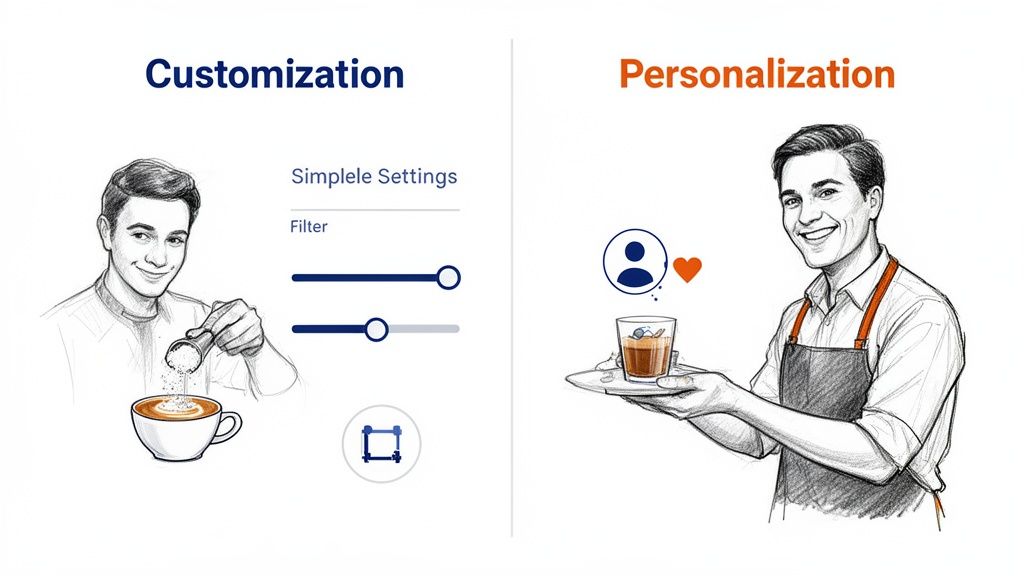
Think of it like a coffee shop. Customization is adding your own sugar at the condiment bar. Personalization is when the barista starts making "your usual" the moment you walk through the door.
| Attribute | Customization (Customer-Driven) | Personalization (System-Driven) |
|---|---|---|
| Who controls it | The customer makes explicit choices | The system uses data and algorithms |
| Data source | Direct customer input (clicks, selections, configurations) | Implicit data (browsing history, purchase data, traffic source) |
| Customer effort | High. They do the work. | Low. The experience adapts automatically. |
| Ecommerce example | Size filters, product configurators, build-your-own bundles | Dynamic homepage banners, personalized sorting, segment-specific offers |
| Primary benefit | Reduces friction, increases product fit | Increases relevance, reduces decision fatigue |
Understanding where customization ends and personalization begins matters because it changes how you build, measure, and optimize each one. For a deeper dive into the personalization side specifically, see our guide on what is website personalization.
Product Customization Features That Drive Revenue
Customization is often treated as a basic hygiene feature: filters, sort options, variant selectors. But the highest-performing Shopify Plus stores treat customization as an active conversion strategy. Every customization touchpoint is an opportunity to reduce friction, increase engagement, and guide the customer closer to purchase.
Smart Filtering and Sort Options
Most collection pages default to a hidden filter button that opens a modal. That forces the customer to do extra work. The better approach: surface the most important filters as visible, one-tap pills directly on the page.
The key is choosing the right filter criteria. In our testing, customer-centric filters (based on the customer's situation) consistently outperform product-centric filters (based on product attributes). A dog treat brand saw a +$39,779/month revenue increase when we tested dog size filter pills (Puppy, Small Dog, Medium Dog, Large Dog) against need-based, dietary, and product-type alternatives. Dog size won because it's objective, safety-relevant (choking hazards), and applies to nearly every visitor. Read the full filter strategy case study.
The lesson: don't just add filters. Test which filter taxonomy matches how your customers actually think about their purchase decision.
Guided Product Finders
A product finder (or quiz) is customization at its most powerful. Instead of making the customer browse and compare, you ask them a few questions and surface the right products for them.
For the same dog treat brand, we tested a need-based product finder on the homepage: "TREATS FOR EVERY PUP" with four categories (Powerful Chewers, Picky Eaters, Sensitive Stomachs, Training Rewards). This replaced a standard bestseller grid. The result: +$17,813/month in incremental revenue. The guided approach reduced cognitive load and got customers to product pages faster. Read the full product finder case study.
Product finders work because they flip the experience from "browse and figure it out" to "tell us what you need and we'll show you." That's customization working as a conversion driver, not just a navigation feature.
Product Configurators and Build-Your-Own Options
For brands selling configurable products, 3D product visualizations and configurators let customers build exactly what they want: choosing materials, colors, components, or engravings. This type of customization serves two purposes. First, it increases willingness to pay because the customer feels ownership before they buy. Second, it reduces returns because the customer chose exactly what they wanted.
Build-your-own bundles are the most accessible version of this for Shopify brands. Let customers pick their items instead of pre-selecting them. When customers invest effort in creating their own combination, they're more committed to the purchase. For more on how to present bundle options effectively, see our guide to price bundling examples.
How Personalization Multiplies the Effect
Customization gives customers control. Personalization makes that control smarter. When you layer personalization on top of customization features, you get compounding returns.
According to McKinsey, 71% of consumers expect businesses to deliver personalized interactions. And fast-growing companies generate 40% more revenue from personalization than their slower-growing competitors. This isn't a nice-to-have anymore. It's table stakes for scaling brands.
Here's how personalization works alongside customization:
- Personalized defaults in customization tools. A product configurator that starts with suggested options based on past purchases removes a step. A filter page that remembers a returning customer's last selections saves time.
- Segment-specific offers and messaging. A first-time visitor from a discount-focused ad sees "15% off your first order." A VIP with 5+ purchases sees "Early access to new arrivals." Same store, different experience. Same checkout, different motivation.
- Dynamic cart and checkout optimization. We tested personalized cart drawer messaging for an 8-figure brand: simple progress messaging ("You've got 4 Free Gifts! Add 1 more slime to get more Free Gifts") drove +$50,099/month. More complex visual displays with doubled emphasis actually performed worse. Clarity wins. Read the cart drawer case study.
For a hands-on look at how to understand and use your customer data for content personalization, start with your existing analytics: traffic source, device, purchase history, and on-site behavior are all signals you already have.
Want to see more personalization in action? Our post on ecommerce personalization examples breaks down seven specific implementations for Shopify brands, and our guide to behavioral segmentation covers how to build the segments that power these experiences.
Where Customization and Personalization Overlap
The most profitable ecommerce experiences combine both. A customer starts with customization (choosing their preferences) and the system uses that data for personalization (adapting future visits based on those choices).
Real examples of the overlap:
- Saved preferences that power future visits. A customer selects "Large Dog" in the filter pills. On their next visit, the collection page automatically sorts by large-dog-friendly products. The initial filter was customization. The remembered preference is personalization.
- Quiz results that feed segment data. A skincare brand's product quiz asks about skin type and concerns. The quiz itself is customization (customer-driven input). But the answers feed into a customer segment that personalizes homepage content, email flows, and product recommendations on every future visit.
- Bundle selections that inform upsells. A customer builds their own supplement bundle. The system uses those choices to suggest complementary products at checkout and in follow-up emails. Customization creates the data. Personalization deploys it.
This feedback loop is where the real compounding happens. Each customization interaction teaches your system something about the customer, making future personalization more accurate and more profitable.
Real Test Results: Customization and Personalization in Action
Theory is useful. Dollar figures are better. Here are four A/B tests from our work with 8-figure Shopify brands that demonstrate how customization and personalization features directly impact revenue.
| Test | Type | What Changed | Monthly Revenue Impact |
|---|---|---|---|
| Collection page filter pills (dog size) | Customization | Visible filter pills replacing hidden filter modal | +$39,779/mo |
| Need-based product finder | Customization | Guided category navigation replacing bestseller grid | +$17,813/mo |
| Cart drawer gift tier messaging | Personalization | Dynamic progress messaging based on cart contents | +$50,099/mo |
| Product pricing optimization | Personalization | Asymmetric pricing across product pairs | +54.7% profit/visitor |
The pattern across all four tests: the winning variations made the experience more relevant to the customer's specific situation. Filters that matched how customers think about their purchase. Navigation that answered "which product is right for me?" before showing products. Cart messaging that showed clear progress toward a reward. Pricing that reflected actual willingness to pay.
Every one of these tests was run with Intelligems, a testing platform built for Shopify Plus that measures profit per visitor, not just conversion rate. That distinction matters because a test can lift conversions while simultaneously killing margins.
Implementation Roadmap for Shopify Plus
You don't need to launch everything at once. Start with the highest-impact, lowest-complexity features and build from there.
Phase 1: Audit Your Current Customization Tools (Week 1-2)
Before building anything new, evaluate what you already have. Most Shopify stores have basic filters and sort options, but they're often buried behind modals or using generic product-attribute taxonomies that don't match how customers think.
- Map every customization touchpoint: filters, sort options, variant selectors, search, size guides
- Check if your filter taxonomy is product-centric (by attribute) or customer-centric (by need/use case)
- Identify the biggest drop-off points in your collection-to-PDP flow
Phase 2: Add Guided Selling (Week 3-4)
Introduce at least one guided selling feature: a product quiz, a need-based category navigation, or a "help me choose" flow. These are high-impact customization tools that also generate first-party data for future personalization.
- Start on your highest-traffic collection page or homepage
- Keep it to 2-4 questions maximum. More questions means more drop-off
- Use the quiz responses to build customer segments in your CRM
Phase 3: Layer Personalization on Top (Month 2-3)
Once you have customization data flowing, use it to power personalized experiences. Start with your highest-traffic pages and your most clear-cut segments.
- Personalize homepage hero banners by traffic source (paid social vs. paid search vs. direct)
- Customize collection sort order for returning customers based on past purchase behavior
- Test segment-specific offers: welcome discounts for new visitors, loyalty perks for VIPs
Phase 4: Test, Measure, Compound (Ongoing)
Every customization and personalization change should be an A/B test, not a gut-feel rollout. Measure profit per visitor by segment, not just sitewide conversion rate. Winners compound over time as each test teaches your system more about what different customer segments respond to.
Frequently Asked Questions
What is the difference between customization and personalization in ecommerce?
Customization is customer-driven: the shopper actively chooses options like filters, configurations, or bundles. Personalization is system-driven: your site automatically adapts content, offers, and layout based on data like browsing behavior, purchase history, and traffic source. Both improve conversion rates, but customization requires customer effort while personalization happens automatically.
Should I implement customization or personalization first?
Start with customization. Smart filters, guided product finders, and bundle builders are simpler to implement on Shopify Plus and they generate the first-party data that powers effective personalization later. Once customers are interacting with customization tools, you have the behavioral signals needed to build meaningful personalization segments.
How do I measure ROI on customization and personalization features?
A/B test every change and measure profit per visitor by segment, not just sitewide conversion rate. A feature might lift conversions for new visitors while hurting VIP performance. Segment-level data reveals what's actually working. Tools like Intelligems are built specifically for this type of Shopify Plus testing.
How much do customization and personalization features cost to implement on Shopify?
Basic customization improvements like better filters and guided navigation can often be done within your existing Shopify theme. Product configurators and quizzes typically require an app ($50-200/month) or custom development. Personalization platforms range from $200-2,000+/month depending on sophistication. The key is starting with high-impact, low-complexity changes: a well-placed filter redesign can drive $39K+/month in revenue before you invest in complex tooling.
Convertibles helps Shopify Plus brands build customization and personalization strategies that increase profit per visitor. If you want a segment-driven approach instead of generic CRO, book a 30-minute strategy call.