

8 Price Bundling Examples That Actually Increase AOV (2026)

[ SUMMARIZE WITH AI ]
[ FREE CRO TEARDOWN ]
Find the 3 biggest revenue leaks on your store.
Every day a conversion leak goes unfixed, you're paying for traffic that doesn't buy. Get a 5-minute Loom through your PDP, cart, and checkout, with mockups of the fixes. No pitch.
Get My TeardownPrice bundling is a sophisticated lever for improving profit per visitor, not just a tactic for a quick AOV lift. For growth-stage DTC brands, it’s about optimizing unit economics and boosting customer lifetime value. Generic "buy one, get one" offers fail with discerning customers who expect personalized, relevant solutions. Moving beyond basic discounts is essential for scaling profitably. For a deeper dive into optimizing your sales approach, explore how to maximize profits with various bundling strategies in ecommerce.
This article breaks down eight advanced examples of price bundling we implement for high-growth brands. We move past the obvious to show you how to build strategic offers that convert. Each example is a mini-playbook, complete with:
- The Mechanics: A breakdown of how the bundle is structured and presented.
- Ideal Customer Segment: Who to target for maximum impact.
- Expected KPIs: The specific metrics you can expect to improve.
- Implementation & A/B Test Ideas: Actionable steps for launching and optimizing the bundle.
This isn’t a theoretical guide. It's a collection of replicable strategies for operators who need measurable lift from their conversion optimization efforts. We'll show you how to leverage segmentation and personalization to create bundles that feel like a curated solution, not just a sale. Let's get into the examples.
1. Tiered Subscription Bundles with Segment-Specific Pricing
This strategy involves creating multiple subscription tiers, such as Basic, Premium, and VIP, each offering a distinct package of products or benefits. The core idea is to cater to different customer segments by aligning price points with perceived value, allowing a brand to capture a wider range of customers than a single-price model ever could. A budget-conscious shopper might choose a basic tier, while a loyal brand advocate will gladly pay for premium perks.
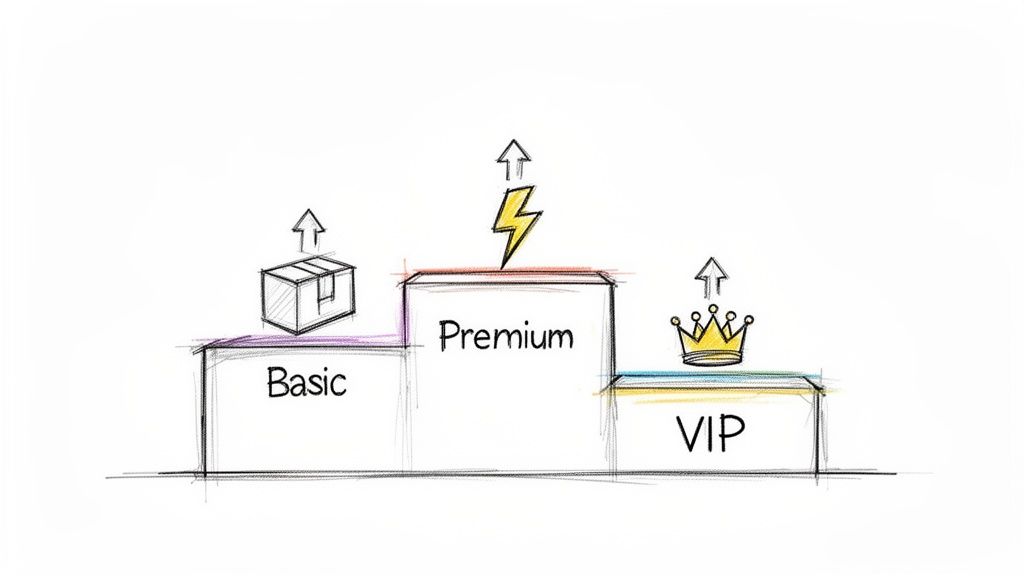
This approach is one of the most effective examples of price bundling because it directly links your offerings to customer motivation and spending capacity. By personalizing which tiers are presented based on user behavior (like past purchase value or browsing history), you can significantly increase conversion rates and average order value.
Strategic Breakdown & Implementation
- Bundle Mechanics: Create 3-4 distinct tiers. The lowest tier offers a basic product assortment at an accessible price. The middle tier, often the most profitable, provides the best value. The highest tier includes exclusive products, early access, or premium services for your most dedicated customers.
- Ideal Customer Segments: This model works for nearly any DTC brand with a consumable product or loyal repeat customer base. It allows you to serve new, price-sensitive customers and high-spending VIPs simultaneously.
- Expected KPIs: Key metrics to track are Average Revenue Per User (ARPU), Customer Lifetime Value (CLV), and Subscription Conversion Rate. A well-executed tiered strategy should improve all three. For a deeper dive into this, explore ways of improving customer lifetime value.
Actionable Takeaways & A/B Test Ideas
- Highlight the "Best Value" Tier: Use visual cues like a colored border, larger font, or a "Most Popular" banner to guide users toward the middle tier, which typically offers the best balance of margin and value.
- Personalize Tier Presentation: Use a personalization engine to show different default tiers to different segments. For a first-time visitor from a discount-focused ad, pre-select the Basic tier. For a returning VIP customer, showcase the Premium or VIP option first.
- Test Segment-Specific Messaging: For your budget segment, frame the bundle with "Save More" or "Best Value" messaging. For your premium segment, use language like "Exclusive Access" or "Limited Edition."
- A/B Test Pricing Thresholds: Use a tool like Intelligems to continuously test price points for each tier. You might find that a $5 increase in your premium tier has a minimal impact on conversions but significantly boosts your margins.
For a documented example of tier-level value framing in practice, see our subscription buy-box value-breakdown test that lifted conversion 18% on a Shopify Plus brand.
2. Product + Service Bundles for Increased Cart Value
This price bundling strategy combines a core physical product with a complementary service, such as installation, customization, an extended warranty, or premium support. The goal is to enhance the perceived value of the core product and significantly increase the average order value (AOV) by upselling a high-margin service at the point of purchase. For DTC brands, this is a powerful way to differentiate from competitors who only sell the product.
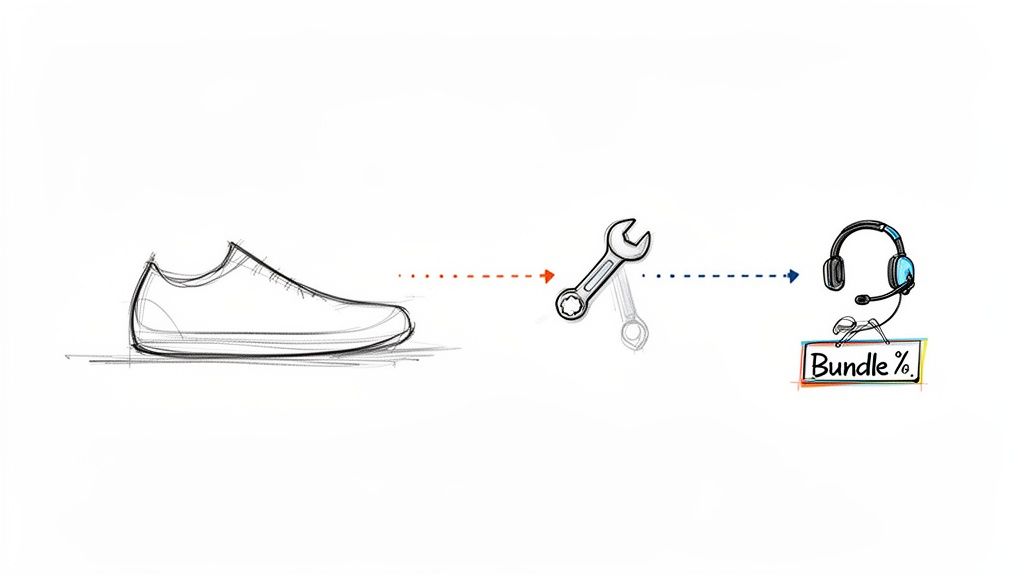
This method is one of the most effective examples of price bundling because it addresses customer pain points beyond the initial purchase. For instance, a customer buying complex furniture might be anxious about assembly; offering an installation service bundle removes that friction. To maximize revenue from each customer, explore proven strategies for increasing Average Order Value, which often includes strategic price bundling.
Strategic Breakdown & Implementation
- Bundle Mechanics: Identify high-friction points in your customer journey that a service could solve. For example, Warby Parker pairs glasses with free home try-ons and lifetime adjustments. Peloton bundles its hardware with installation and a mandatory content membership, turning a one-time purchase into a recurring revenue stream.
- Ideal Customer Segments: This is highly effective for brands selling products that are complex, require setup, or have a high perceived value. It appeals to customers who prioritize convenience and peace of mind over the lowest possible price, making it ideal for affluent or time-poor segments.
- Expected KPIs: The primary metrics to monitor are Average Order Value (AOV), Service Attachment Rate, and Customer Lifetime Value (CLV). A successful implementation will see a direct lift in AOV and a corresponding increase in long-term customer loyalty and CLV. For more on this, check out our guide on how to increase average order value.
Actionable Takeaways & A/B Test Ideas
- Test Placement for Maximum Uptake: Offer the service bundle on both the Product Detail Page (PDP) and in the cart. A/B test which placement drives a higher attachment rate without hurting the core product conversion rate.
- Use Social Proof to Drive Adoption: Use pre-checkout messaging like "85% of customers add professional installation" or "Recommended for you" to build confidence and leverage social proof.
- Personalize Service Offers: Don't show the same service bundle to everyone. For a high-value product, push an "extended warranty" or "premium support" bundle. For first-time buyers of a complex item, highlight the "expert setup" service.
- A/B Test Your Discount Structure: Experiment with how you frame the value. Test a specific percentage discount (e.g., "Save 15% on installation when you bundle") against a fixed dollar amount or offering the service for "free" with a higher-priced product package. Check out our case study on $ vs % offers.
3. Frequency-Based Volume Discounts and Auto-Replenishment Bundles
This price bundling strategy incentivizes customer loyalty by offering discounts on products purchased in larger quantities or through a recurring subscription. The core concept is trading a lower per-unit price for higher, more predictable customer lifetime value. By bundling a recurring purchase (e.g., a monthly auto-shipment) with an upfront discount, brands like Dollar Shave Club and Liquid IV transform one-time transactions into a stable revenue stream.
This approach is one of the most powerful examples of price bundling for brands with consumable products because it directly addresses two key business goals: increasing average order value and locking in future sales. It automates the repurchase process, removing friction for the customer while boosting retention and predictability for the business.
Strategic Breakdown & Implementation
- Bundle Mechanics: Offer customers a discount (e.g., 10-20%) for committing to auto-replenishment on a set schedule (e.g., every 30, 60, or 90 days). Another variation is offering a tiered discount for buying a multi-month supply upfront, such as "Buy a 3-month supply and save 15%."
- Ideal Customer Segments: This model is perfect for brands selling consumables like supplements, coffee, personal care items, or pet food. It appeals to busy, routine-driven customers who value convenience and savings and have already demonstrated a preference for your product.
- Expected KPIs: The primary metrics to monitor are Subscription Cohort Retention, Customer Lifetime Value (CLV), and Repeat Purchase Rate. A successful implementation will show a significant lift in CLV for the subscribed cohort compared to one-time purchasers.
Actionable Takeaways & A/B Test Ideas
- Present the Offer at the Right Time: Use personalization to trigger the subscription bundle offer. For a customer who has purchased the same SKU twice in 60 days, display a pop-up or on-page banner offering a "Subscribe & Save" option on their third visit.
- Test Commitment Length vs. Discount: Segment your customers and A/B test different commitment levels. A high-LTV cohort might convert on a 6-month commitment for a 20% discount, while a new customer may need a 10% discount for a simple monthly renewal.
- Frame the Value Proposition: Test messaging to different segments. For price-sensitive shoppers, lead with "Save 20% on every order." For convenience-focused customers, use messaging like "Never run out again."
- A/B Test Cart-Level Upsells: When a customer adds a popular consumable to their cart, trigger an upsell module that clearly shows the savings of switching to a subscription or buying a 3-month bundle. Display the math in real-time: "You save $12 by subscribing today."
For a documented example of cart-level threshold framing, see our cart-drawer free gift progress bar test that added $50K/month.
4. Cross-Category Product Bundling with Personalized Recommendations
This strategy involves bundling complementary products from different categories at a discounted price, often presented dynamically based on customer behavior. Instead of just offering a multi-pack of the same item, you create curated kits that solve a complete problem or fulfill a broader need. For example, a skincare brand bundles a cleanser, serum, and moisturizer, or an outdoor gear company pairs a backpack with a water bottle and hiking poles. The goal is to increase basket size while improving the discovery of adjacent product lines.
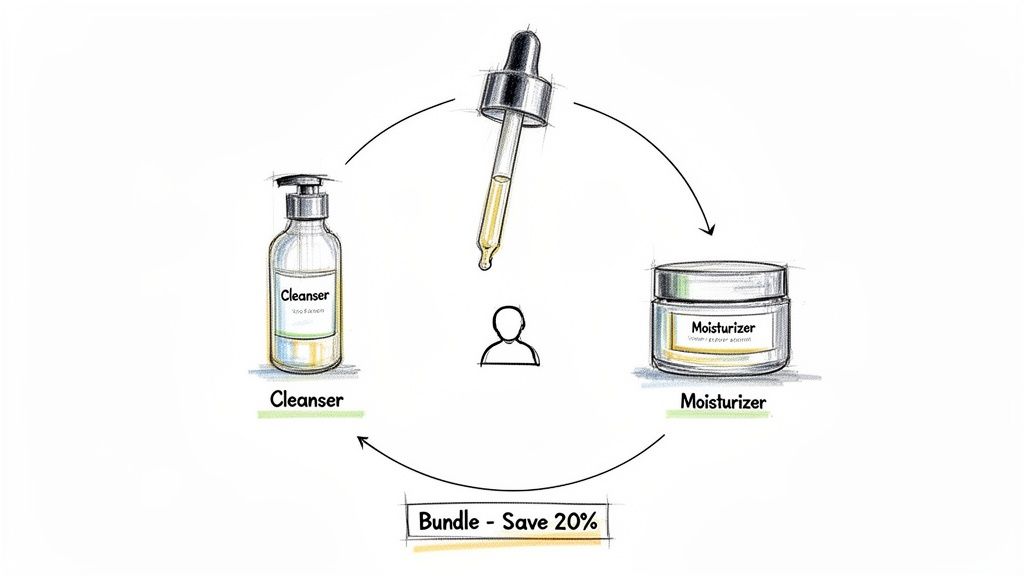
This is one of the most powerful examples of price bundling because it uses customer data to guide purchasing decisions. By recommending bundles based on browsing history, past purchases, or segment profiles, you remove decision paralysis and present a compelling, high-value offer. The personalization element transforms a simple discount into a thoughtful, curated customer experience.
Strategic Breakdown & Implementation
- Bundle Mechanics: Identify logical product groupings that form a complete "solution" (e.g., a "Morning Routine" or "New Runner's Kit"). Offer these as a single unit with a clear discount, such as "Save 20% when you buy the set." The key is to make the bundle more convenient and valuable than buying each item separately.
- Ideal Customer Segments: This works exceptionally well for both new and repeat customers. New customers benefit from curated starter kits that simplify their first purchase. Repeat customers can be targeted with "upgrade" or "expansion" bundles that introduce them to new categories based on their known preferences.
- Expected KPIs: The primary metrics to watch are Average Order Value (AOV), Units Per Transaction (UPT), and Product Attach Rate. A successful cross-category bundle strategy will lift all three by encouraging customers to purchase more items in a single order.
Actionable Takeaways & A/B Test Ideas
- Personalize PDP Recommendations: Use a customer’s browsing and purchase history to dynamically display relevant bundles on product detail pages. If a user is viewing a foundation, show them a "Flawless Face" bundle that includes the matching primer and setting spray. For more insight, explore the fundamentals of what website personalization is.
- Segment by Lifecycle Stage: Present "Foundation" or "Starter" bundles to new visitors to ease their entry into your brand. For loyal, repeat buyers, create "Advanced" or "Expansion" bundles that encourage them to try products in categories they haven't explored yet.
- Test Discount Elasticity: Don't assume a standard 20% discount is optimal. Run A/B tests on your bundle discount levels (e.g., 10%, 15%, 25%) to find the sweet spot that maximizes conversion rate without unnecessarily eroding your margins.
- Optimize Bundle Presentation: A/B test the way you present the bundle. Does a pop-up recommendation work better than an in-page banner? Should you show the individual products first and then suggest the bundle, or present the bundle as the primary offer?
- Use a Dedicated Bundle App: On Shopify, tools like Easy Bundles by Skai Lama let you build mix-and-match, tiered, and "frequently bought together" bundles without custom development — so you can focus on the strategy and testing rather than the build.
5. Time-Sensitive Flash Bundles and Scarcity-Driven Offers
This price bundling strategy leverages urgency and scarcity to drive immediate conversions. By creating bundle offers that are only available for a limited time or in limited quantities, you tap into powerful psychological triggers like Fear Of Missing Out (FOMO). This method is incredibly effective for liquidating excess inventory, boosting sales during seasonal peaks, or re-engaging hesitant customers. A brand might offer a "Weekend Flash Sale" on a curated product set with a countdown timer prominently displayed on the site.
This approach is one of the most dynamic examples of price bundling because it creates a high-velocity sales event. When you combine flash bundles with segment-specific timing, such as showing a unique offer to a cart abandoner via email or SMS, you can dramatically increase conversion rates during the offer window, often by 30-50%. It turns a standard purchase decision into an immediate, can't-miss opportunity.
Strategic Breakdown & Implementation
- Bundle Mechanics: Create a compelling bundle of 2-4 products and offer it at a significant discount for a short, defined period (e.g., 24-48 hours) or in a limited quantity (e.g., "Only 100 available"). Use highly visible countdown timers and stock level indicators on product and cart pages to reinforce urgency.
- Ideal Customer Segments: This strategy works exceptionally well for high-intent segments like cart abandoners, recent site visitors who didn't purchase, and existing customers who haven't bought in a while. It's also perfect for capturing impulse buys from your general audience during key sales periods.
- Expected KPIs: The primary metrics to monitor are Conversion Rate Velocity (the speed of conversions during the offer period), Average Order Value (AOV), and Inventory Sell-Through Rate. A successful flash bundle should show a sharp spike in all three.
Actionable Takeaways & A/B Test Ideas
- Segment Offers by Intent: Don't show the same flash bundle to everyone. Present a unique bundle discount to checkout abandoners within two hours of their session. For browse abandoners, trigger an email with a related flash bundle 24 hours later.
- Test Urgency Triggers: A/B test different scarcity messages. For one segment, use a time-based message like "Offer ends in 3 hours." For another, use a quantity-based message like "Only 12 bundles left." Analyze which trigger drives a higher conversion lift for each audience.
- Create Predictable Flash Events: Build anticipation and customer habits by running flash bundles on a recurring schedule. For instance, launching "Friday Flash Bundles" every week at a specific time encourages repeat visits and creates a loyal following.
- Combine with Paid Retargeting: Amplify your flash bundle's reach by targeting recent site visitors on platforms like Meta and Google. Use ad copy that explicitly calls out the limited-time nature of the bundle to drive high-intent traffic back to your site.
6. Customer Lifecycle Stage Bundling with Progressive Upsells
This sophisticated price bundling strategy involves tailoring bundle offers to a customer's specific stage in their lifecycle: new, active, or at-risk. Instead of a one-size-fits-all approach, you present different combinations and incentives to align with their current relationship with your brand. For example, a new customer might see a low-risk "discovery kit," while a loyal VIP is offered an exclusive "loyalty vault."
This method is one of the most powerful examples of price bundling because it directly maps your offers to customer intent and history. It acknowledges that the bundle needed to convert a first-time visitor is fundamentally different from the one that will re-engage a lapsed customer. By meeting customers where they are, you maximize relevance, conversion potential, and long-term value at every touchpoint.
Strategic Breakdown & Implementation
- Bundle Mechanics: Create distinct bundles for 3-5 key lifecycle stages. A "New Customer" bundle could feature 2-3 bestsellers at a 20-25% discount. A "Repeat Customer" bundle might introduce adjacent product categories. An "At-Risk" bundle could offer a steep "we miss you" discount (e.g., 30% off) on a popular item pairing to win them back.
- Ideal Customer Segments: This strategy is ideal for brands with a high repeat purchase rate, such as those in beauty (like Glossier's 'Discovery Set'), consumables, or fashion. It requires customer data that can accurately segment users based on purchase frequency and recency.
- Expected KPIs: The primary metrics to monitor are Repeat Purchase Rate, Customer Lifetime Value (CLV) by cohort, and Customer Churn Rate. A successful lifecycle bundling program should show a clear lift in repeat purchases and a reduction in customer churn.
Actionable Takeaways & A/B Test Ideas
- Define Clear Lifecycle Triggers: Use your analytics platform to set specific rules for each stage. For example: New Customer (first purchase), Active Customer (2-5 purchases), Loyal VIP (6+ purchases), and At-Risk (no purchase in the last 90 days).
- Automate Bundle Offers via Email/SMS: Use your marketing automation platform (e.g., Klaviyo) to trigger specific bundle offers based on lifecycle stage. When a customer makes their second purchase, automatically send them an email introducing the "Repeat Customer" bundle.
- Personalize On-Site Messaging: Use a personalization tool to dynamically change on-site banners and product recommendations. A first-time visitor sees "Welcome! Try Our Bestsellers," while a returning customer sees "Ready for Your Next Favorite?"
- A/B Test Discount Depth vs. Exclusivity: For your loyal VIP segment, test a 15% discount bundle against a full-price bundle that includes a "free gift" or an exclusive, not-for-sale item. You may find that exclusivity drives more value than a simple discount for this cohort.
7. Paid Media Bundle Continuity (Ads-to-Site Cohesion)
This bundling strategy synchronizes your product bundles and messaging across paid advertising and your onsite experience, creating a seamless journey from ad click to checkout. When a customer sees a specific bundle offer in an ad, they land on a page featuring that exact bundle with matching creative, copy, and price. This cohesion significantly improves Return on Ad Spend (ROAS) and conversion rates by reducing cognitive dissonance and building immediate trust.
This approach is one of the most powerful examples of price bundling for DTC brands because it bridges the gap between customer acquisition and conversion. Instead of sending valuable ad traffic to a generic homepage, you guide users to a highly relevant offer, directly aligning their initial interest with a clear path to purchase. Brands like Jones Road Beauty use this to link Instagram ads for "The Everyday Bundle" directly to a matching landing page, reinforcing the value proposition instantly.
Strategic Breakdown & Implementation
- Bundle Mechanics: Define 3-5 core bundle offers tailored to different customer intentions (e.g., a "Starter Kit" for new users, a "Pro Collection" for enthusiasts). Assign each a unique UTM campaign tag to track performance from ad to conversion. The ad creative, landing page, and even the cart should all reflect the same bundle name, products, and discount.
- Ideal Customer Segments: This strategy is essential for any brand spending significantly on paid media. It’s particularly effective for acquiring new customers through platforms like Meta (Facebook/Instagram) and Google, where a strong, clear offer is needed to capture attention and drive action. It also works well for retargeting campaigns where you can present a tailored bundle to users based on their browsing history.
- Expected KPIs: The primary metrics to monitor are Return on Ad Spend (ROAS), Landing Page Conversion Rate, and Cost Per Acquisition (CPA). Successful implementation should lead to a higher ROAS for bundle-specific campaigns compared to general product ads, alongside a lower CPA due to improved conversion efficiency.
Actionable Takeaways & A/B Test Ideas
-
Create a Bundle Matrix: Map specific bundles to audience segments. For instance, a fitness-focused audience sees a "Post-Workout Recovery" bundle, while a busy professional sees a "5-Minute Morning Routine" bundle. Use dedicated UTMs (e.g.,
utm_campaign=bundle_recovery) for precise tracking. - Personalize Landing Page Presentation: When a user clicks an ad for "Bundle A," ensure the landing page prominently features "Bundle A" above the fold. Use dynamic content tools to hide other offers and eliminate distractions, focusing the user journey entirely on the advertised bundle.
- Test Discount Depth by Platform: Audience intent varies by channel. Test a more aggressive discount (e.g., 25% off) on Meta platforms where users are in a discovery mindset. For high-intent Google Shopping traffic, you may find a smaller discount (e.g., 15% off) with strong value-prop copy performs just as well.
- A/B Test On-Page Elements: Use a tool like Intelligems to test the presentation of your bundle on its landing page. Experiment with the order of products shown, the prominence of the discount callout, and whether adding social proof like reviews directly beneath the bundle increases conversions.
8. Demographic and Behavioral Segment-Specific Bundles
This advanced price bundling strategy moves beyond one-size-fits-all offers by creating distinct bundles for different customer segments. Instead of showing everyone the same deal, you tailor the product mix, discount depth, and messaging based on demographic data (like age or location) or behavioral signals (like past purchases, browsing history, or traffic source). For example, a price-sensitive visitor might see a "Value Bundle" with a 25% discount, while a returning VIP sees an "Exclusive Pro Kit" with premium items and a smaller, value-add incentive.
This approach is one of the most powerful examples of price bundling because it directly aligns your offer with the customer's specific needs and motivations. By presenting a bundle that feels uniquely relevant, you dramatically increase the likelihood of conversion and can maximize revenue from each distinct audience segment. Sephora has perfected this, showing a "Beginner Beauty Bundle" to new users while offering a "Pro Artistry Set" to known makeup enthusiasts.
Strategic Breakdown & Implementation
- Bundle Mechanics: Define 3-5 core customer segments using analytics. Create unique bundles for each, varying the products, price points, and discount levels. A "Sustainable Starter" bundle for an eco-conscious segment might feature best-selling green products, while a "Style Icons" bundle for a fashion-forward segment would include new arrivals and trend-focused items.
- Ideal Customer Segments: This strategy is highly effective for brands with a diverse customer base and a broad product catalog. It works exceptionally well for beauty, fashion, and consumer electronics, where user needs and price sensitivity vary significantly.
- Expected KPIs: The primary metrics to monitor are Conversion Rate by Segment, Average Order Value (AOV) by Segment, and Bundle Adoption Rate. You should see an uplift in these KPIs for targeted segments compared to a control group seeing a generic offer.
Actionable Takeaways & A/B Test Ideas
- Use Traffic Source for Segmentation: Create segment-specific bundles based on where the user came from. If a user clicks through from a "25% Off" Facebook ad, show them a pre-packaged value bundle that delivers on that promise. A visitor from a high-end influencer collaboration should see a premium, curated bundle.
- Test Discount Depth vs. Product Exclusivity: For your premium segments, A/B test a standard 15% discount against a bundle that includes an exclusive or early-access product at full price. High-intent buyers often respond better to exclusivity than to a simple discount.
- Personalize Bundle Naming and Messaging: The name matters. Test "Build Your Skincare Routine" for new customers versus "Replenish Your Favorites" for returning buyers. The messaging should reflect the segment's journey and goals.
- Create Segment-Specific Landing Pages: Don't just show a different bundle on the product page. Drive segmented traffic from ads to dedicated landing pages that feature the tailored bundle prominently. This creates a cohesive, high-converting path from ad to checkout.
Your Next Step: From Bundling Examples to Actionable Strategy
We have explored a range of sophisticated examples of price bundling, moving far beyond simple "buy one, get one" offers. From tiered subscriptions that align with customer needs to paid media bundles that create a seamless journey from ad to site, a clear pattern emerges. Effective bundling is not a one-off promotional tactic; it is a strategic system built on deep customer understanding.
The most successful ecommerce brands treat bundling as a core component of their conversion optimization and personalization programs. They recognize that a generic, site-wide bundle is a blunt instrument. It might increase Average Order Value (AOV) in the short term, but it often fails to maximize profit per visitor because it doesn't speak to the unique motivations of different customer segments.
Your Actionable Roadmap to Smarter Bundling
Reading these examples of price bundling is just the first step. True growth comes from implementation and iteration. Here is how to translate these ideas into action:
- Identify Your Top 2-3 Customer Segments: Start by analyzing your customer data. Who are your most valuable cohorts? This could be customers who buy a specific category first, those who come from a particular marketing channel, or those with the highest lifetime value.
- Map Their Unmet Needs: For each segment, what problem are they trying to solve? A first-time buyer in the skincare space might need a complete introductory routine, while a long-time customer may want to stock up on their favorite product at a discount.
- Choose One Bundling Strategy to Test: Don't try to implement everything at once. Select one strategy from this article that directly addresses the needs of a key segment. If you have a strong repeat purchase rate, a frequency-based volume discount bundle is a logical starting point.
- Design and Launch Your First Test: Create two or three variations of your bundle concept. Test the composition, the discount structure, and the on-page messaging. Use a robust A/B testing tool to measure the impact not just on AOV, but on conversion rate and, most importantly, profit per session.
Mastering price bundling is about building a system of continuous improvement. It’s about replacing guesswork with a data-driven process that relentlessly personalizes the shopping experience. By aligning your offers with your customers, you create a powerful engine for sustainable, profitable growth.
Frequently Asked Questions
What is the most profitable type of product bundle for ecommerce?
Cross-category bundles that combine complementary products from different lines typically deliver the highest margins. They introduce customers to products they wouldn't have discovered on their own and increase average order value without discounting individual items.
How do I know if my bundle pricing is right?
A/B test bundle prices against individual product totals. The discount should be large enough to motivate the bundle purchase but small enough to protect margins. Start with 10-15% off the combined individual prices and test from there. Measure profit per visitor, not just conversion rate.
Should I offer bundles to all visitors or specific segments?
Segment-specific bundles outperform generic ones. New visitors respond better to starter or discovery bundles with lower risk. Returning customers convert higher on replenishment or upgrade bundles based on their purchase history. Tailor the offer to where the customer is in their journey.
How many products should be in a bundle?
Three to five products is the sweet spot for most ecommerce bundles. Fewer than three doesn't feel like a meaningful deal. More than five creates decision fatigue and can make the total price feel too high, even with a discount.
We work on tactics like these daily, book a call to get 3 custom (tailored for your business), researched personalization ideas to get you started.