

What Is Behavioral Segmentation? A Profit-Driven Guide for Ecommerce (2026)

[ SUMMARIZE WITH AI ]
[ FREE CRO TEARDOWN ]
Find the 3 biggest revenue leaks on your store.
Every day a conversion leak goes unfixed, you're paying for traffic that doesn't buy. Get a 5-minute Loom through your PDP, cart, and checkout, with mockups of the fixes. No pitch.
Get My TeardownBehavioral segmentation is the practice of grouping customers based on their actions, not just their demographics. For a growing ecommerce brand, this means analyzing what people do on your site. Did they abandon a cart? Browse a specific product category? Or only buy when you're running a sale?
Focusing on these actions is the most direct path to increasing profit from your existing traffic. It allows you to stop shouting the same message at everyone and start having thousands of individual conversations that lead to a sale.
Moving Beyond Demographics to Drive Profit
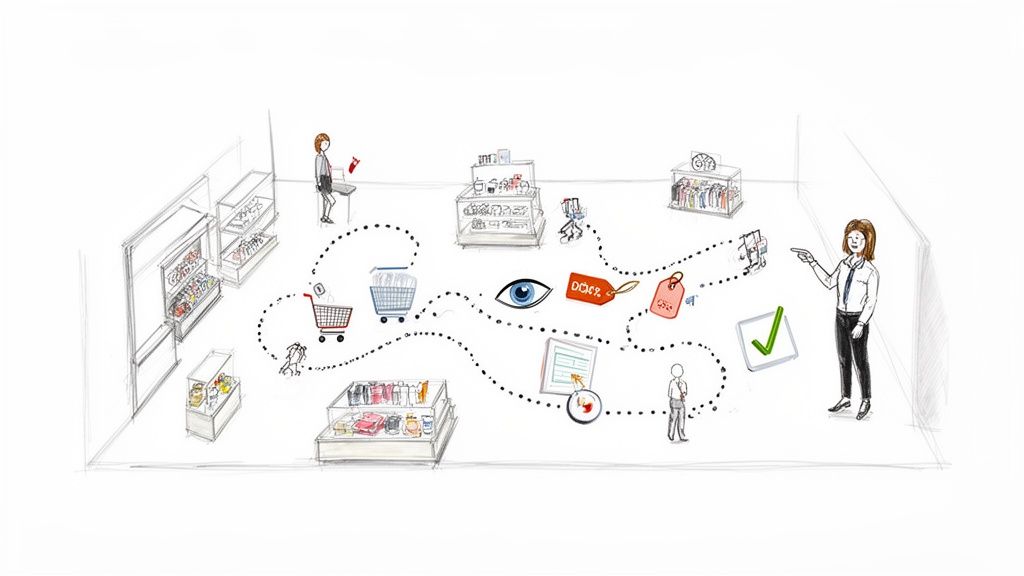
Imagine a sharp sales associate in a physical retail store. They observe how a customer moves, what they pick up, where they linger, and what they ignore. That real-time observation allows them to step in with genuinely helpful advice that closes the sale.
Behavioral segmentation is how you replicate that experience at scale online.
It's a massive leap from relying on static data points like age or location. While demographics tell you who your customers are, their behavior tells you what they want right now. Understanding these online interactions is critical for any brand that wants to improve ecommerce conversion rates and see a real impact on its bottom line.
The Financial Case for Action-Based Personalization
This isn't a "nice-to-have" marketing concept. Focusing on user actions has a direct and measurable impact on revenue. It lets you deliver the kind of precise, relevant experiences that get people to spend more money, more often.
The numbers back this up. A McKinsey study found that companies excelling at personalization generate 40% more revenue from those activities than average players. The difference comes from treating each visitor as an individual rather than a number.
Instead of delivering the same generic experience to every visitor, behavioral segmentation lets you engineer different onsite journeys for different types of intent. This is the foundation of modern conversion optimization and the key to making your ad spend work harder.
Comparing Segmentation Methods for Ecommerce
For a brand spending over $50K a month on ads, sticking with old-school segmentation is like flying blind. You have to understand why some methods just don't cut it anymore. Behavior-based data is more effective because it's dynamic and tells you what a shopper is interested in at this very moment.
Here's a quick breakdown of how these methods stack up:
| Segmentation Type | Data Focus | Typical Weakness | Strategic Advantage |
|---|---|---|---|
| Demographic | Who they are (age, gender, income) | Poor predictor of immediate intent | Useful for broad product-market fit |
| Geographic | Where they are (city, country) | Lacks context on individual needs | Essential for shipping and localization |
| Psychographic | Their lifestyle and values | Difficult to measure and scale | Good for top-of-funnel brand messaging |
| Behavioral | What they do (clicks, views, purchases) | Requires sophisticated tracking | Directly tied to purchase intent |
While other methods have their place, only behavioral data gives you the real-time insight needed to drive conversions effectively. This guide is a practical playbook for putting behavioral segmentation to work, focused on concrete tactics that deliver financial results for your brand.
The Four Core Types of Behavioral Segments
To make behavioral segmentation work, you have to know which customer actions matter. You could slice your data a million ways, but the fastest-growing ecommerce brands get the best results by focusing on four core types of behavior.
These are not academic theories. They are practical toolkits for getting inside your customers' heads. Mastering these four will help you leave generic, one-size-fits-all marketing behind and start creating the precise, personal experiences that grow a business.
1. Purchase Behavior
This is the most obvious one, but it goes deeper than just looking at what someone bought. Real purchase behavior segmentation is about understanding the how and why behind every transaction. This is where you find your most profitable customer groups.
You can segment customers based on a few key buying habits:
- Average Order Value (AOV): Are they a big spender or a bargain hunter? A customer who drops $250 every time they visit should not see the same homepage as someone who usually spends $50. Greet your VIPs with new arrivals and high-end collections, not a splashy discount banner.
- Product Affinity: Group people by their go-to categories. For example, a skincare brand can easily create a segment for "Acne-Prone Skin" customers and another for people focused on "Anti-Aging." This lets you personalize everything from product recommendations to email content.
- Discount Sensitivity: You have customers who only buy during a sale. You also have loyal fans who happily pay full price. Give your "Bargain Hunters" early access to sales, but offer your full-price "Brand Loyalists" loyalty points or exclusive products instead.
When you analyze these patterns, you start to see exactly who your best customers are, what they want to buy, and what they're willing to pay for it.
2. Engagement Behavior
What a visitor does on your site before they click "buy" is a goldmine. Their engagement patterns tell you who's just window shopping and who's getting serious about a purchase. By tracking these non-purchase actions, you can figure out what motivates them and where they might be getting stuck.
A visitor's clicks are a conversation. By paying attention to how they engage, you're listening to what they want. This lets you step in and provide the right information or nudge in real time.
Try building segments based on common engagement signals like these:
- High-Intent Search Queries: Someone using your search bar for "women's waterproof hiking boot size 8" is telling you exactly what they want. That's a much stronger signal than someone just browsing the homepage. You can use that to show them a personalized banner with the exact boots they're looking for.
- Content Consumption: Are they watching product demo videos? Are they spending a lot of time reading customer reviews? If so, they're deep in the decision-making process. You can give them a little push with social proof, like a notification that says, "54 people bought this today."
- Feature Usage: If you have tools like a "compare products" feature or a "find your size" quiz, pay attention to who uses them. These people are actively trying to solve a problem, and you can help them by showing more relevant info or even a special offer.
At CONVERTIBLES, we tested a need-based product finder against a standard best sellers section for a dog treats brand. The finder, which segmented visitors by their dog's needs ("Powerful Chewers," "Picky Eaters," "Sensitive Stomachs"), generated an additional $17,813 in monthly revenue. It worked because it addressed the customer's actual question before presenting products.
3. Timing and Occasion Behavior
Many purchases are driven by the calendar. Timing and occasion-based segmentation is about anticipating customer needs and showing up with the right offer at the right moment. It's about being timely and relevant.
This goes way beyond Black Friday. You can build powerful segments around:
- Seasonal Purchases: A clothing store knows which customers buy sweaters every fall or sandals every spring. You can get ahead by targeting these groups with "New Fall Collection" or "Summer Getaway Essentials" campaigns a few weeks before the season starts.
- Holiday-Specific Buying: Who bought gifts for Valentine's Day or Mother's Day last year? Create a segment for them and send a reminder with a curated gift guide a week or two before the holiday. You'll save them the stress of last-minute shopping.
- Replenishment Cycles: If you sell consumables, you can create segments based on purchase frequency. A customer who buys protein powder every six weeks should get a reminder at week five, not a generic email blast.
4. Benefits Sought
This last one is more advanced. It's about grouping customers based on the primary value they're looking for. It answers the question, "What problem is this person really trying to solve?" Once you understand their core motivation, you can adjust your messaging to speak directly to that need.
This requires you to infer their motivation from their behavior. Here are a few common benefit-driven segments:
- The "Best Value" Shopper: This person always sorts products by "Price: Low to High" and never checks out without a discount code. You can win them over with product bundles, BOGO offers, or messaging that screams "best deal."
- The "Highest Quality" Buyer: This customer is the opposite. They filter for premium materials, read all the technical specs, and often buy the most expensive option. Your messaging to them should focus on craftsmanship, durability, and luxury, not discounts.
- The "Fastest Shipping" Customer: In a world dominated by Amazon Prime, speed is everything for some people. Identify users who always pay for expedited shipping and make your fast delivery options front and center for them in the cart and at checkout.
By mastering these four core types of behavioral segmentation, you can build a personalization strategy that feels personal. You'll be speaking directly to what your customers want, and that's how you drive more sales and increase profit from every visitor.
How to Collect and Analyze Behavioral Data
Great behavioral segmentation is built on solid, clean data. You can't personalize what you don't measure. For any growing ecommerce brand, this means going beyond surface-level analytics to create a single, unified view of every customer's journey, from the first ad they clicked to their most recent purchase.
The magic happens when you connect scattered data points into a cohesive story that reveals what your customers actually want. It's about sourcing information from all your platforms and piecing it together to see the complete picture.
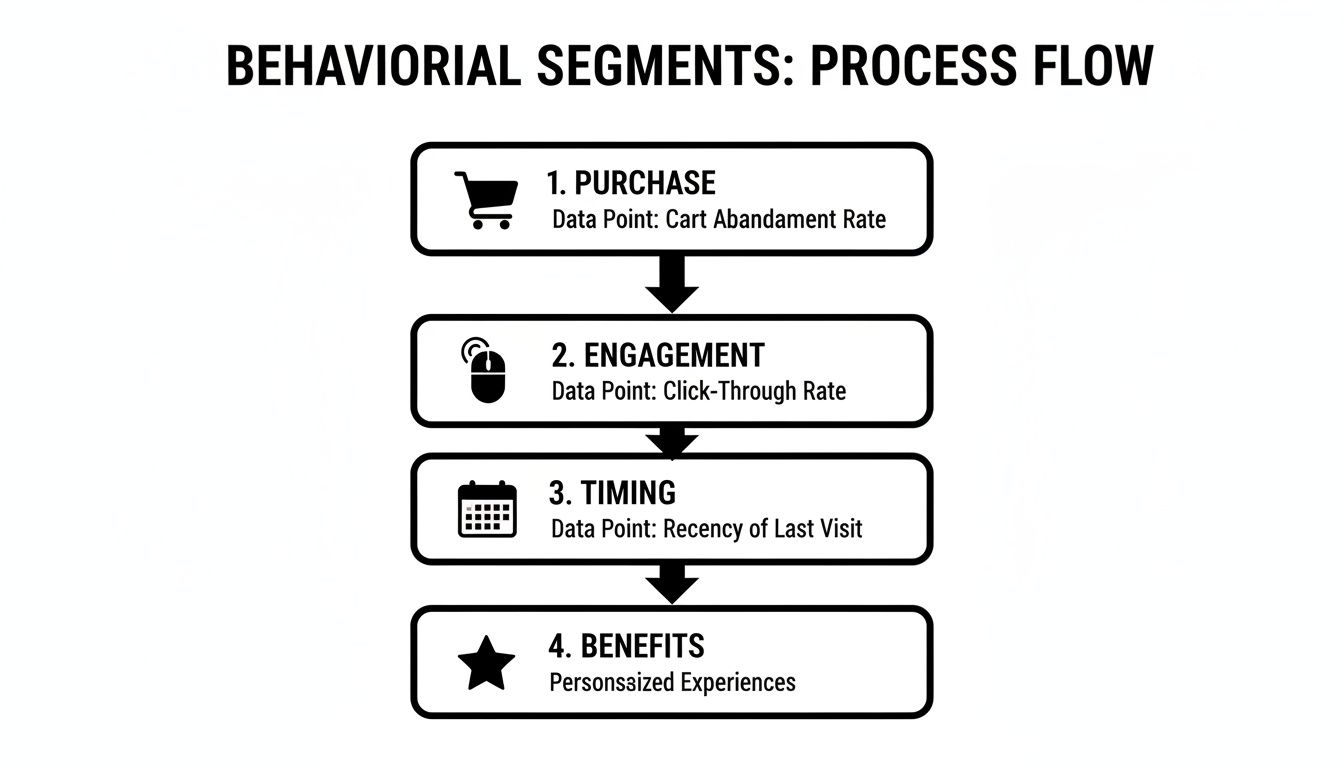
Think of these (purchase actions, site engagement, timing, and benefits sought) as the fundamental pillars for building powerful segments that actually drive profit.
Sourcing Your On-Site Behavioral Data
Your own website is ground zero for real-time behavioral signals. It's where you can watch how people interact with your products and content, giving you a direct window into their immediate interests and frustrations. Two types of tools are non-negotiable here.
First is Google Analytics 4 (GA4). This is your go-to for the hard numbers. GA4 is built around events, which makes it perfect for tracking the specific actions that signal a visitor's intent.
Make sure you're tracking these key GA4 events:
-
view_item_list(when someone looks at a category page) -
view_item(when they click into a specific product) add_to_cartbegin_checkoutpurchase
But don't stop there. The real insights often come from custom events. Track engagement with unique features on your site, like a size finder tool, a product video view, or a "compare" feature. These tell you much more about how a person is making their decision.
Second, you need tools that add the why to GA4's what. Session recording and heatmap tools like Hotjar or Microsoft Clarity give you that crucial qualitative context. Watching session recordings of users who bail at checkout can show you exactly where the friction is, maybe a confusing shipping calculator, in a way that raw numbers never could.
Unifying Purchase and Communication Data
While on-site tools show you what people are browsing, your back-end systems hold the keys to their actual purchase history and how they interact with your communications. This is where you find out who your best customers really are.
Your CRM and email service provider (ESP), like Klaviyo, is a goldmine. This is where you can start building segments based on what customers have done, not just what they've looked at.
Key data points to pull from your CRM/ESP include:
- Customer Lifetime Value (CLV): Pinpoint your top 10% of customers by their total spending.
- Purchase Frequency: Group users by how often they buy, say, in the last 30, 60, or 90 days.
- Average Order Value (AOV): Separate the big spenders from the bargain hunters.
- Product Affinity: Find people who consistently buy from a specific category.
Don't forget to look at direct feedback. Analyzing survey responses and support tickets can give you unfiltered insights into what your customers want. Honing your customer feedback analysis skills is essential for turning this raw input into smart segmentation choices.
Finally, pull it all together by connecting data from your ad platforms like Meta and Google. Using solid UTM parameters and server-side tracking, you can trace a user's entire journey from a specific ad campaign. This lets you create a seamless experience from ad to landing page, making sure what they see on your site matches the promise that got them there.
This complete, unified view is the bedrock for any serious effort to improve your ecommerce conversion rate through personalization.
Putting Your Behavioral Segments into Action
This is where data becomes profit. All the analysis is just theory until you use it to build specific, personalized on-site experiences that make you more money. We're not talking about minor tweaks here. This is about fundamentally changing what a visitor sees based on what their actions tell you they want.
The goal is to make your store feel like it was built just for them. For any brand serious about growth, this level of personalization isn't a "nice-to-have" anymore. It's a core driver of conversions and loyalty.
Let's walk through four powerful, real-world ways you can put this into practice right now.
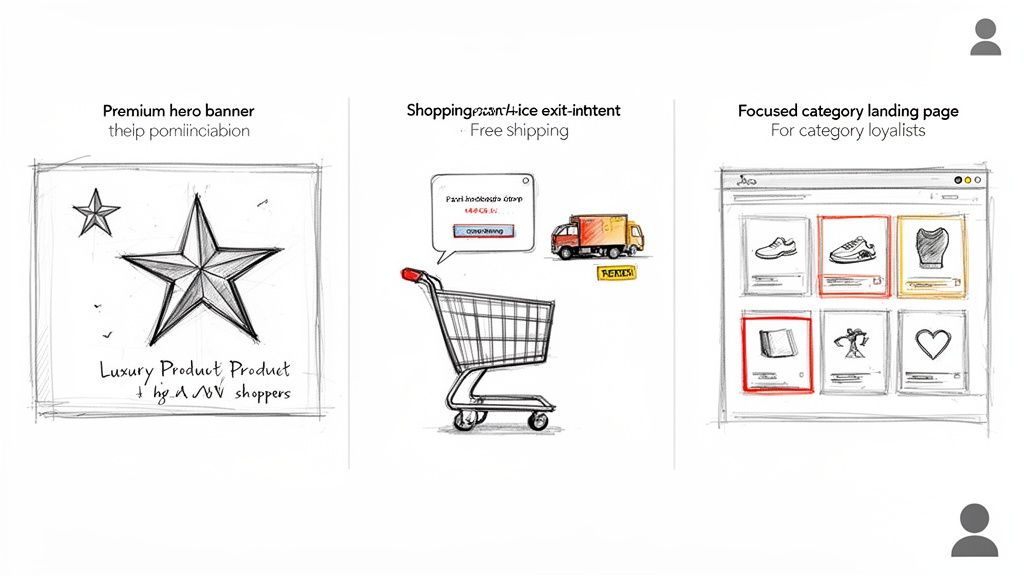
Experience 1: High AOV Customers
Your big spenders are your most valuable asset, but most brands greet them with the exact same homepage as a first-time visitor. That's a huge missed opportunity. Instead of a generic welcome, it's time to roll out the digital red carpet for this crucial segment.
Here's how to do it:
- Swap the Hero Image: The moment they land, greet them with a hero banner showing off your "New Arrivals" or a premium, high-ticket collection, not a generic sale.
- Curate Product Carousels: The product recommendations they see should feature your most expensive items or best-sellers from the high-end categories they've bought from before.
- Grant Exclusive Access: Use a top banner to offer "early access" to a new collection or limited-edition drop. This reinforces their VIP status and drives repeat, high-value purchases.
Experience 2: Dynamic Cart Abandoners
Everyone deals with cart abandonment, but a one-size-fits-all solution is lazy and ineffective. The reason someone abandons a $35 cart is likely very different from why they'd leave a $150 cart. Your exit-intent popups and follow-up emails need to reflect that.
Try breaking your abandoners into two groups and deploying dynamic offers:
- High-Value Cart Abandoners (e.g., over $100): These shoppers are often on the fence because of unexpected shipping costs. An exit-intent popup offering free shipping is an incredibly powerful nudge to get them over the finish line.
- Low-Value Cart Abandoners (e.g., under $100): Offering free shipping on a small order can kill your margins. A better approach is to offer a more modest incentive, like 10% off their order. It's often just enough to convert without giving away the farm.
We've seen this play out in our own testing at CONVERTIBLES. In one cart drawer test for an 8-figure slime brand, adding simple progress messaging for free gift tiers generated an additional $50,099 in monthly revenue. The key was surfacing the incentive at the critical decision point without overcomplicating the design.
By tailoring your abandonment strategy, you protect your margins on smaller orders while still recovering the high-value carts that really move the needle.
Experience 3: Category Loyalists
Some customers are fiercely loyal to one product category. If someone has only ever bought running shoes from your store, why are you making them navigate past hiking boots and sandals every time they visit? You can create a vastly better experience for them.
- Build a Personalized Landing Page: When a known "running shoe loyalist" returns, skip the generic homepage. Send them straight to a custom landing page dedicated exclusively to running shoes.
- Rearrange the Navigation: For this segment, you can dynamically reorder your main navigation menu to put "Running" right at the front.
- Show Relevant Content: The hero image, the product grid, and even the blog posts featured on their page should all be about running. This creates a hyper-focused journey that makes it effortless for them to find what they love and discover new, related products.
For more ideas on how this looks in practice, check out our ecommerce personalization examples.
Experience 4: Ad-Driven Visitors
One of the biggest money pits in paid advertising is the gap between the ad a person clicks and the page they land on. If someone clicks a Meta ad for "women's waterproof hiking boots," the page they see must instantly deliver on that promise. No ambiguity, no extra work.
This is all about maintaining ads-to-site continuity. For visitors coming from a specific ad, you need to make the landing page a perfect mirror of what they just saw.
- Matching Hero Image: The hero image on the landing page should be the same one from the ad creative, or at least thematically identical.
- Pre-Filtered Product Grid: Don't make them search. The product grid should already be filtered to show only women's waterproof hiking boots.
- Consistent Headline: The main headline on the page should echo the exact language from the ad.
This seamless handoff from ad to site builds instant trust. It confirms to the user that they're in the right place, which dramatically cuts down on bounce rates and boosts your ad spend efficiency.
Measuring the ROI of Your Segmentation Strategy
A sharp segmentation strategy isn't built on gut feelings. It's built on cold, hard data. To make a real business case for personalization, you have to look past feel-good metrics and zero in on the numbers that actually move the needle on profit. Measuring your return on investment is the only way to prove your efforts are paying off.
The whole point is to tell a clear, data-backed story that proves your segment-specific experiences are crushing the generic, one-size-fits-all approach. This demands a solid testing framework where every personalized experience goes head-to-head with a control group. That's how you know your wins are real.
Key Metrics That Drive Profit
To get a handle on the financial impact of segmentation, you need to track metrics that go beyond website traffic or bounce rate. These are the KPIs that give you a direct line of sight into how your personalization is hitting the bottom line.
Your measurement plan should revolve around these core metrics:
- Profit Per Visitor (PPV): This is your ultimate efficiency metric. It tells you exactly how much profit you're making from each person who visits your site. When you track PPV for specific segments, you can pinpoint which personalized experiences are creating the most value.
- Segment-Specific Conversion Rates: Stop looking at your overall conversion rate in a vacuum. You need to compare the conversion rate of a personalized experience, say, for your 'High AOV Customers', directly against the rate for your control group. This is how you prove you're generating incremental lift.
- Average Order Value (AOV) Lift: Are your targeted upsells and product recommendations working? A measurable increase in AOV for specific segments is the proof. Track this lift to quantify the direct revenue impact of your tactics.
- Customer Lifetime Value (CLV): This one is about the long game. Take a look at how personalization influences the CLV of key segments over time. For instance, does a special onboarding experience for 'First-Time Buyers' lead to a higher lifetime value compared to those who got the standard welcome?
Measuring these specific outcomes is non-negotiable. Without this data, you're just guessing. A rigorous testing methodology ensures that the gains you're seeing are real and repeatable, forming the foundation of a personalization program that can scale.
Building Your Testing Framework
A reliable testing framework is the backbone of your validation process. Every single personalized experience you launch should be part of a structured A/B or multivariate test. It's simple: a portion of your segment's traffic sees the personalized version, while the rest (the control group) sees the default experience.
For brands spending over $50K a month on ads, this isn't a "nice-to-have." It's the only way to be sure your marketing budget and dev resources are being spent on changes proven to increase profit. Without a control group, you can never be certain that your segmentation strategy is what's truly causing the uplift.
If you're ready to go deeper, check out our guide on improving customer lifetime value for more strategies.
Common Pitfalls to Avoid in Behavioral Segmentation
Behavioral segmentation is powerful, but it's also easy to mess up. I've seen countless brands get excited about personalization, dive in headfirst, and end up with a tangled mess that costs more than it makes.
Getting this right isn't about building a complicated, academic system. It's about building something that actually works and makes you money. Steer clear of these three common traps.
Pitfall 1: Going Overboard with Segments
This is the classic mistake. You get excited about the possibilities and start slicing your audience into dozens of tiny, hyper-specific groups. It sounds smart in a meeting, but in reality, it's an operational nightmare.
Trying to manage unique creative, messaging, and offers for 20 different segments will burn your team out and kill your ROI. You get tangled in the complexity before you see any real results.
Instead, start with three to five high-impact segments. That's it. Focus on the big, obvious groups first where you can make the most impact.
Good places to start are:
- New vs. Returning Visitors: This is the most fundamental split in ecommerce and a no-brainer.
- High-Intent Visitors: People who have added to their cart or are deep-diving into product pages.
- High AOV Customers: These are your VIPs. Treat them like it.
Nail the experience for these core groups first. You'll generate meaningful returns, and you can always get more granular later once you've built a solid, manageable foundation.
Pitfall 2: Letting Your Segments Get Stale
Customer behavior changes constantly. The person who was a 'new visitor' on Monday might be a 'first-time buyer' by Tuesday afternoon. If your segments don't update in real time, your personalization efforts will quickly become irrelevant or, worse, just plain wrong.
Think of segments as living, breathing groups. A customer's journey is dynamic, and your segmentation must reflect their current relationship with your brand. Sending a "Welcome" discount to someone who just made their third purchase is a clear sign you aren't paying attention.
Your system needs to be smart enough to move people from one segment to another based on their latest actions. This is how you ensure a returning customer sees "New Arrivals" instead of the same first-time visitor pop-up they just dismissed.
Pitfall 3: Forgetting About the Control Group
This one is a deal-breaker. If you launch personalized experiences without a control group, you have no way of knowing if they're actually working. You can't prove that your changes are driving real profit. You're just guessing.
Every single personalization effort needs to be run as a proper A/B test. One portion of your segment, the control, gets the generic, default experience. Everyone else sees the personalized version you built.
This is the only way to prove with statistical confidence that your strategy is responsible for that lift in conversions or profit. Without a control group, you're flying blind.
Frequently Asked Questions
How many behavioral segments should we start with?
It's tempting to slice and dice your audience into dozens of tiny groups, but that's a classic rookie mistake. You'll just end up with a tangled mess that's impossible to manage.
Start small and smart. We recommend focusing on three to five high-impact segments to begin with. These are the groups that represent the biggest chunks of your traffic or revenue.
Good places to start are:
- New Visitors: You only get one chance to make a first impression.
- Returning Customers: These are your people. Nurture that loyalty.
- High-Intent Visitors: Anyone who has added an item to their cart is sending a strong signal.
- Cart Abandoners: The low-hanging fruit for recovering lost sales.
Nail the personalized experiences for these core groups first. Once you have a smooth, proven system, you can get more granular.
What tools do I actually need for behavioral segmentation?
To do this right, you need a few key pieces of tech that play nicely together. It's not just about collecting data. It's about being able to understand it and, most importantly, act on it instantly.
Your essential toolkit looks like this:
- A Solid Analytics Platform: Google Analytics 4 is the baseline here. It's essential for tracking what people are actually doing on your site. Shopify's report and analytics have also greatly improved and are a solid foundation.
- An Advanced ESP/CRM: A tool like Klaviyo is a game-changer. It connects the dots between purchase history, customer lifetime value, and how your emails influence on-site behavior.
- A Dedicated Personalization & A/B Testing Tool: This is the action layer. It's how you actually launch and test different experiences for each segment, from custom banners to unique offers, and prove they're making you more money. We use Intelligems with all our clients.
This trio gives you everything you need: the insight, the audience-building capability, and the power to launch personalized experiences that are validated by real data.
Isn't this just demographic segmentation?
That's a great question, and the difference is crucial. Demographic segmentation lumps people together based on who they are, think age, gender, or location. While that has its place for high-level brand messaging, it's a poor predictor of what someone is about to buy.
Behavioral segmentation, on the other hand, is all about what they're doing right now. It focuses on their actions: the products they click, the searches they make, the items they add to their cart. This is so much more powerful because it's based on current intent, allowing you to create relevant, in-the-moment experiences that speak directly to what a visitor wants.
Your Next Step: From Theory to Profit
Understanding behavioral segmentation is the first step. The next is putting it into action in a way that generates a measurable return. Start by identifying your single most valuable segment, whether it's new visitors from a specific ad campaign or your high-AOV repeat customers. Then, design one specific, personalized on-site experience for them. Test it against a control group and measure the lift in profit per visitor. That's how you build a real-world case for personalization and turn traffic into profit.
At CONVERTIBLES, we help Shopify Plus brands stop guessing and start building profitable, segment-specific onsite experiences. We connect your ad spend to your conversion rate, making sure every click leads to a journey that feels personal and relevant.
Schedule a consultation to see how we can build a personalization roadmap for your brand.