

8 Psychological Pricing Examples That Drive Revenue (2026)

[ SUMMARIZE WITH AI ]
[ FREE CRO TEARDOWN ]
Find the 3 biggest revenue leaks on your store.
Every day a conversion leak goes unfixed, you're paying for traffic that doesn't buy. Get a 5-minute Loom through your PDP, cart, and checkout, with mockups of the fixes. No pitch.
Get My TeardownPsychological pricing examples are real cases where a brand changes how a price looks, not what the product is, to change what people buy. A $49.99 price instead of $50. A crossed-out "was" price. A middle plan that looks like the obvious pick. Psychological pricing is also called pricing psychology, and its best-known form, prices ending in .99, is called charm pricing or odd pricing.
Below are 8 psychological pricing examples from companies like Amazon, Apple, Netflix and The Economist, each with test ideas for a Shopify store. Then we share results from pricing A/B tests we ran ourselves. One raised profit per visitor 54.7%. One lost. Both are in here, because the losers teach as much as the winners.
One rule before you start: judge every pricing test on revenue or profit per visitor, not conversion rate alone. A tactic that lifts conversion but drops average order value can still lose money. For context on what a good rate looks like, see the current average ecommerce conversion rate by industry.
Companies That Use Psychological Pricing
Short answer: almost every big retailer and subscription brand. Here are the clearest psychological pricing examples by company, with the tactic each one uses.
| Company | Tactic | What it looks like |
|---|---|---|
| Amazon, Target | Charm pricing | Prices ending in .99 across most of the catalog |
| Nordstrom, Alo Yoga | Anchoring | Original price crossed out next to the sale price |
| Apple | Bundling + prestige pricing | iPhone sold with AppleCare and accessories; premium price points held year after year |
| Netflix, Notion | Good-better-best tiers | Three plans, with the middle one framed as the default |
| The Economist | Decoy pricing | Print-only priced the same as print + digital, so the bundle looks like a free upgrade |
| Louis Vuitton (LVMH) | Prestige pricing | Round prices with no .99, to signal quality |
| Booking.com, Amazon Lightning Deals | Scarcity and urgency | "Only 2 rooms left" and countdown timers |
| Uber, airlines | Dynamic pricing | Price rises with real-time demand |
| Radiohead | Pay-what-you-want | The 2007 album "In Rainbows" let fans pick the price |
For Shopify brands, the most testable tactics are anchoring, bundling, tiers and how a discount is shown. Our own results on those are in What Our Own Pricing A/B Tests Show.
1. Charm Pricing (The .99 Effect)
Charm pricing, often called the ".99 effect," is one of the oldest and most effective psychological pricing examples. This strategy uses prices ending in digits like .99, .95, or even .49 to make the total cost seem significantly lower than it is. The power behind this tactic lies in a cognitive shortcut known as left-digit bias, where consumers anchor their perception of a price on the leftmost digit, largely ignoring the cents that follow.
For example, a product priced at $49.99 is perceived as being in the "$40 range," making it feel substantially more affordable than a product priced at a round $50.00, despite the one-cent difference. This small change frames the price as a discount or a bargain, appealing directly to price-sensitive shoppers.
Odd-Even Pricing Examples
Odd-even pricing is the choice between a price that ends in an odd number and a round one. Both send a signal:
- Odd pricing: $19.99, $9.95, $47. Reads as a deal. Amazon and Target use it on most products.
- Even pricing: $20, $100, $500. Reads as premium and simple. Luxury houses like Louis Vuitton use it.
Pick the one that matches the brand position, then test it. A .99 ending on a premium product can make it feel cheaper in the wrong way.
Strategic Analysis & Actionable Insights
Charm pricing isn't a one-size-fits-all solution, its effectiveness depends heavily on brand positioning and customer segmentation.
-
Mass-Market vs. Premium Brands: Major retailers like Amazon and Target use .99 pricing across a vast majority of their products to reinforce their value proposition. Conversely, luxury brands (e.g., LVMH) intentionally use round numbers (like $500.00) to signal quality, exclusivity, and a premium experience. DTC brands often find a middle ground with .95 endings, which can feel slightly more sophisticated than .99.
-
Segment-Specific Application: A powerful strategy for Shopify Plus brands is to personalize pricing displays. You can show prices ending in .99 to first-time visitors or segments identified as price-sensitive (perhaps from discount-focused ad campaigns). For returning VIP customers or segments with a high AOV, displaying round numbers could reinforce brand quality and avoid the perception of being a "discount" brand.
Key Takeaway: Use paid advertising data to identify which customer segments respond best to charm pricing. If a specific audience converts better on ads showing "$19.99," carry that pricing strategy through to their on-site experience on product and collection pages.
Testing & Implementation Ideas
To implement charm pricing effectively, systematic testing is crucial. Don't just change all your prices at once.
- Isolate by Page Type: The impact of charm pricing can differ by its location. Test it separately on Product Detail Pages (PDPs), where a customer is evaluating a single item, and on cart or checkout pages, where they see the total cost.
- Test the Endings: Run experiments comparing .99 vs .95 vs .49 vs .00. You might discover that a .95 ending converts just as well as .99 but results in a slightly higher AOV. You can learn more about how to structure these experiments by comparing multivariate testing vs A/B testing to find the right approach.
- Monitor Key Metrics: Track not only conversion rates but also Average Order Value (AOV) and Revenue Per Visitor (RPV). While charm pricing may lift conversions, it can sometimes slightly lower AOV. Ensure the net effect on RPV is positive before scaling the change across your entire site.
2. Anchoring and Price Framing
Anchoring is a powerful cognitive bias that ecommerce brands can leverage to frame the value of their products. This strategy involves presenting a higher initial price, the "anchor," right next to the actual selling price. The anchor serves as a reference point, making the lower price seem more attractive and like a significant deal. The human brain latches onto the first piece of information it receives, using it to make subsequent judgments.
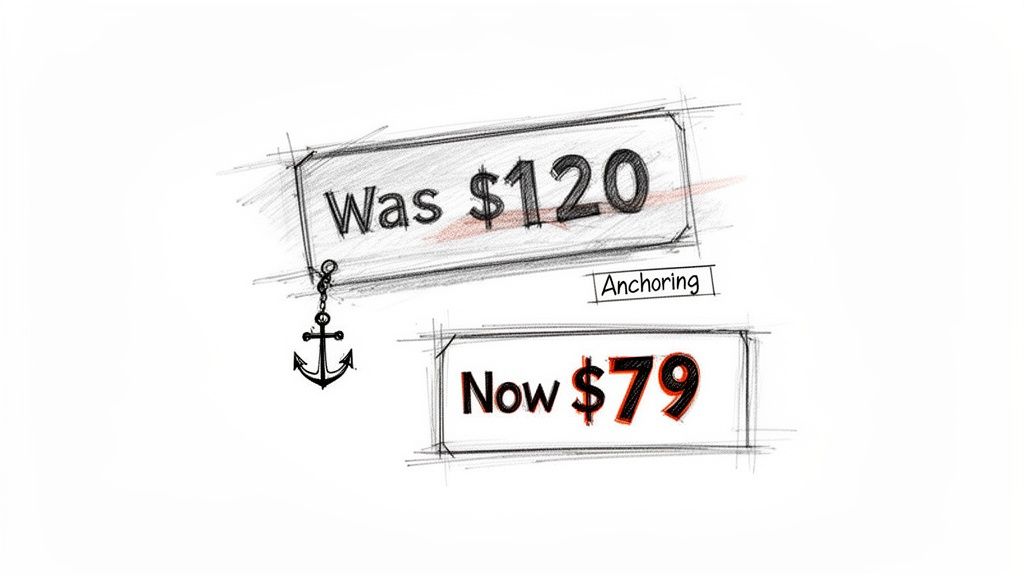
When a customer sees "Was $120, Now $79," their perception of the product's value is immediately anchored to $120. This makes the $79 price feel like a substantial saving, increasing their willingness to buy. This tactic is extremely effective on product detail pages (PDPs), during high-intent moments like sales events, and within cart recovery emails to highlight the value the customer is leaving behind.
Strategic Analysis & Actionable Insights
Effective anchoring requires authenticity and strategic placement. The anchor price must be believable to avoid eroding customer trust.
-
Legitimate Anchors vs. Fabricated Prices: Always use a legitimate reference point, like the Manufacturer's Suggested Retail Price (MSRP), a previous non-sale price, or a key competitor's price. Brands like Nordstrom and Alo Yoga excel at this by consistently showing the original retail price next to the sale price, reinforcing the value of the discount. Fabricating a high "original" price is a quick way to lose credibility.
-
Segment-Specific Anchoring: Your anchor's effectiveness can vary by audience. Price-sensitive shoppers acquired through discount-focused ad campaigns may respond best to a strikethrough price that emphasizes savings (e.g.,
Was $100). In contrast, high-AOV or luxury-focused segments might be more influenced by seeing the MSRP or a competitor's price, which frames the purchase based on quality and market value rather than just a discount.
From our tests: anchoring won twice for us, once with a crossed-out BFCM price and once with a subscription frequency gap. It also did nothing once, when we added retail values to a subscription box. Details in our pricing A/B tests.
Key Takeaway: Implement anchoring not just on product pages but also within the mini-cart and at checkout. Reinforcing the total savings ("You're saving $41.00") just before payment can significantly reduce cart abandonment by reminding customers of the value they're receiving.
Testing & Implementation Ideas
Systematically test different anchoring presentations to find what resonates most with your audience.
-
Test the Presentation Style: Don't just settle for a simple strikethrough. A/B test different visual treatments. Compare a standard
Was $100 / Now $79format against a percentage-off badge ("Save 21%") or a dollar-amount-saved callout ("You save $21"). - Combine with Urgency: Amplify the effect of your anchor by pairing it with scarcity or urgency. Test copy like, "Was $80, now $49 (Sale ends Friday)" or "Limited time: Get it for $49 instead of $80." This creates a powerful combination of value and the fear of missing out.
- Track the Right Metrics: Anchoring doesn't just lift conversion rates. It often increases Average Order Value (AOV) because the perceived savings can encourage customers to add more items to their cart. Monitor Conversion Rate, AOV, and Revenue Per Visitor (RPV) to get a complete picture of your test's impact on the bottom line.
3. Bundling and Package Pricing
Bundling is a classic psychological pricing example where multiple products are sold together as a single package for one price. This strategy taps into the consumer's desire for value and convenience, as the bundled price is typically lower than the sum of the individual items. It simplifies the purchasing process, reduces decision fatigue, and creates a perception of getting a great deal.
For instance, a beauty brand might package a popular cleanser, serum, and moisturizer into a "Skincare Essentials Set." This not only increases the Average Order Value (AOV) but also introduces customers to complementary products they might not have purchased otherwise. The key is that the bundle feels like a curated, value-added solution rather than just a random assortment of products.
Strategic Analysis & Actionable Insights
Effective bundling is more science than art, relying on customer data to create combinations that feel intuitive and compelling.
-
Data-Driven vs. Inventory-Driven Bundles: A common mistake is using bundles solely to offload slow-moving inventory. While it can be a useful tactic, the most successful bundles are created from product affinity analysis. Use your order data to identify which products are frequently purchased together and build your bundles around those natural pairings. Tech brands like Apple excel at this, offering an iPhone bundled with AppleCare and accessories, a combination that addresses a new buyer's immediate needs.
-
Segment-Specific Bundling: Personalization dramatically increases bundle effectiveness. For a Shopify Plus brand, this means moving beyond one-size-fits-all packages. Create a "Starter Kit" bundle with core products for first-time visitors. For loyal, repeat customers, offer an "Advanced Routine" or "Complete the Look" bundle featuring premium or new arrival items, reinforcing their status and encouraging deeper brand engagement.
Key Takeaway: Use post-purchase surveys and "Frequently Bought Together" data to engineer your bundles. A bundle’s success is directly tied to how well it solves a specific customer problem or fulfills a complete need in a single, convenient purchase.
Testing & Implementation Ideas
To maximize revenue from bundling, you need to test both the composition of the bundle and how it's presented to the customer.
- Test Bundle Discounts: The discount is a critical lever. Start by A/B testing a 15% vs. 20% discount on the total price of individual items. The goal is to find the sweet spot that maximizes conversion rate and AOV without unnecessarily eroding margins.
- Placement and Visibility: Experiment with where you promote bundles. Test featuring them prominently on collection pages versus presenting them as a cross-sell on Product Detail Pages (PDPs) or as a post-purchase upsell. The context in which a customer sees the bundle matters.
- Monitor Product Mix: Keep a close eye on your product mix report. While bundles should increase AOV, they shouldn't cannibalize the sales of your high-margin, standalone hero products. If individual product sales dip too much, adjust your bundle strategy. You can discover more advanced strategies in these examples of price bundling to refine your approach.
From our tests: a "Buy 3 Get 1 Free" offer in a cart drawer lost. Only 2.3% of shoppers took it and revenue per visitor came in at -2.8%. A bundle deal is not a win by default. See the full test.
4. Tiered Pricing and Good-Better-Best
Tiered pricing, often executed as a "Good-Better-Best" model, is a powerful psychological pricing example that frames value for customers. This strategy presents multiple options at different price points, each with a corresponding set of features or benefits. It leverages cognitive biases like the Goldilocks Effect, where consumers naturally gravitate toward the middle option when presented with three choices, perceiving it as the safest and most balanced value proposition.
This approach steers customers away from a simple "buy or not buy" decision and shifts them into a "which one should I buy?" mindset. By anchoring the customer's perception with a lower-tier "Good" option and a high-end "Best" option, the middle "Better" tier appears to be the most reasonable and popular choice. SaaS companies like Notion and streaming services like Netflix have mastered this, making their standard plans feel like the default, logical selection.
Strategic Analysis & Actionable Insights
Effective tiered pricing is less about offering choice and more about guiding a specific choice. The goal is often to make the middle tier the most profitable and popular option.
-
Product Variants vs. Service Tiers: For ecommerce brands, this extends beyond SaaS. Allbirds might offer a standard shoe ("Good"), a premium wool-runner with enhanced materials ("Better"), and a limited-edition collaboration ("Best"). Each tier appeals to a different customer segment, from the price-conscious buyer to the brand loyalist seeking exclusivity.
-
Segment-Specific Tier Highlighting: You don't have to show all tiers equally to all visitors. For traffic arriving from a "best budget running shoes" blog post, you could use personalization to visually emphasize the "Good" or "Better" tier on the product page. Conversely, for returning VIP customers with a high AOV, the "Best" tier could be pre-selected or highlighted with a "VIP Favorite" badge, framing it as the most appropriate choice for them.
Key Takeaway: Structure your tiers so the "Better" option is your profit-driver. It should contain the features most of your core customers want, making the upgrade from "Good" feel small in price but large in value, while the "Best" option adds niche features for a premium.
Testing & Implementation Ideas
Implementing tiers requires careful design and testing to ensure you're guiding customers effectively, not just overwhelming them with choice.
- Test the "Anchor" Tier: The price and features of your lowest "Good" tier set the stage. A/B test a very basic, low-priced version against a slightly more feature-rich version. A bare-bones option can make the middle tier look like an incredible deal, boosting its uptake.
- Highlight the Target: Experiment with visual cues to make your target tier stand out. Test different labels like "Most Popular" vs. "Recommended" vs. "Best Value." Also, experiment with design elements like a different background color, a subtle border, or making the "Better" column slightly larger.
- Analyze Tier Metrics: Go beyond conversion rate. Track the adoption rate for each tier. If the setup works, most customers should land on the middle option. If too many people choose "Good," your "Better" tier may be overpriced or lack compelling features. If too many choose "Best," you might be leaving money on the table.
5. Decoy Pricing (The Asymmetric Dominance Effect)
Decoy pricing, also known as the asymmetric dominance effect, is a sophisticated strategy that introduces a third, less attractive option to make a specific "target" product seem like a much better deal. This "decoy" option is intentionally designed to be inferior to the target option in terms of value, nudging customers toward the higher-margin choice without aggressive upselling. It's a powerful tool for shaping customer choice architecture and increasing average order value.
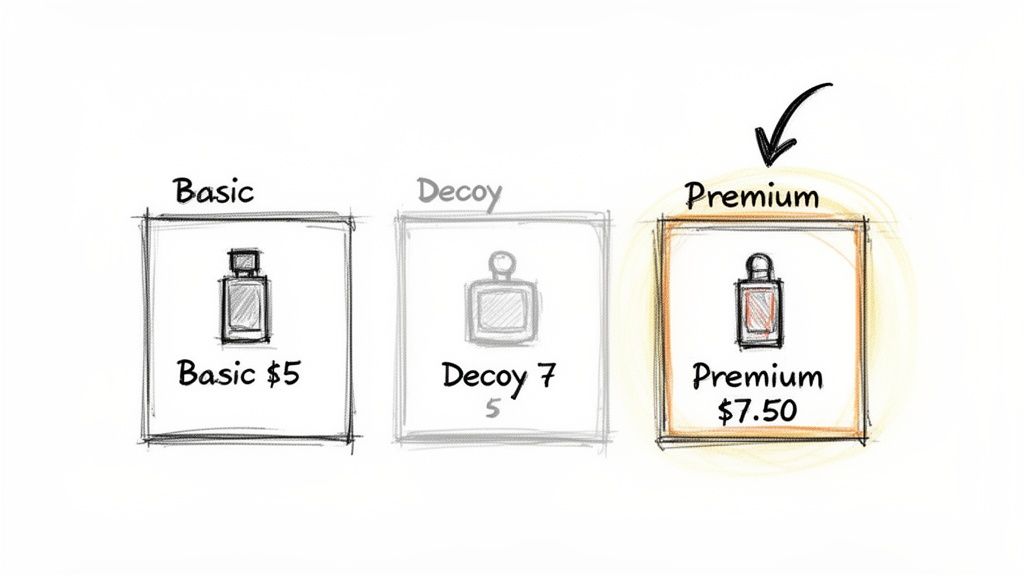
A classic example is a magazine subscription: a "Digital Only" plan for $59, a "Print Only" plan for $125 (the decoy), and a "Digital + Print" bundle for $125 (the target). The "Print Only" option makes the bundle seem like an incredible value, as you get the digital version for free. This is one of the most effective psychological pricing examples for guiding purchasing decisions.
Strategic Analysis & Actionable Insights
Decoy pricing is particularly effective for businesses with tiered products, subscriptions, or bundles. Its power lies in simplifying complex decisions for the consumer.
-
SaaS vs. Ecommerce Application: While famously used by SaaS companies to push users to a "Pro" plan over a "Basic" one, ecommerce brands can apply this to product bundles. For instance, a skincare brand could offer a cleanser for $30, a moisturizer for $50 (the decoy), and a "Cleanser + Moisturizer Kit" for $55 (the target). The high standalone price of the moisturizer makes the kit the obvious, high-value choice.
-
Personalization with Decoys: The true power for DTC brands lies in personalizing the decoy. You can dynamically present different decoy options based on user behavior. A segment of high-AOV customers might see a decoy that pushes them toward a premium, three-product bundle, while a price-sensitive segment might see a decoy designed to move them from a single item to a more modest two-product kit.
Key Takeaway: The best decoys are not meant to sell. Their sole purpose is to make the target option look superior. If your decoy option is getting significant sales, it's not functioning as a decoy and needs to be redesigned to be less appealing.
Testing & Implementation Ideas
Implementing decoy pricing requires careful calibration to ensure the decoy frames the target correctly without cannibalizing sales.
- Test the Decoy's Value Proposition: The decoy should be clearly worse value than the target. A/B test different decoy configurations. For example, test a decoy that is 10% cheaper than the target but missing one key feature against a decoy that is 15% cheaper but missing two key features.
- Experiment with Visual Hierarchy: The placement and design of your pricing options matter. Run tests where the target option is visually highlighted, slightly larger, or has a "Most Popular" banner. Test placing the decoy between the cheapest option and the target option versus placing it last.
- Monitor Product Mix & AOV: The primary goal is to shift sales to the target product. Track your product mix to ensure the decoy isn't accidentally becoming a popular choice. The key metrics to watch are an increase in the sales percentage of your target product and a corresponding lift in overall Average Order Value (AOV) and Revenue Per Visitor (RPV).
6. Prestige Pricing (Price as Quality Signal)
Prestige pricing is a strategy where brands set artificially high prices to signal superior quality, luxury, and exclusivity. This tactic operates on the powerful psychological principle that consumers often equate a higher price with higher value, a phenomenon known as the price-quality heuristic. For certain products and customer segments, a higher price can paradoxically increase desirability and demand.
For example, a luxury handbag priced at $3,500 is not just valued for its materials but for the status and craftsmanship its price implies. Similarly, a skincare serum from a brand like Estée Lauder at $125 is perceived as more effective than a $25 alternative, even if the parent companies and core ingredients are similar. Apple consistently uses this among other psychological pricing examples, maintaining premium price points for iPhones to reinforce their position as a market leader in quality and innovation.
Strategic Analysis & Actionable Insights
Prestige pricing is a brand-building tool, not just a revenue lever. Its success hinges on authentic brand storytelling and precise customer segmentation.
-
Premium vs. Value Positioning: This strategy is the direct opposite of charm pricing. Luxury brands like LVMH and premium DTC brands like Alo Yoga use round, high price points to anchor their products in a premium tier, differentiating them from mass-market competitors. The price itself becomes a key feature, communicating that the product is not for everyone.
-
Segment-Specific Application: A common mistake is applying prestige pricing universally. This approach is highly effective for affluent buyers or brand loyalists but will alienate price-sensitive shoppers. For Shopify Plus brands, this is a prime opportunity for personalization. You can display a premium price of $250 for a jacket to users who arrive from high-intent organic search or have a history of high AOV, while showing a slightly lower price of $225 to first-time visitors from a discount-focused social media ad.
From our tests: raising one product from $99 to $125 and lowering its sibling to $90 lifted profit per visitor 54.7%. Raising both to premium prices lost. Prestige pricing has a ceiling, and you only find it by testing. See the full test.
Key Takeaway: Your product, packaging, and on-site experience must justify the premium price. Combine prestige pricing with rich content about material sourcing, founder stories, and unique craftsmanship to build a cohesive narrative of superior value.
Testing & Implementation Ideas
Implementing prestige pricing requires more than just increasing numbers, it demands strategic testing to find the sweet spot between perceived value and conversion.
- Test Price Thresholds by Segment: Identify customer segments with a high willingness to pay (e.g., returning customers with AOV > $300). For these groups, test raising prices on key products by 10%, 15%, and 20% to find the new optimal price point where demand remains strong or even increases.
- Isolate by Product Line: Not all products can sustain prestige pricing. Apply it to your "hero" or flagship products that have clear differentiators. You can test keeping introductory or entry-level products at a more accessible price point to acquire new customers.
- Monitor Brand Perception Metrics: Beyond conversion rate and RPV, track qualitative metrics. Are customer reviews still positive? Is the "perceived value" feedback high? A successful prestige pricing strategy enhances brand equity, while a poorly executed one can lead to accusations of being overpriced.
7. Scarcity and Urgency Pricing
Scarcity and urgency pricing leverages the powerful psychological principles of loss aversion and Fear of Missing Out (FOMO) to accelerate purchase decisions. This strategy creates the perception that a product or offer is in limited supply or only available for a short time, compelling customers to act immediately rather than delay. The core idea is that people place a higher value on items they believe are scarce.
This tactic is extremely common in ecommerce. Think of Amazon's "Lightning Deals" with their prominent countdown clocks or Booking.com's famous "Only 2 rooms left at this price!" messages. Fast-fashion brands like Shein have built entire business models around flash sales, creating a constant cycle of urgency that drives repeat purchases. These are all powerful psychological pricing examples designed to shorten the consideration phase and drive immediate conversions.
Strategic Analysis & Actionable Insights
Effective scarcity and urgency pricing is about credibility and context, not just slapping a timer on every product page. Authenticity is paramount, as fabricating scarcity can permanently damage brand trust.
-
Real vs. Artificial Scarcity: Real scarcity (e.g., "Only 5 left in stock") is based on actual inventory levels and is highly effective. Artificial scarcity (e.g., "Sale ends tonight!") is time-based and controlled by the brand. Both work, but real scarcity is often more powerful. The key is to never lie. If you claim only five are left, it must be true.
-
Segment-Specific Application: This tactic is not universally effective. Urgency messaging often performs best with price-sensitive segments or first-time buyers who are on the fence. For high-LTV, loyal customers, a constant barrage of "act now" messages can feel cheap and erode brand equity. Consider using scarcity for cart abandonment flows targeting hesitant shoppers, but remove it for VIP customers who value a premium, unpressured experience.
Key Takeaway: Implement scarcity dynamically. Use inventory-based messages for products with genuinely low stock and reserve time-based urgency for specific campaigns or promotions. Tie these messages to user behavior, like showing a "items in your cart are selling fast" notification after a user has been inactive for several minutes.
Testing & Implementation Ideas
To avoid "urgency fatigue" and maximize impact, you must test your scarcity tactics methodically.
- Test the Trigger: Compare the effectiveness of different scarcity types. Does an inventory counter ("Only 3 left") outperform a time-based counter ("Offer ends in 02:59:15")? Or does social proof ("27 people are viewing this right now") drive more conversions? Test them in isolation before combining them.
- Vary the Placement: Experiment with where you introduce scarcity. Test it on the Product Detail Page (PDP) to encourage adding to the cart, in the slide-out cart to push customers to checkout, and on the checkout page itself to prevent final-stage abandonment. The impact can vary significantly at each stage.
- Monitor Trust & Long-Term Metrics: Beyond conversion rates, monitor your return rates and customer reviews. An overuse of aggressive scarcity tactics might lift short-term sales but could lead to an increase in impulse-buy returns and negative sentiment. Ensure your Revenue Per Visitor (RPV) growth is not coming at the cost of brand loyalty.
8. Pay-What-You-Want and Dynamic Pricing
Pay-what-you-want (PWYW) and dynamic pricing are advanced strategies that introduce pricing flexibility based on customer input or algorithmic data. PWYW allows customers to set their own price, leveraging principles of fairness and reciprocity. Dynamic pricing, more common in ecommerce, adjusts prices automatically based on demand, inventory levels, time, or customer segment characteristics. This is one of the more complex psychological pricing examples, but it can be highly effective.
A famous PWYW example is Radiohead's 2007 album "In Rainbows," while dynamic pricing is standard practice for airlines and ride-sharing services like Uber, whose "surge" pricing algorithmically matches price to real-time demand. For ecommerce brands, dynamic pricing doesn't have to be complex surge-style pricing, it can be as simple as offering segment-specific discounts or time-based promotions to maximize revenue.
Strategic Analysis & Actionable Insights
While PWYW is rare in physical product DTC, dynamic pricing is a powerful tool for Shopify Plus brands to maximize revenue per visitor and increase average order value (AOV).
-
Segment-Based Personalization: The core of dynamic pricing in ecommerce is personalization. Instead of a one-size-fits-all price, you can display different offers to different customer segments. For example, a high-intent segment arriving from a brand-focused search campaign might see the standard price, while a price-sensitive segment from a discount-focused social ad could see a "10% Off Today" offer.
-
Inventory and Demand Rules: Dynamic pricing can be automated based on business rules. A brand could implement a rule to automatically apply a 15% discount on products with more than 1,000 units in stock to move inventory faster. Conversely, a best-selling item with low stock could have its price slightly increased to capitalize on scarcity and demand.
Key Takeaway: Connect your paid advertising data to your on-site pricing strategy. If a Google Ads campaign targeting "cheap running shoes" has a high click-through rate, show those visitors a dynamic offer or a slightly lower price on relevant product pages to maintain conversion momentum.
Testing & Implementation Ideas
Implementing dynamic pricing requires a systematic, data-driven approach to avoid hurting brand perception or margins.
- Test Pricing Rules Separately: Don't try to implement demand-based, inventory-based, and segment-based rules all at once. Isolate each variable. Start by testing a segment-based rule, like offering a first-time visitor discount, and measure its impact on conversion rate and RPV.
- Implement Volume-Based Tiers: A simple and effective form of dynamic pricing is tiered discounting to increase AOV. Test offers directly on the product page or in the cart, like "Buy 2, Get 15% Off" or "Spend $100, Unlock Free Shipping." This encourages customers to add more to their cart to reach a threshold.
- Monitor Margin Impact: The biggest risk of dynamic pricing is margin compression. Set strict guardrails and monitor your product margins rigorously. Ensure that any lift in conversion rate or AOV results in a net positive impact on overall profitability, not just top-line revenue.
What Our Own Pricing A/B Tests Show
The psychological pricing examples above come from big brands. These come from A/B tests we ran on Shopify stores in Intelligems. Every result below is public in our case studies, with the setup and screenshots.
| Test | Tactic | Result |
|---|---|---|
| Two products at $99 each: tested lower, higher and split prices | Prestige pricing + anchoring | $125 / $90 split won: +54.7% profit per visitor. Cutting both prices in half only nudged profit. Raising both lost. |
| "$30 off over $150" vs "15% off" popup | Price framing | Dollar-off won: +43% email capture, +21% AOV |
| BFCM: "$198 crossed out, $148.50 with code" vs "25% off with code" | Anchoring | The calculated price won. Shoppers did not have to do the math. |
| Subscription: bi-monthly raised to $109, monthly kept at $99, "save $10/box" callout | Anchoring + decoy | Monthly sign-ups rose and overall conversion held |
| "CHECKOUT $176" vs "CHECKOUT" in the cart drawer | Price transparency | The price on the button beat three other cart changes |
| Subscription box: contents preview with and without retail values | Value anchoring | Both versions: +18% conversion. The retail values added nothing on top. The contents preview did the work. |
| "Buy 3 Get 1 Free" in the cart drawer | Bundling | Lost: 2.3% took the offer, -2.8% revenue per visitor |
Three patterns we keep seeing:
- Show the number, not the math. "$148.50" beat "25% off". "$30 off" beat "15% off". "CHECKOUT $176" beat "CHECKOUT". Concrete prices win.
- Most stores test price cuts first. Test price increases too. Our biggest profit lift came from charging more for one product, not less.
- A tactic is not a result. The same anchoring idea won in one test and did nothing in another. Bundling lost. Only the test tells you.
Your Next Step: From Generic Pricing to Personalized Profit
We’ve explored a powerful arsenal of psychological pricing examples, from the subtle influence of charm pricing to the strategic genius of the decoy effect. Each tactic offers a proven method to frame value, guide customer choice, and ultimately, drive more revenue. But simply knowing these strategies exist is not enough to move the needle.
The real takeaway isn't just a list of tactics to copy. It's the underlying principle that pricing is perception, not just mathematics. How you present your prices is just as important as the numbers themselves. The brands that win are those that treat pricing not as a static, one-size-fits-all number, but as a dynamic and strategic component of the customer experience.
Beyond the Basics: The Power of Personalization
The difference between a minor uplift and a major profit driver lies in personalization. The most sophisticated ecommerce operators understand that a single pricing strategy rarely works for every single visitor.
- Anchor Pricing for VIPs vs. New Visitors: A high-value repeat customer might respond better to an anchor price framed around a new, premium bundle. A first-time visitor from a paid social ad might need a simpler anchor focused on a single best-seller to reduce friction.
- Segmented Bundles: Instead of creating one generic "starter pack," you could create dynamic bundles. A customer who has previously purchased skincare might see a bundle featuring a new cleanser and moisturizer, while a customer who only buys makeup is shown a bundle of best-selling lipsticks and foundation.
- Tiered Discounts by AOV: For a customer with a historically high average order value, a "Spend $250, get 25% off" tier makes sense. For a new customer, a more accessible "Spend $75, get 10% off" might be the perfect entry point.
This level of granularity is where you unlock compounding returns. You stop guessing what works for the "average" customer and start delivering precisely the right value proposition for specific segments. Implementing these psychological pricing examples with a layer of personalization turns a good strategy into an unbeatable one.
Building Your Pricing Experimentation Roadmap
Adopting this mindset requires shifting from random changes to a structured testing system. Your next step isn't to overhaul your entire pricing structure overnight. It's to build a deliberate, data-driven experimentation roadmap.
- Identify High-Value Segments: Start by analyzing your Shopify and advertising data. Who are your most valuable customer cohorts? Is it your email subscribers, your VIP loyalty members, or traffic from a specific high-performing ad campaign? Isolate one or two segments to begin with.
- Choose One High-Impact Tactic: Don't try to test everything at once. Pick one of the psychological pricing examples from this article that aligns with your goals. For instance, if your goal is to increase AOV, testing a tiered pricing or a bundling strategy would be a logical first step.
- Design a Focused A/B Test: Create a clear hypothesis. For example: "We believe that by introducing a decoy option to our best-selling product's pricing tiers for new customers, we can increase the take-rate of our premium option by 15%." Then, design two distinct variations to test against your current control.
- Measure the Right Metrics: Look beyond just conversion rate. Track AOV, profit margin per session, and customer lifetime value. A lower conversion rate might be acceptable if the AOV and profit margin for converting customers are significantly higher.
Transitioning from a generic approach to personalized profit requires a deep understanding of customer psychology and behavior. This can often be uncovered through various kinds of market research, from surveys and focus groups to deep analysis of on-site user behavior. This insight fuels your testing roadmap, ensuring your experiments are based on real customer motivations, not just assumptions. The goal is to create a repeatable process for continuous optimization, turning your pricing strategy into a powerful growth engine.
Frequently Asked Questions
Does charm pricing (.99) work for premium or luxury products?
No. Charm pricing signals value or discount positioning. Premium and luxury brands should use round numbers like $50 or $100 instead. Round prices feel more premium and signal quality, while .99 endings feel promotional. Test both on your audience to confirm.
How do I know which pricing strategy works best for my store?
A/B test the pricing presentation, not just the price itself. Measure profit per visitor and average order value, not just conversion rate. A strategy that lifts conversions but drops AOV can hurt overall revenue. Start with anchoring and bundling as they tend to have the broadest impact.
Is decoy pricing manipulative?
Decoy pricing guides decisions by providing context, which is what all good pricing does. The key is that every option must deliver real value. If a customer buys the decoy and feels satisfied, the strategy is ethical. If any option feels like a trap, it will damage trust.
What companies use psychological pricing?
Amazon and Target use charm pricing (.99 endings). Nordstrom and Alo Yoga use anchoring with crossed-out prices. Netflix and Notion use good-better-best tiers. The Economist is the classic decoy pricing example. Apple uses bundling and prestige pricing. Booking.com uses scarcity, and Uber uses dynamic pricing.
What is psychological pricing also called?
It is also called pricing psychology or price psychology. Its most common form, prices ending in .99 or .95, is called charm pricing or odd pricing. Round prices like $100 are called even pricing or prestige pricing.
Does raising prices ever increase profit?
Yes. In one of our tests, raising one product from $99 to $125 and lowering another to $90 lifted profit per visitor 54.7%. Raising both prices lost. Test price increases, not just discounts.
Can I combine multiple psychological pricing strategies?
Yes, and the best-performing stores do. Anchoring pairs naturally with charm pricing. Tiered pricing works well alongside bundling. The key is testing combinations rather than layering them blindly - each addition should be validated with an A/B test measuring revenue impact.
We run pricing and offer tests like these every week for Shopify brands. Book a call and we will bring 3 researched test ideas for the store.