

Why Your A/B Tests Fail: 7 Reasons You're Not Getting Wins (2026)

[ SUMMARIZE WITH AI ]
[ FREE CRO TEARDOWN ]
Find the 3 biggest revenue leaks on your store.
Every day a conversion leak goes unfixed, you're paying for traffic that doesn't buy. Get a 5-minute Loom through your PDP, cart, and checkout, with mockups of the fixes. No pitch.
Get My TeardownMost A/B tests fail because brands optimize for the wrong metric, lack sufficient traffic, or call winners too early. The fix isn't running more tests. It's diagnosing why your current tests aren't producing actionable results, then addressing the root cause before your next experiment.
At Convertibles, we run dozens of tests monthly for Shopify Plus brands doing $3M-$200M in revenue. We've seen patterns emerge: the same seven mistakes tank test after test, regardless of industry or product category. Below, we break down each failure mode and show you how to fix it.
1. You're Optimizing for the Wrong Metric
The most common reason A/B tests "fail" is that they succeed at the wrong thing. You run a test, conversion rate goes up 8%, you celebrate, you deploy. Three months later, your CFO asks why profit is flat despite the "wins."
Here's what happened: the test pushed visitors toward low-margin products or discount offers. More transactions, less profit per order. Your conversion rate metric told you everything was working. Your bank account told a different story.
The Fix
Stop optimizing for conversion rate in isolation. Track profit per visitor as your North Star, which combines conversion rate, average order value, and margin into a single metric that actually matters. A test that lifts conversion rate 5% but drops AOV 10% is a loss, not a win.
At Convertibles, every test we run for clients tracks revenue per visitor at minimum, with profit per visitor for brands that share margin data. This prevents false positives from polluting your roadmap. Learn more in our Shopify conversion rate optimization guide.
2. You Don't Have Enough Traffic (But Run Tests Anyway)
Statistical significance isn't optional. It's the difference between a real insight and an expensive coin flip.
We see this constantly: a brand with 50,000 monthly sessions runs 4 tests simultaneously, splitting traffic four ways. Each test now has 12,500 sessions to work with. At a 2% conversion rate, that's 250 conversions per test, split across 2-3 variations. You're trying to detect a 10% lift with maybe 80 conversions per variation.
The math doesn't work. You'll get "winners" that are actually noise, and you'll deploy changes that do nothing, or worse, hurt performance.
The Fix
Run fewer tests, run them longer, and be honest about your traffic constraints. Use a sample size calculator before launching any test. For most Shopify stores, we wait for at least 1,000 orders per variation. Below that, only very large lifts show up as real. More on how long to run an A/B test.
If your traffic can't support that within 2-4 weeks, you have two options: test bigger changes that produce larger lifts (easier to detect), or consolidate your testing roadmap to one test at a time. Both are better than running underpowered tests that produce garbage data.
3. You're Testing Trivial Changes
Button color tests. Font size tweaks. "Add to Cart" vs "Buy Now" copy. These tests rarely produce statistically significant results because the changes are too small to meaningfully alter customer behavior.
Think about it from the customer's perspective. They came to your site with intent. They're evaluating whether your product solves their problem at a price they'll pay. The color of your CTA button is maybe the 47th thing they care about.
The Fix
Test changes that address real customer objections or create meaningful new value. Examples that actually move the needle:
- Adding social proof where doubt exists: A "People also bought" upsell section added to a cart drawer generated $33K/month in additional revenue for a dog treats brand.
- Reducing friction in navigation: Horizontal filter pills on a collection page produced $42K/month for a slime brand by making product discovery faster.
- Restructuring information hierarchy: Testing which product benefits lead in your description, not whether to use bullet points or paragraphs.
The pattern: winning tests address customer psychology, not page aesthetics.
4. You're Ignoring Segmentation
Traditional A/B testing assumes you're optimizing for an "average visitor." That visitor doesn't exist. Your traffic is a mix of first-time browsers, loyal repeat customers, discount hunters, and premium buyers. A change that converts one segment might repel another.
We ran a test for a gin subscription brand adding editorial press quotes to their homepage. The blended result? Inconclusive. When we segmented by device, the truth emerged: +$9K/month on desktop, a loss on mobile. Desktop visitors had time to read the quotes. Mobile users experienced it as another block of content slowing them down.
If we'd only looked at blended results, we'd have called it a failed test. Instead, we deployed to desktop only and captured the win.
The Fix
Always segment your test results by device at minimum. Better yet, build tests designed for specific segments from the start:
- New vs. returning visitors: First-timers need trust signals. Repeat buyers want what's new.
- Traffic source: Someone from a brand search has different intent than someone from a cold Meta ad.
- Purchase history: High-AOV customers respond differently to offers than discount shoppers.
Our guide on behavioral segmentation covers this in depth. The core principle: stop testing for everyone and start testing for your most valuable segments.
5. Your QA Process Is Broken
A single bug can invalidate weeks of testing. We've audited programs where "losing" tests were actually broken variations that threw JavaScript errors on Safari, or displayed incorrectly on iPhone 14 screens, or failed to fire conversion tracking events.
The brand thought they had data showing the test lost. What they actually had was data showing their QA process lost.
The Fix
No test goes live without completing this checklist:
- Cross-device testing: Check your top 3-5 devices from Google Analytics. For most Shopify stores, that's iPhone (multiple models), Android, and desktop Chrome.
- Cross-browser testing: Chrome, Safari, and Firefox at minimum. Edge if your audience skews corporate.
- Audience targeting verification: Confirm the test only fires for the intended segment, not your entire audience.
- Conversion tracking confirmation: Manually complete a purchase in each variation and verify the event fires correctly in your analytics.
This takes 30-60 minutes per test. It saves you from making business decisions on broken data.
6. You're Calling Tests Too Early
Early results lie. A test that's up 20% after three days will often regress toward zero as more data comes in. This happens because early visitors aren't representative of your full audience mix. Tuesday afternoon shoppers behave differently than Saturday night browsers.
The temptation to "call it early when the winner is obvious" is one of the most expensive mistakes in testing. You roll out false positives, build your next tests on faulty assumptions, and wonder why your "winning" roadmap isn't moving revenue.
The Fix
Three rules, no exceptions:
- Wait for 95% statistical significance. This is your proof that results aren't random noise. Anything less is gambling.
- Run for full business cycles. Minimum two weeks to capture weekday and weekend behavior patterns. For higher-ticket items with longer consideration periods, three to four weeks.
- Hit 1,000 orders per variation. Probability swings hard on small samples: one of our tests read 97% at 138 orders and fell to 82% about 30 orders later. Full breakdown: how long to run an A/B test.
If leadership pressures you to call tests early, show them the math on false positive rates. At 80% confidence, you have a 1 in 5 chance of deploying a change that does nothing or hurts performance. That's not optimization, it's expensive randomness.
7. Your Ads and Landing Pages Don't Match
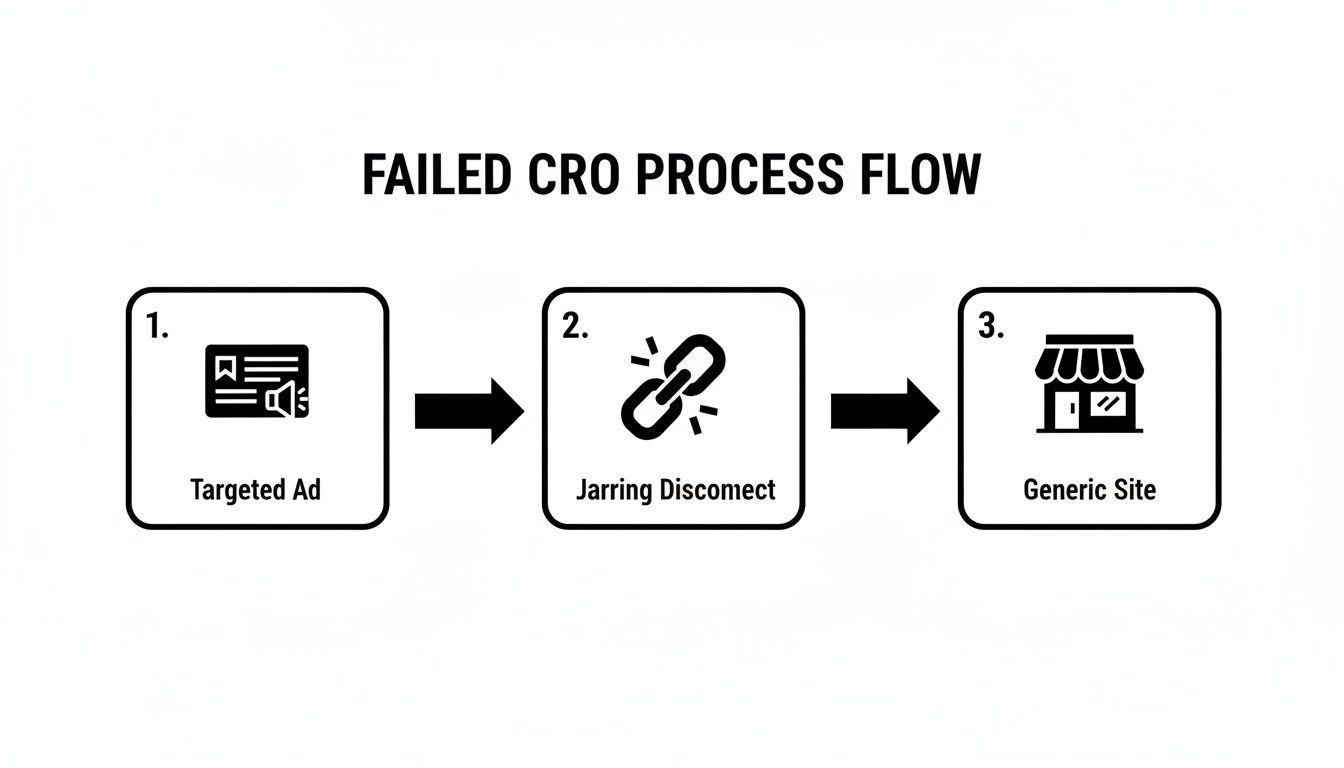
Brands spend $50K+ monthly crafting hyper-targeted ad campaigns. Specific audiences, specific messaging, specific offers. Then they dump that traffic onto a generic homepage that ignores everything the ad promised.
This disconnect kills conversion. The visitor clicked because the ad spoke to their specific situation. They land on a page that speaks to nobody in particular. Trust evaporates. They bounce.
Your tests will fail because you're trying to optimize a fundamentally broken journey. No amount of button testing fixes a messaging mismatch.
The Fix
Build landing page variations that continue the conversation your ads started:
- Premium audience ads: Hide sale banners, lead with quality messaging, show higher-end product imagery.
- Discount-focused ads: Reinforce the offer immediately, show price comparisons, make the deal obvious.
- Product-specific ads: Land on the product page, not the homepage. Pre-select the variant shown in the ad if applicable.
Continuity between ad and landing page is table stakes. Test different landing experiences for different traffic sources, not one generic page for all visitors.
Integrating your testing program with your deployment workflow helps catch issues before they reach production. Understanding CI/CD pipelines allows teams to automate this quality control, ensuring tests launch correctly every time.
What to Do After You Fix These Problems
Diagnosing why tests fail is step one. Step two is building a system that compounds wins over time.
Our collection page filter pills test didn't stop at the initial $42K/month win. The team iterated, testing variations on the winning concept.
This is what a mature testing program looks like. Every test, including losers, generates learnings that inform the next experiment. You stop running random tests and start building institutional knowledge about what your customers actually respond to.
For a complete framework on building this kind of program, see our CRO testing program guide.
Frequently Asked Questions
How do I know if my test has enough traffic?
Use our sample size calculator before launching. Input your current conversion rate, the minimum lift you want to detect (typically 10-20%), and your desired confidence level (95%). The calculator tells you how many visitors per variation you need. If your traffic can't deliver that within 2-4 weeks, either test bigger changes or run fewer concurrent tests.
What's a good win rate for A/B tests?
Industry benchmarks suggest 20-30% of well-designed tests produce statistically significant wins. If your win rate is below 15%, you're likely testing trivial changes or have methodology problems. If it's above 40%, you might be calling tests too early or not pushing bold enough variations. A healthy program has more "inconclusive" results than clear losses, because you're testing meaningful changes at the edge of what you know.
Should I test on mobile and desktop separately?
Always analyze results by device, even if you didn't design device-specific variations. Many tests show opposite results on mobile vs desktop. If you see divergent performance, deploy winners selectively. A change that wins on desktop but loses on mobile should only go live for desktop visitors. Your testing tool should support this level of targeting. We use Intelligems.
How long should I wait before calling a test?
Minimum two full weeks to capture complete business cycles (weekday and weekend shopping patterns). For higher-ticket products with longer consideration periods, extend to three or four weeks. Never call a test before reaching 95% statistical significance, regardless of how "obvious" the winner looks. Early results regress toward the mean more often than they hold.
What metrics should I track beyond conversion rate?
Revenue per visitor (RPV) is the minimum. It combines conversion rate and AOV into a single metric that catches tests which boost conversions but tank order value. If you have margin data, profit per visitor is even better. Also track leading indicators like add-to-cart rate as early warning signals. A test that drops add-to-cart rate is unlikely to win, even if early conversion data looks promising.
Stop Guessing, Start Diagnosing
Failed tests aren't wasted effort if you learn from them. The seven problems above account for the majority of testing failures we see at Shopify Plus brands. Fix them systematically and your win rate, and your revenue, will follow.
At Convertibles, we run testing programs for 8 and 9-figure Shopify brands. We handle the methodology, the development, the QA, the deployment of winners and the analysis so your team can focus on implementing winners. If you're tired of inconclusive tests and want a program that actually moves profit per visitor, book a free strategy call to discuss your roadmap.