

Customer Acquisition and Retention: A Practitioner's Guide for Ecommerce Growth

[ SUMMARIZE WITH AI ]
[ FREE CRO TEARDOWN ]
Find the 3 biggest revenue leaks on your store.
Every day a conversion leak goes unfixed, you're paying for traffic that doesn't buy. Get a 5-minute Loom through your PDP, cart, and checkout, with mockups of the fixes. No pitch.
Get My TeardownThe most effective way to unify customer acquisition and retention is through segment-aware personalization that carries the ad promise through the entire on-site journey. When your acquisition and retention teams operate from the same playbook, targeting the same profit metrics, you stop bleeding cash on disconnected experiences and start compounding customer value.
For most 8-figure ecommerce brands, acquisition and retention feel like two different sports played by two separate teams. They're not. They are two halves of the same game, and when they aren't working together, you get a disjointed customer journey that bleeds cash.
The Cost of Disconnected Customer Journeys
Here's a scenario we see constantly with scaling brands. The paid media team obsesses over one metric: Customer Acquisition Cost (CAC). They live and die by their Cost Per Click (CPC) and Return on Ad Spend (ROAS).
Meanwhile, on a different Slack channel, the CRM team focuses on a completely different world of metrics. They're all about Customer Lifetime Value (LTV), repeat purchase rates, and keeping churn low.
Both teams believe they're driving growth. But because they have different playbooks, budgets, and conflicting goals, they create a jarring experience for the customer.
Imagine someone sees a highly specific Meta ad for a new line of activewear. They click, full of intent, and land on your generic homepage. The product from the ad is nowhere in sight. The special offer is gone. The connection is broken. That person who was ready to buy is now confused, annoyed, and one click away from leaving. All that ad spend? Wasted.
The Financial Impact of Siloed Teams
This isn't just a minor user experience hiccup, it's a direct hit to your bottom line. When your acquisition and retention strategies are out of sync, you actively cap your own profitability.
Here's exactly how the damage is done:
- Wasted Ad Spend: Every click from an ad that leads to an irrelevant landing page is money down the drain. The killer ROAS your media buyer is so proud of means nothing if the visitor bounces before converting.
- Inflated Acquisition Costs: A clunky ad-to-site experience kills conversion rates. This means your ad team has to spend more to acquire the same number of new customers, pushing your blended CAC through the roof.
- Lower Lifetime Value: A bad first impression is hard to shake. Research consistently shows it costs five times more to attract a new customer than to retain an existing one. A frustrating first touchpoint makes it exponentially harder to earn that second, third, and fourth purchase.
This disconnect puts a hard ceiling on your growth. You can't scale profitably when your front-end marketing actively sabotages your back-end retention efforts. It's like filling a bucket with holes in it, you're constantly spending more just to stay level.
Bridging the KPI Divide
At its core, the problem is a battle of metrics. The paid media manager hits their CPA target and calls it a win, regardless of whether those new customers ever buy again. The retention marketer is pulling their hair out over low repeat purchase rates, not realizing the problem started way back at that first click.
The fix requires a fundamental shift in thinking. Stop treating acquisition and retention as separate stages, they are a single, continuous journey.
The goal isn't just to get a cheap click or a first-time sale. The goal is to acquire a profitable, long-term customer. Aligning your teams to achieve this isn't just a nice-to-have, it's a financial necessity for any brand that wants to break through its current growth plateau.
How to Bridge the Gap From Ad to Website
To fix the silo problem, you have to nail the handoff from your ad to your website. Don't think of this moment as just customer acquisition, it's the very first step in customer retention. The promise you make in an ad has to be instantly delivered the second a user lands on your site.
This continuity creates a powerful feeling of recognition and trust. The ad creative, the specific offer, and the exact messaging a visitor just saw are all mirrored right there on the landing page. Anything less feels disconnected and immediately creates friction, making potential customers wonder if they've even landed in the right place.
A generic homepage is the mortal enemy of efficient growth. Sending traffic from a highly targeted Meta campaign to your standard homepage is one of the quickest ways to burn through your ad budget. You're forcing the visitor to hunt for the product or offer that caught their eye, and most won't bother.
The Power of Dynamic Landing Pages
The solution is to build experiences where the ad and the landing page are a perfect match. This doesn't mean you need to create hundreds of unique pages. Instead, you can use URL parameters to dynamically change key elements on a single page template.
This means a visitor who clicks on an ad for your new skincare line sees a headline and hero image featuring that exact product line. Someone else who clicks a "20% Off Your First Order" ad sees that offer displayed front and center, while another visitor from a different campaign might see a "Free Shipping" banner instead.
This approach is the core of effective conversion optimization. It keeps the message consistent, which drastically cuts down bounce rates and boosts conversion rates for first-time visitors. You're meeting their expectations right at the peak of their interest.
An Actionable Example in Practice
Let's walk through how this works for a Shopify Plus brand running multiple campaigns on Meta.
- Campaign Setup: You're running two different ads. Ad A promotes a "Limited Edition Summer Collection" with specific lifestyle imagery. Ad B offers a "15% Welcome Discount" for new customers.
-
URL Parameters: Each ad's destination URL gets a unique parameter. For Ad A, the link might be
yourstore.com?utm_campaign=summer-collection. For Ad B, it'syourstore.com?utm_campaign=welcome-15. -
On-Site Personalization: Using a tool like Intelligems, you set up rules on your site. If the URL contains
summer-collection, the page's hero image and headline automatically switch to match the ad creative. If it containswelcome-15, a banner pops up with the 15% discount code.
The result is a seamless, one-to-one journey from a social feed to your storefront. This isn't just good UX, it's a strategic move that makes your entire ad budget work harder. By kicking off the relationship with such relevance, you set the stage for a much stronger customer lifecycle. You can dive deeper into these tactics by exploring our guide on effective Facebook ad strategies for ecommerce.
This level of precision is more critical than ever as acquisition costs keep climbing. According to data compiled by SimplicityDX, the average cost to acquire a new customer has increased by 60% in the past five years. This massive jump is exactly why smart brands are unifying their acquisition and retention efforts, starting with the very first click. Discover more insights about customer retention from Semrush.
Treating that first click as the real start of your retention efforts is a fundamental mindset shift. It turns your ad spend from a simple acquisition expense into a long-term investment in a profitable customer relationship.
Mapping Your On-Site Personalization Strategy
So, you've nailed the handoff from your ad to your site. What's next? It's time to carry that personalized touch through the entire on-site journey. A generic, one-size-fits-all website shoves every visitor down the exact same path, which is a huge missed opportunity for both customer acquisition and retention. The real magic happens when you map your personalization strategy to where your customer actually is in their lifecycle.
This isn't about guesswork. It's about being smart with your audience, breaking them down into meaningful groups, and then serving up experiences that feel like they were made just for them. For a Shopify Plus brand, this means going way beyond basic demographics and digging into the behavioral and transactional data that tells you what people actually do.
Defining Your Core Customer Segments
Your whole personalization program hinges on having clear, well-defined customer segments. Think of these as your building blocks. They're what let you stop shouting at a crowd and start having a conversation with smaller, more engaged groups.
Every scaling ecommerce brand should begin with these four essential segments:
- First-Time Visitors: They've never bought from you and probably just clicked an ad or a search result. They need to trust you and understand what makes you special, fast.
- First-Time Buyers: They took the plunge and made one purchase, but they're not loyal yet. The goal here is to get them to buy a second time and start turning that purchase into a habit.
- Repeat Customers: These are your regulars who have bought from you two or more times. They already like and trust you, so your focus should shift to increasing their lifetime value and showing them other products they might love.
- High-Value VIPs: This is your all-star team, often your top 10% of spenders. Your job is to make them feel special, reward their loyalty, and turn them into your biggest advocates.
Treating these four completely different groups with the exact same on-site experience is a rookie mistake. Each one has different needs, motivations, and history with your brand. A winning strategy knows this and tailors the experience to match.
If you want to go deeper on the mechanics behind this, you can learn more about what website personalization is and how it directly impacts revenue.
The diagram below shows how this all connects, creating a smooth path from the initial ad click to the on-site experience.
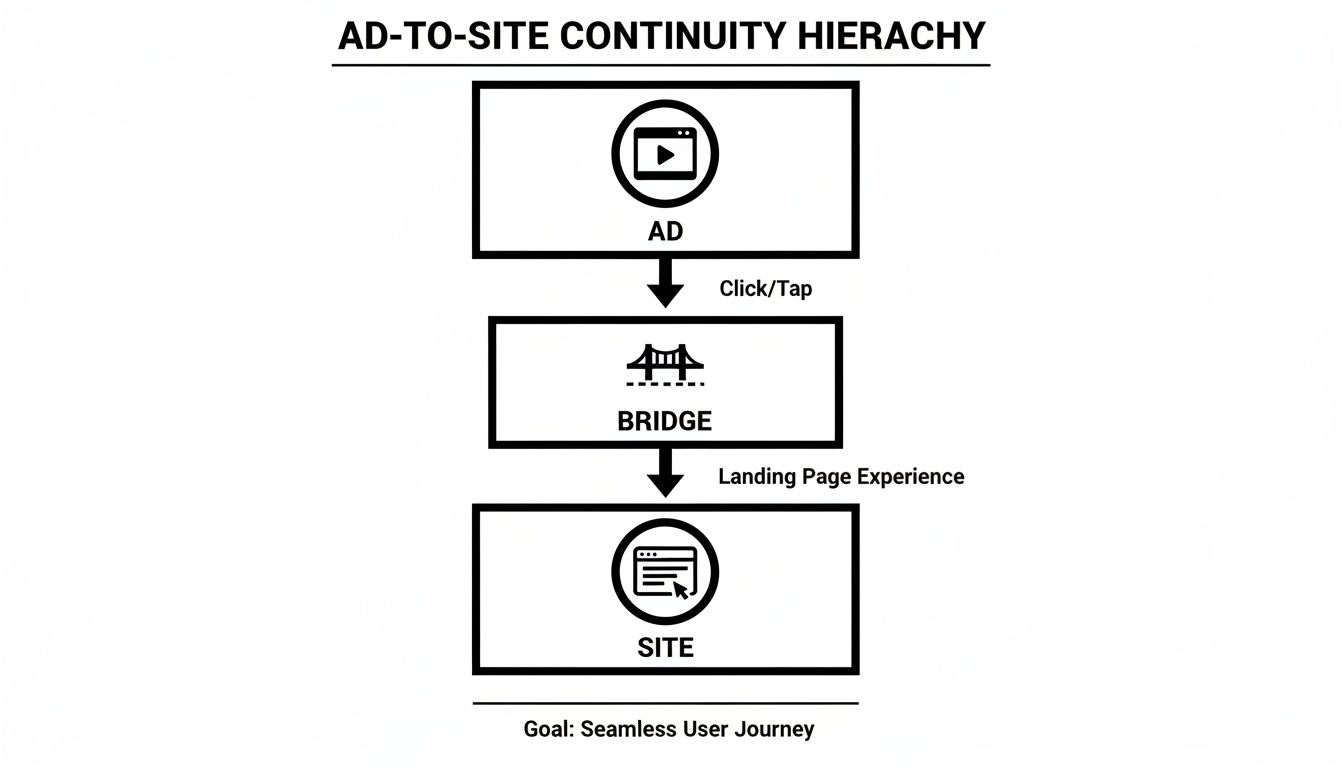
As you can see, that "Bridge", the dynamic landing page experience, is the critical piece that connects your acquisition efforts to your on-site retention journey.
Tailoring Experiences for Each Segment
With your segments locked in, you can start building a playbook of personalization tactics for each one. The idea is to make your store feel uniquely relevant to every single person, no matter where they are in their journey with you.
This playbook helps visualize how to connect your goals for each lifecycle stage with concrete, on-site actions.
Customer Lifecycle Personalization Playbook
| Lifecycle Stage | Primary Goal | On-Site Personalization Tactic | Example Implementation |
|---|---|---|---|
| First-Time Visitor | Build Trust & Drive First Purchase | Display a compelling welcome offer and social proof. | Show a hero banner with "15% off your first order" and feature prominent customer reviews or "As Seen In" logos near the call-to-action. |
| First-Time Buyer | Encourage Second Purchase | Swap introductory offers for relevant product recommendations. | When they return, hide the first-time discount and instead show a "New Arrivals" banner or a post-purchase offer for a complementary item. |
| Repeat Customer | Increase LTV & Loyalty | Personalize content based on past purchase history. | If they've only bought men's apparel, show the men's collection by default on the homepage. Use a pop-up to promote your loyalty program. |
| High-Value VIP | Foster Advocacy & Exclusivity | Provide exclusive access and premium messaging. | Show a navigation link to an "Early Access" collection that is hidden from all other users. Suppress all discount codes and highlight premium perks. |
This table is just a starting point, but it illustrates the core principle: the on-site experience should evolve as your relationship with the customer deepens.
For a First-Time Visitor, for example, your site needs to be all about conversion and building trust. That means a clear welcome offer, easy-to-find social proof, and a simple navigation menu pointing them right to your best-sellers. We've seen firsthand how powerful this can be. In one test for a luxury pajama brand, we added a storytelling module to the homepage that highlighted their Philadelphia studio and hand-painted design process. The result? A $130K per month revenue lift. The insight: price objections often stem from insufficient value communication, so establishing your brand story before visitors encounter the price tag reframes your products from expensive commodities to something worth paying for.
Once they become a First-Time Buyer, the experience shifts. The introductory discount they already used? Gone. In its place, the hero banner might feature "Shop New Arrivals" to encourage that crucial second purchase.
For your Repeat Customers, you can get even more personal. If they've always bought from a specific category, make that the first thing they see on the homepage. You can also start pushing your loyalty program to get them more invested in the brand.
And finally, your High-Value VIPs get the red-carpet treatment. We're talking exclusive access to new collections before anyone else, a dedicated support line, or special content. You stop talking about discounts and start reinforcing their status, building an emotional connection that makes them stick around for the long haul.
Actionable Personalization Plays to Drive Revenue
Mapping out your customer segments is the strategic blueprint. Now it's time for the tactical side, the specific, high-impact personalization playbooks you can roll out to actually drive revenue. We're moving past theory and into proven approaches that connect your customer acquisition and retention efforts directly to your bank account.
The point is to stop serving a one-size-fits-all website and start engineering specific journeys that squeeze more profit out of every visitor. Each playbook below is a mini-breakdown of the strategy, how to execute it, and the results you can expect. Think of them as ready-to-go recipes for growth.
We're moving beyond a single, site-wide offer to a smarter, segment-aware strategy that can seriously move the needle on profitability.
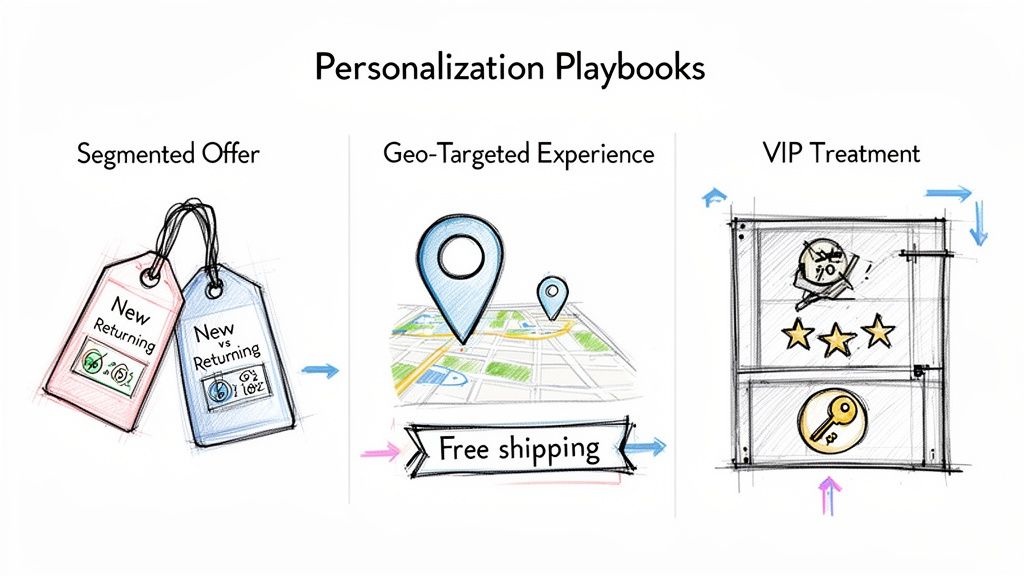
Let's dive into three of our favorites.
Playbook 1: The Segmented Offer
One of the costliest mistakes scaling brands make is slapping a blanket discount on their site for every single visitor. It's a quick way to kill your margins and teach customers to always wait for a sale. This playbook fixes that by letting you test different offers for new vs. returning visitors, so you can maximize AOV without giving away the farm.
- The Strategy: Convert new visitors without handing out unnecessary discounts to loyal customers who were going to buy from you anyway. This play puts a welcome discount for new users head-to-head with a non-discount experience for your regulars.
- How to Execute It: For anyone visiting for the first time, hit them with a hero banner or pop-up with a compelling offer like "15% off your first order." But for all returning customers (identified by a cookie or login), that discount is completely hidden. Instead, show them new arrivals or a reminder about your free shipping threshold.
- The Expected Outcome: You'll see a lift in conversion rates for new visitors while protecting your margins on sales from your loyal repeat buyers. It's a direct boost to your overall profit per session.
This simple split is often the first and most impactful personalization test a brand can run. It immediately separates your acquisition incentive from your retention messaging.
The math behind this is a no-brainer. Research shows that 65% of a company's business typically comes from repeat customers. Those customers also spend about 67% more than new ones. You can dig into the retention research yourself to see just how powerful this is.
For returning customers specifically, consider optimizing the moments where they're most likely to increase their order value. We tested a cart drawer optimization for an 8-figure brand that surfaced their free gift progress at the top of the cart with simple messaging. The result: a $50K per month revenue lift. The key insight was that simple messaging at the point of decision beat complex visuals and double-emphasis strategies.
Playbook 2: The Geo-Targeted Experience
If you ship across the country or internationally, you know shipping is a massive friction point. A generic "Free Shipping over $100" banner doesn't mean much to a customer in New York when your warehouse is in California. This playbook uses a visitor's location to make your shipping promises feel personal and urgent.
- The Strategy: Shrink the perceived shipping time and cost by tailoring on-site messaging based on where the user is browsing from.
- How to Execute It: Set up dynamic banners that change based on a visitor's proximity to your fulfillment centers. A customer in Florida could see, "Fast 2-Day Shipping to Florida," while someone in Oregon sees, "Get it By Friday! We Ship from LA." You're turning a boring operational detail into a personalized benefit.
- The Expected Outcome: This tactic is fantastic for lowering cart abandonment because it tackles shipping anxiety head-on. The added relevance and urgency can lift conversion rates by 2-5% in the regions you target.
Playbook 3: The VIP Treatment
Your best customers should never see the same website as a first-time browser. The VIP Treatment playbook uses Shopify customer tags to create exclusive, password-free experiences for your most valuable buyers. This is a pure retention play designed to build a loyal tribe and boost LTV.
- The Strategy: Reward your high-spenders with exclusive access to products or perks, making them feel like true insiders who are part of the club.
- How to Execute It: Use Shopify tags (like 'VIP' for anyone who has spent over $1,000) to create rules that reveal a unique navigation link to a hidden collection. This page could feature early access to new drops or VIP-only merch. For everyone else, that link is completely invisible.
- The Expected Outcome: This builds a powerful emotional bond with your top customers. That feeling of exclusivity drives higher repeat purchase rates and turns your best buyers into your most vocal brand advocates, creating a powerful loop for both customer acquisition and retention.
Measuring Success with Unified Performance Metrics
To get your acquisition and retention efforts working together, both sides of the house need to be looking at the same scoreboard. It's a classic problem: the paid media team is high-fiving over a low CPA, while the retention team is pulling their hair out over a high churn rate. When this happens, you're operating with conflicting data, and it's impossible to see the real health of your business.
The fix is to ditch the channel-specific vanity metrics. What you need is a single, unified dashboard of KPIs that your entire marketing organization can rally behind. These metrics force both your acquisition and retention teams to take ownership of the entire customer lifecycle, proving the financial impact of a truly cohesive strategy.
Adopting a Unified KPI Dashboard
Shifting to unified metrics means you start asking bigger, better questions. You stop asking, "What was our ROAS on this campaign?" and start asking, "How profitable is each visitor we acquire?" It's a subtle but powerful change in perspective.
Here are the core metrics we use to bridge the gap between getting a customer and keeping them:
- Profit per Visitor (PPV): This is the ultimate top-line metric. It forces you to look past revenue and factor in ad spend, COGS, and discounts to see if you're actually making money from your traffic.
- Blended CAC to LTV Ratio: This is the long-game metric. It connects the cost to get a customer with the total value they bring over their entire relationship with you. For a deeper dive on this, check out our guide on improving customer lifetime value.
- Conversion Rate by Segment: A single site-wide conversion rate doesn't tell the whole story. This KPI breaks down performance by key lifecycle stages, like 'First-Time Visitor' vs. 'Repeat Customer,' instantly showing you where your on-site experience is winning or falling flat.
By focusing on these KPIs, you create a shared language. The ad buyer's success is now directly tied to the LTV manager's goals, forcing collaboration and a more holistic view of performance.
Calculating Your Key Unified Metrics
You don't need a data science team to get these numbers. You can pull them together using the tools you already have, like Google Analytics 4 and your Shopify reports.
Let's quickly break down how to calculate the most important one: Profit per Visitor (PPV).
- Calculate Gross Profit: Start with your Total Sales, then subtract your Cost of Goods Sold (COGS) and any transaction fees.
- Subtract Marketing Spend: From that Gross Profit, subtract all your marketing and advertising costs for the same period.
- Divide by Total Visitors: Take that final number (your Marketing Profit) and divide it by the total number of unique visitors to your site during that period.
The result is a single, powerful number that tells you exactly how much profit each visitor generates on average. This becomes the north star for both your acquisition and retention teams.
Why This Shift Is a Financial Necessity
The old playbook of "growth at all costs" is dead. The balance between acquisition and retention has fundamentally changed, and the data proves it. Companies with strong recurring revenue models are blowing past the rest of the market.
These businesses saw 10.4% revenue growth in 2023, compared to just 6% for the average S&P 500 company. Their secret? They obsess over keeping churn low while increasing the value of each customer they already have.
To get the full picture of your brand's performance, it's also helpful to analyze the relationship between share of market vs share of voice. This unified approach to measurement isn't just about cleaner reporting, it's about building a more resilient and profitable business. When both of your teams are gunning for profit, you create a self-reinforcing cycle of sustainable growth.
Building Your 90-Day Personalization Roadmap
Looking at the big picture of overhauling your entire marketing operation can be overwhelming. Shifting from siloed teams to a single engine for customer acquisition and retention feels like a massive project. But you don't have to do it all at once.
The secret is to start small and build momentum with a structured, 90-day plan. Think of it less as a single "big bang" launch and more as a compounding series of segment-specific experiments. The goal is to build a predictable growth engine, and that starts by picking off the low-hanging fruit first.
We prioritize tests using a simple matrix: potential impact versus ease of implementation. Focus on what's easy to do but has a high chance of success. This helps you get early wins on the board, which builds momentum and proves the value of this approach to the rest of the company.
Prioritizing Your First Tests
So, where do you start? Your first experiments should be simple to launch and have the potential to really move the needle on core metrics like profit per visitor. The segmented offer playbook we just covered is a perfect starting point.
Here's what that looks like in practice:
- Hypothesis: If we show a 15% discount only to new visitors, we'll boost their conversion rate without giving away margin on repeat buyers who were likely to purchase anyway.
- Segments: New Visitors vs. Returning Customers.
- Implementation: Use a personalization tool to display a discount banner just to first-time visitors (those with no purchase history) and hide it from everyone else.
This is a classic "quick win" test. It's usually easy to set up, doesn't require a ton of new creative, and gives you a clean, measurable result. By starting here, you begin to collect real data on how different customer groups respond to your offers, which makes every test that follows even smarter.
Your 90-day plan is a commitment to continuous learning. Every test, win or lose, hands you an insight that sharpens the next one. This is how you systematically increase profit across the entire customer lifecycle.
Structuring Your Roadmap for Compounding Growth
As you work through your 90-day plan, your tests should naturally become more sophisticated, each one building on what you learned from the last.
A typical roadmap might flow like this:
- Month 1: Go after high-impact acquisition plays. Think segmented welcome offers and creating that seamless ad-to-site continuity for your top-performing campaigns.
- Month 2: Start layering in retention-focused tests. You could try showing personalized product recommendations to first-time buyers or promoting your loyalty program specifically to returning customers.
- Month 3: Introduce more advanced segmentation. This is where you can get creative with things like geo-targeted free shipping messages or exclusive on-site experiences for your VIPs.
This methodical approach ensures you're deliberately improving the journey for every important customer group. The result? A compounding system where small, consistent wins in customer acquisition and retention add up to significant, long-term growth.
Burning Questions About Tying It All Together
We get a lot of questions from brands trying to connect the dots between their acquisition and retention efforts. Let's tackle the most common ones we hear, giving you some straight answers to help you figure out what to do next.
How Can We Start Personalizing Without a Big Dev Team?
You'd be surprised how far you can get without a massive development team. The trick is to start with tools that let your marketing team run the show, no coding required. Platforms like Intelligems are built for this, allowing you to easily change headlines, swap out hero images, or test different offers based on where a visitor came from.
Start small but smart. A segmented welcome offer is a perfect first play. It's simple to set up but immediately syncs your ad's promise with the on-site experience. This one move can prove the value of personalization and help you get buy-in for bigger projects down the road.
What's the Biggest Mistake Brands Make Here?
Hands down, the biggest mistake is measuring things in isolation. Too often, the acquisition team is high-fiving over a low CPA, while the retention team is pulling their hair out over poor LTV from those same customers. They never connect the dots because their goals and dashboards are completely separate.
When you truly unify customer acquisition and retention, you have to use shared metrics. Think Profit per Visitor (PPV). When both the ad buyers and the email marketers are on the hook for the same number, they're forced to work together. It stops being a choice and starts being a necessity.
How Long Until We See a Positive ROI?
A well-planned personalization program can pay for itself surprisingly fast. While a full-blown, multi-segment strategy is a long-term game, individual tests can show a lift in just a few weeks. Simple plays, like that segmented offer we just talked about, can often produce a measurable jump in profit per session within the first 30-60 days.
The real magic is in the compounding growth. Each winning test builds on the last, creating a system that gets smarter and more profitable over time, improving performance across the entire customer journey.
Frequently Asked Questions
Should I focus on customer acquisition or retention first?
It depends on your stage. Early-stage brands need acquisition volume to build a customer base. But for established brands past $3M revenue, retention typically delivers higher ROI since acquiring a new customer costs 5x more than retaining an existing one. The real answer is bridging both with a unified strategy.
How do I measure if my acquisition and retention efforts are working together?
Track three metrics: Profit Per Visitor across segments, blended CAC-to-LTV ratio, and conversion rate by visitor type (new vs returning). If acquisition costs are rising but LTV is flat, your retention strategy is leaking the value your acquisition is generating.
What is the fastest personalization win for acquisition and retention?
Segment your homepage by visitor type. Show first-time visitors social proof and welcome offers. Show returning customers personalized recommendations based on browsing or purchase history. A single homepage personalization test can produce measurable results within 14-21 days.
How long does it take to build a personalization program?
A focused 90-day roadmap works for most brands. Month one covers acquisition plays like segmented landing pages. Month two focuses on retention tests like VIP experiences. Month three introduces advanced segmentation. You should see measurable results within 30-60 days of the first test.
We work on tactics like these daily, book a call to get 3 custom (tailored for your business), researched personalization ideas to get you started.