

Ecommerce Dynamic Pricing for Shopify Plus: A Complete Guide (2026)

[ SUMMARIZE WITH AI ]
[ FREE CRO TEARDOWN ]
Find the 3 biggest revenue leaks on your store.
Every day a conversion leak goes unfixed, you're paying for traffic that doesn't buy. Get a 5-minute Loom through your PDP, cart, and checkout, with mockups of the fixes. No pitch.
Get My TeardownDynamic pricing adjusts product prices in real time based on market conditions and customer behavior. Instead of a rigid, one-price-fits-all model, it responds to demand, competitor moves, and shopper context to find the optimal price for every transaction.
For operators managing multi-million dollar Shopify Plus brands, this isn't a novelty. It's a critical lever for protecting margins when ad costs keep climbing.
What Is Dynamic Pricing and Why It Matters
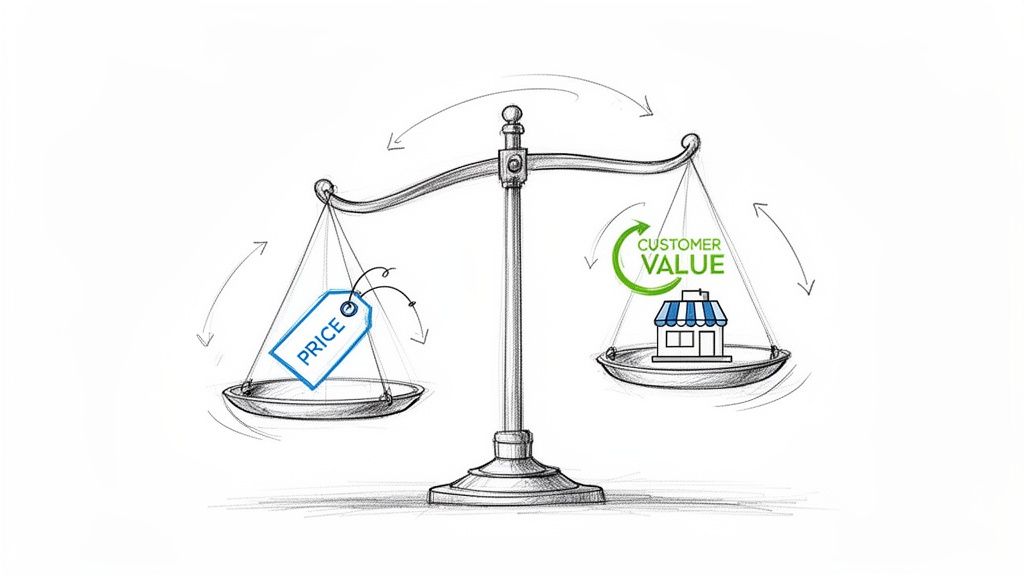
With rising ad costs and tightening margins, sticking to a single, static price is a liability. You're forced to pick one price and hope it works for everyone, all the time. This inevitably means you're either undercharging high-intent shoppers or deterring price-sensitive ones. Either way, you're leaving profit on the table.
Dynamic pricing treats price as a conversion tool, not a fixed number. It creates a direct, real-time link between what a customer sees and the value they perceive at that moment. For any brand investing heavily in paid acquisition, this is how you protect margins and maximize return on ad spend.
At CONVERTIBLES, we help Shopify Plus brands implement dynamic pricing as part of a broader personalization strategy. The brands seeing the best results don't treat pricing as isolated from their optimization program. They test prices the same way they test headlines, images, and offers.
Moving Beyond a Single Price Point
The objective is to stop guessing and start responding. Instead of setting prices based on historical data or gut feeling, dynamic strategies use live signals to find the revenue-maximizing sweet spot. This isn't just about matching a competitor's sale. It's about proactively managing demand and profitability.
For example, you could show a slightly higher price to a loyal, returning customer who values your brand, while offering a small welcome discount to a first-time visitor from a competitive shopping ad.
Static vs Dynamic Pricing At a Glance
| Feature | Static Pricing | Dynamic Pricing |
|---|---|---|
| Price Adjustment | Manual, infrequent changes | Automated, real-time adjustments |
| Strategy Basis | Cost-plus or competitor-based | Based on demand, behavior, and market data |
| Customer Focus | One price for all customers | Personalized or segmented prices |
| Profit Potential | Limited, average margin focus | Maximized, captures full value from each segment |
| Inventory Impact | Can lead to excess stock or stockouts | Helps clear inventory and manage demand spikes |
| Competitive Edge | Reactive and slow to adapt | Proactive and highly responsive |
The Strategic Advantage for Growing Brands
For brands generating between $3M and $200M annually, a smart dynamic pricing strategy isn't a nice-to-have. It's a direct path to higher profits:
- More Profit From Every Visitor: By tailoring prices to different customer segments, you stop leaving cash on the table with shoppers who are willing to pay more.
- Better Conversion Rates: You can nudge hesitant buyers over the finish line with targeted offers, converting visitors who would have otherwise abandoned their cart. This builds on the concepts in our guide on psychological pricing examples.
- Smarter Inventory Control: Need to move excess stock? Dynamic pricing lets you offer discounts to specific audiences without running a site-wide sale that erodes your margins.
The goal isn't just to change prices. It's about aligning price with a customer's intent and perceived value. A well-run dynamic pricing model matches the right price to the right person at the right time.
Four Core Dynamic Pricing Models for Growth
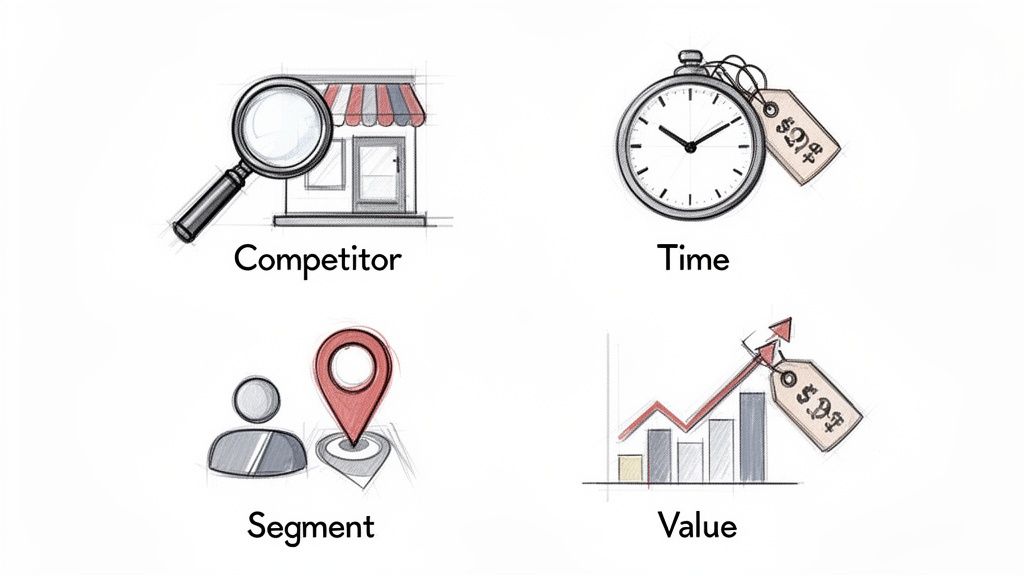
Implementing dynamic pricing isn't about flipping a single switch. It's about deploying the right strategic model that fits your brand, products, and business objectives.
1. Competitor-Based Pricing
This is the most common entry point for many brands. With competitor-based pricing, you set your prices to automatically react to your direct rivals' actions.
The goal isn't a race to the bottom. It's about strategically defending your position on price-sensitive products. If a key competitor drops the price of a hero product by 10%, your system can automatically match it to remain competitive on that specific SKU. If a competitor sells out, your price could nudge upward to capture more margin from the remaining demand.
- Who It's For: Brands in crowded markets with direct competitors and easily comparable products (electronics, supplements, household goods).
- When to Use It: Essential for maintaining market share during major shopping events like Black Friday or when launching a new product into a saturated category.
2. Time-Based Pricing
Often called surge pricing, the time-based model uses time as the primary lever for price changes. The strategy is built on a simple truth: demand for a product is never flat. It fluctuates based on time of day, day of week, or season.
A classic "happy hour" sale offers a discount during historically slow traffic hours to stimulate sales. Increasing the price of seasonal items like swimwear as summer approaches lets you maximize revenue when demand is high.
- Who It's For: Businesses with products tied to clear seasonal demand (fashion, outdoor gear) or those with predictable daily or weekly traffic patterns.
- When to Use It: A great way to clear end-of-season inventory without resorting to a site-wide sale, or for creating urgency with flash sales on specific collections.
3. Segmented Pricing
This is where you execute true personalization. With segmented pricing, you offer different prices to different customer groups based on their profile or acquisition channel. It's a direct acknowledgment that not all shoppers are the same, and their willingness to pay varies significantly.
You can define segments in numerous ways:
- Geography: Show different prices to customers in different countries or states to account for shipping costs, local market prices, or taxes.
- Customer Lifecycle: Offer a 15% welcome discount to a first-time visitor while showing the full price to a loyal, repeat customer.
- Traffic Source: Provide a special offer to users who clicked a high-intent Google Shopping ad, which differs from what a visitor from a general social media post might see.
The core idea is to match the price to the shopper's context. When you align the offer with their journey and profile, you create a much more relevant experience that improves conversion rates.
This is the model we implement most often at CONVERTIBLES. Connecting your ad spend to tailored onsite pricing creates a seamless experience that drives both conversion and margin.
4. Value-Based Pricing
This is the most sophisticated and profitable model. Value-based pricing shifts focus from external factors like competitors or time to a customer's perceived value of your product. Executing this requires a deep understanding of your customers and the discipline to test price elasticity rigorously.
Implementing this means running controlled A/B price tests on different customer segments to find the sweet spot that maximizes revenue without tanking your conversion rate. For example, you might test whether a $5 price increase on a bestseller affects conversion for repeat buyers differently than for new customers.
Brands often pair this strategy with product kitting. You can dive deeper into that in our guide on examples of price bundling.
- Who It's For: Mature brands with strong brand recognition, unique products, and a serious commitment to data analysis and testing.
- When to Use It: When you have a high-margin hero product and want to find the absolute price ceiling the market will bear, or when launching a premium version of an existing product.
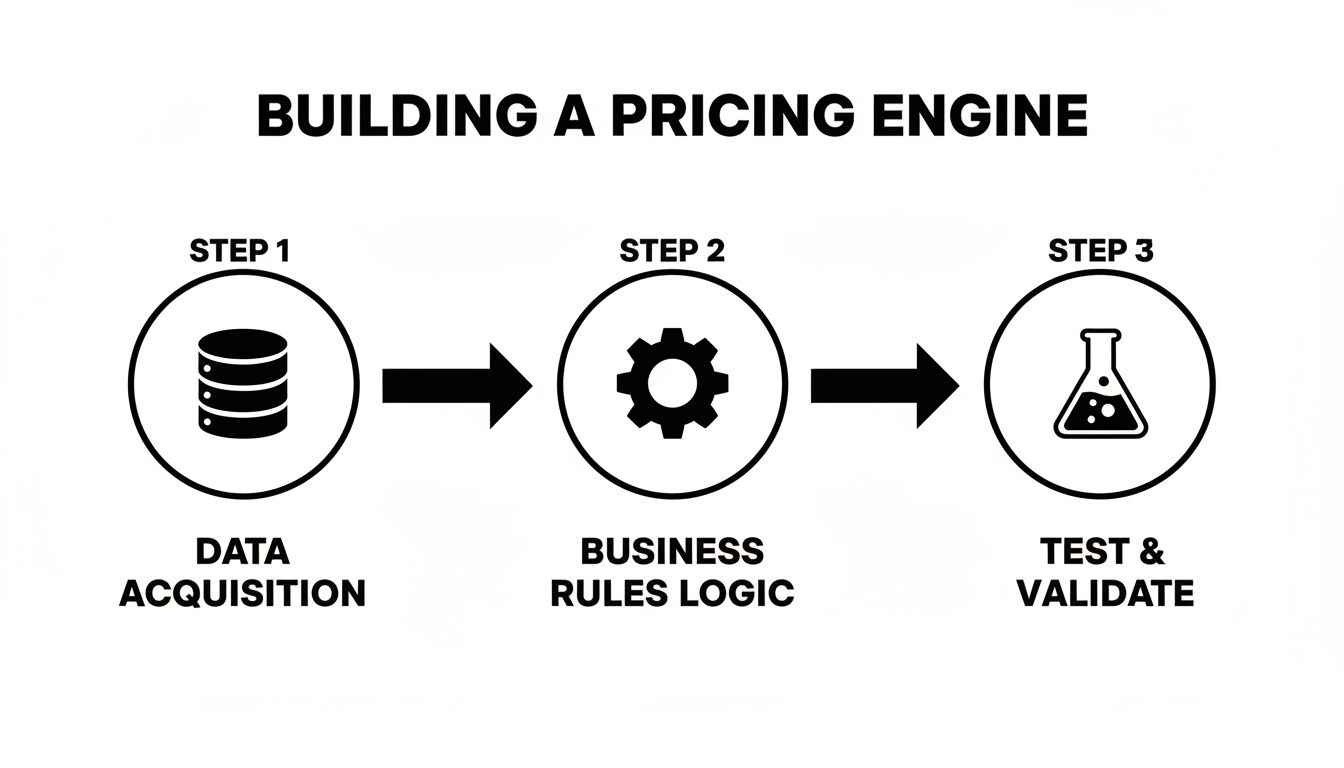
Building Your Dynamic Pricing Engine on Shopify Plus
Moving from theory to execution requires two things: the right data and the right technology. For brands on Shopify Plus, this doesn't mean building a monolithic, enterprise-level system from scratch.
The real challenge is intelligently connecting your data sources with a lean, effective tech stack. It's about making your data actionable to drive profitable personalization.
What Data Do You Actually Need?
Your pricing strategy is only as smart as the data you feed it. A solid dynamic pricing model needs to pull from several sources to make intelligent, real-time decisions.
Think of the data inputs falling into four main buckets:
- Customer Data: This is the foundation for segmented or personalized pricing. Purchase history, browsing activity, and customer lifecycle stage (new vs. loyal). This information typically comes from your Customer Data Platform (CDP) or CRM.
- Internal Product Data: Data from your Shopify admin and inventory system. Sales velocity, current stock levels, profit margins per SKU, and return rates.
- Competitor Data: You can't price in a vacuum. Knowing your competition's moves is critical. Competitor AI analysis tools and monitoring platforms like Prisync provide live feeds on what rivals are charging and their stock levels.
- Market Data: Broader signals that influence demand. Seasonality, holidays, and ad performance. If CPCs are soaring for a specific campaign, that's a strong signal of high intent, potentially justifying a unique offer for that traffic.
Essential Data Inputs for Dynamic Pricing Models
| Pricing Model | Primary Data Source | Secondary Data Source |
|---|---|---|
| Segmented Pricing | Customer Data (CDP, CRM) | Internal Product Data |
| Value-Based Pricing | Customer Data (Behavioral) | Market Data (Trends, Seasonality) |
| Competitive Pricing | Competitor Data (Monitoring Tools) | Internal Product Data (Margins) |
| Time-Based Pricing | Internal Product Data (Inventory) | Market Data (Holidays, Events) |
The Tech Stack to Make It Happen
Once you know what data you're working with, you need the right tools to act on it. The goal isn't to build one giant, all-in-one platform. Instead, connect a few best-in-class Shopify apps that work together seamlessly.
A powerful, agile setup usually includes three core components:
- A Central Data Warehouse: Tools like BigQuery or Snowflake become your single source of truth, consolidating data from Shopify, your CDP, and your marketing platforms.
- A Price Testing & Personalization Engine: This is the action layer. It's where you'll build your pricing rules, set up experiments, and deploy your strategies.
- Analytics & Reporting Tools: A platform like Looker or Tableau helps you monitor performance, analyze test results, and report on key KPIs like profit per visitor.
Putting Your Strategy in Motion with Intelligems
Within the Shopify ecosystem, Intelligems is a standout tool for executing dynamic pricing. It lets you run sophisticated price tests and personalize offers without needing a team of developers to custom-code every experiment.
For example, you could easily set up a test to show one price to new visitors from a specific ad campaign, while everyone else sees your standard price. You can manage multiple price tests and offers at once, closely monitoring metrics like conversion rate, revenue, and most importantly, profit to identify the winner.
The real power is moving beyond simple A/B testing and into a full-blown optimization program. This is exactly how we structure testing programs for CONVERTIBLES clients: continuous experimentation that compounds gains over time.
If you're running international stores, applying these pricing rules correctly across different markets is another challenge entirely. We break that down in our guide on currency formatting on Shopify.
When you connect your data sources to a tool like Intelligems, you create a powerful feedback loop. Test a hypothesis, measure its direct impact on profit, then roll out the winning strategy to the right customer segments. This turns dynamic pricing from a daunting technical project into a repeatable process for growth.
Your First Dynamic Pricing Test Roadmap
Let's translate theory into action. Launching a dynamic pricing test isn't about throwing things at the wall. It's a disciplined process of running methodical experiments, learning from the data, and making intelligent adjustments.
Step 1: Set a Clear and Measurable Goal
Before changing a single price, define exactly what you're trying to achieve. A vague goal like "increase revenue" is a recipe for a failed test. Tie your experiment to a specific, quantifiable business metric.
Actionable goals look like this:
- Increase the profit margin on our bestselling sneaker collection by 5%.
- Boost the Average Order Value (AOV) for first-time customers by $10.
- Improve the conversion rate for traffic from our top-of-funnel Facebook ads by 20%.
Step 2: Select Your Test Segment and Product Category
Don't boil the ocean. Your first test shouldn't be a site-wide free-for-all. Isolate your experiment by focusing on a specific audience and a limited product set. This produces a clean result, minimizes risk, and makes the data much easier to interpret.
Start with a high-intent audience. A great example is targeting new visitors arriving from a high-intent Google Shopping ad campaign. These users are already in a buying mindset, making them a perfect group for a price-based offer.
Next, pick a product category with enough traffic and sales to yield a statistically significant result quickly. A collection of bestsellers or a category with healthy margins is usually the right place to start.
Step 3: Formulate a Strong Hypothesis
Your hypothesis is your educated guess about the outcome, framed as a clear "if-then" statement. It connects your proposed change to your desired result.
A strong hypothesis is specific and measurable. It should clearly state the action you're taking, the segment you're targeting, and the metric you expect to move.
Examples:
- Hypothesis A: "By offering a 10% discount on our core skincare bundle to new users from our TikTok campaign, we will increase the Add-to-Cart rate by 15% because the offer will create a sense of urgency."
- Hypothesis B: "By increasing the price of our premium leather tote bag by $20 for all US visitors, we will increase our profit per visitor by 8% without a significant drop in conversion rate."
Step 4: Configure and Launch the Test
With a goal, segment, and hypothesis locked in, it's time to build the test. Using a tool like Intelligems on Shopify Plus lets you set up all the necessary pricing rules and audience targeting without writing a single line of code.
Inside the platform, you'll define your "variants," the different prices or offers you want to test against your control (the current price). For example, you might set up an A/B/C test: one group sees the original price, a second sees a 5% discount, and a third sees a 10% discount. Then assign these variants to the customer segment you identified in Step 2.
Step 5: Monitor Key Performance Indicators
Once your test goes live, the work isn't over. Don't just obsess over the conversion rate. A lower price will almost always yield more conversions, but that doesn't automatically mean it's more profitable.
The two most important KPIs for any pricing test are profit per visitor and Average Order Value (AOV). These metrics paint the full financial picture. Also monitor secondary metrics like Add-to-Cart rate and cart abandonment to gain deeper understanding of customer behavior.
Step 6: Analyze Results and Iterate
Once your test has run long enough to reach statistical significance, meaning you have enough data to be confident in the outcome, analyze the results. Did your hypothesis hold up? Did the winning variant achieve your goal?
If you found a clear winner that boosted your profit per visitor, roll it out to that segment. But the job isn't done. The insights from this test should fuel your next hypothesis. Perhaps that 10% discount worked well, but would a "Free Shipping" offer for the same segment perform even better? That's your next test.
This is the rhythm of a mature personalization program: shipping multiple, validated experiences every month to compound your gains over time.
Navigating the Risks of Dynamic Pricing
While dynamic pricing can boost profits, it's not without risks. Changing prices on the fly without a solid plan can damage your brand, alienate your best customers, and create legal issues.
The key is to think of it as creating a fair exchange of value, not manipulating numbers.
Avoiding Customer Backlash
Nothing kills brand trust faster than making a customer feel manipulated. Imagine a shopper sees a price, hits refresh, and the price is suddenly higher. That feeling of being played is toxic and can tarnish your reputation for a long time.
The antidote is transparency and a clear sense of fairness. Your pricing logic can't appear random or predatory. It needs to be tied to a clear value proposition.
Here's how to get it right:
- Segment by Behavior, Not Identity: Base your pricing on what people do, not who they are. Offering a special price to a first-time visitor or someone who abandoned their cart is acceptable. Segmenting based on protected classes like race, gender, or religion is not.
- Give a Reason: Frame price adjustments as a benefit. A "Welcome Discount" for new shoppers or a "Loyalty Offer" for returning customers feels like a reward. It's a completely different experience from a price hike that seems to penalize someone for no reason.
- Keep Prices Consistent (in the Moment): Once a customer is on your site, they should see the same price for a product throughout that entire visit. Any changes should occur between sessions or for different, clearly defined customer groups.
When customers feel your pricing is part of a personalized experience that understands them, they're more likely to embrace it. You want them to feel seen, not targeted.
Sidestepping Destructive Price Wars
A classic blunder is blindly following competitors into a race to the bottom. Yes, you need to monitor your competition, but that doesn't mean matching every single price drop. That's a war nobody wins. It just torches your margins and trains customers to only care about the lowest price.
Instead, use competitor data as a compass, not a map you must follow precisely. The goal is to be competitive, not just cheap.
Consider this scenario: your main competitor launches a massive, site-wide sale. You don't have to panic and slash all your prices. A smarter move would be to match their price on only your top three most price-sensitive products. For everything else, hold the line, protecting your margins where customers are less likely to be comparison shopping.
Ensuring You Stay on the Right Side of the Law
Dynamic pricing itself is legal, but price discrimination is not. Laws like the Robinson-Patman Act in the U.S. were specifically created to prevent anti-competitive price discrimination.
The line in the sand is fairness. It's illegal to charge different people different prices based on protected characteristics. However, it's generally acceptable to offer different prices based on legitimate business factors:
- Purchase volume (bulk discounts)
- Customer status (new vs. returning customers)
- Geographic location (especially when tied to real costs like shipping)
Your rules must be built on sound business logic and applied consistently to everyone in a particular segment. Document your pricing policies and ensure your entire team understands the legal boundaries.
Your Next Step to Profitable Personalization
If you're still using a one-price-fits-all model, you're leaving money on the table. Moving into dynamic pricing isn't just another tactic. It's a sign of a mature optimization program. You're no longer just chasing a higher conversion rate. You're focused on maximizing the profit you make from every single visitor.
The strategies we've covered aren't about randomly slashing prices. They're about creating a smarter, more personal experience that connects the right offer with the right person at the right time.
For Shopify Plus brands that have outgrown basic A/B testing, this is how you level up. But a shiny new tool won't do the work for you. A successful dynamic pricing program requires a solid strategy, a team that embraces testing, and the right tech to execute it flawlessly.
Embrace a Continuous Optimization Program
The real goal is to stop running occasional tests and start building a consistent, repeatable process for growth. An effective personalization program should be launching multiple, validated experiences every single month.
Each test, whether it's a small price tweak on a popular product or a special offer for a targeted ad campaign, informs the next. This creates a powerful compounding effect that you'll see reflected directly in your profit margins.
This methodical approach transforms your website from a static storefront into an adaptive engine for growth. By testing, learning, and iterating, you systematically uncover pockets of profit you never knew existed.
If your team is ready to move beyond generic CRO and build a testing program that drives real, measurable profit, we should talk. At CONVERTIBLES, we specialize in helping Shopify Plus brands connect their advertising spend directly to tailored onsite experiences using tools like Intelligems.
Book a free strategy call to discuss how dynamic pricing fits into your optimization roadmap.
Frequently Asked Questions
Is Dynamic Pricing Legal for Ecommerce Stores?
Yes. Dynamic pricing is a legal practice for ecommerce stores, as long as it isn't used to discriminate against legally protected groups.
Strategies based on real-world market factors are generally fine: supply and demand, competitor pricing, or customer behavior (like offering a special price to new vs. returning visitors). The crucial part is making sure your pricing rules are tied to legitimate business reasons and applied fairly to everyone within a specific group.
Will Dynamic Pricing Hurt My Brand Reputation?
It can if done badly. The fastest way to damage your brand is to make customers feel taken advantage of.
The key is transparency and a clear value exchange. Giving a first-time visitor a discount feels like a welcome gift, not a penalty for someone else. Avoid sudden, dramatic price jumps or showing the same person two different prices in the same shopping session.
When done right, a smart pricing strategy actually strengthens loyalty. It shows customers you understand them and are offering a fair price based on their relationship with your brand.
How Much of a Price Change Is Needed to See an Impact?
There's no single magic number, and that's precisely why testing is so important. Even tiny adjustments of 3-5% can make a significant difference to your profit per visitor and overall margins, especially on your most popular products.
If your goal is clearing out old inventory, you might need a bigger discount to get things moving. The best approach is to start with small, controlled A/B tests on specific product lines or customer segments. This is how you'll figure out your price elasticity and discover the sweet spot that works for both your brand and your customers.
What Tools Do I Need for Dynamic Pricing on Shopify?
At minimum, you need a price testing tool that integrates with Shopify Plus. Intelligems is the most popular choice for sophisticated price testing and personalization.
For competitor monitoring, tools like Prisync or PriceMole can track rival pricing automatically. And for the full picture, connecting these tools to a data warehouse (BigQuery, Snowflake) lets you build more sophisticated pricing rules based on multiple data sources.