

High Ticket Ecommerce Playbook: Scaling Profit for 7- and 8-Figure Brands

[ SUMMARIZE WITH AI ]
[ FREE CRO TEARDOWN ]
Find the 3 biggest revenue leaks on your store.
Every day a conversion leak goes unfixed, you're paying for traffic that doesn't buy. Get a 5-minute Loom through your PDP, cart, and checkout, with mockups of the fixes. No pitch.
Get My TeardownSelling high-ticket items online, products priced from $1,000 to over $10,000, is an entirely different discipline. The customer journey is driven by deep consideration, not a split-second impulse. To win, you need a strategy built on trust, granular education, and a personalized experience that surgically targets high-value customer segments. Standard DTC tactics won't cut it.
The High Ticket Execution Gap: Why Standard CRO Fails
The playbook used to sell a $50 t-shirt will fail when selling a $2,000 standing desk or a $5,000 custom sofa. The buyer psychology is worlds apart, yet many brands treat the onsite experience identically.
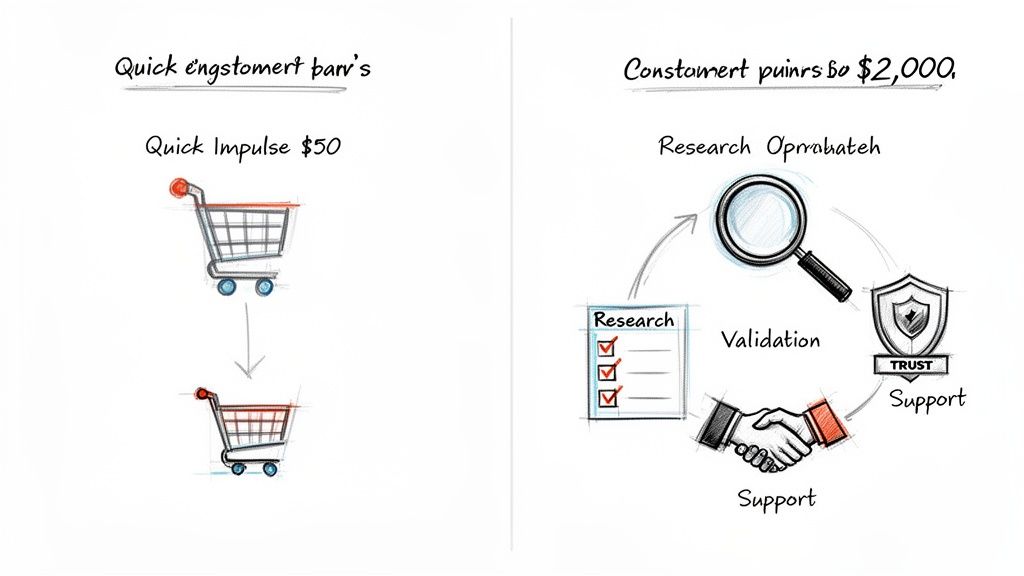
A significant purchase is an investment. Your potential customer spends weeks, sometimes months, conducting research, comparing you to every alternative, and seeking validation. They aren't just buying a product, they are buying confidence in their decision. This longer buying cycle requires your entire approach to shift from transactional to relational.
The Consideration-Driven Journey
A typical customer path might start with a social media ad, followed by a brief site visit, then a departure to read a dozen third-party reviews. A week later, they may return directly after searching for your brand name.
This is where many brands lose. They invest heavily in top-of-funnel ads that promise a premium, bespoke experience, only to dump that highly qualified traffic onto a generic, one-size-fits-all website. That disconnect shatters trust instantly and sends high-intent buyers straight to competitors. Your website experience must match the high-end promise of your marketing.
The core challenge in high-ticket ecommerce isn't just acquiring traffic. It's translating the promise made in your ads into a tangible, confidence-building experience for every visitor.
Why Surface-Level Optimization Falls Short
Traditional conversion rate optimization (CRO) often focuses on minor, sitewide tweaks like changing a button color or testing a homepage headline. While not useless, these tactics are outmatched by the challenge of high-ticket sales. A 0.5% lift from a button test is a rounding error when your objective is to convince someone to part with several thousand dollars.
Instead of tinkering at the margins, you need a strategic framework built on three core pillars:
- Deep Segmentation: Understand not just who your buyers are, but what they need to see and feel at each stage to gain enough confidence to purchase.
- Bespoke Onsite Experiences: Engineer different journeys for different segments. A first-time visitor from a Facebook ad has different questions than a returning prospect from your email list.
- Trust and Validation: Weave social proof, expert endorsements, hyper-detailed specifications, and clear policies into every step of their journey.
This approach moves beyond simple A/B testing into a more sophisticated strategy. While foundational tactics are always important (see our guide on how to improve your ecommerce conversion rate), personalization is the primary engine for profitable growth in the high-ticket world.
This guide outlines the playbook for building a high-ticket strategy that turns cautious consideration into confident conversion.
Finding Your Most Valuable Customer Segments
A one-size-fits-all store experience is the fastest way to kill a high-value sale. In high ticket ecommerce, growth comes from precision, not from casting a wider net. That precision begins with a deep, data-driven understanding of who your best customers are.
Your Shopify backend and ad platforms contain this information. We must move past personas built on demographics. Actionable segments are found in observed behaviors, what people actually do, not just who we think they are.
Extracting Insights from First-Party Data
The goal is not just to analyze traffic, it's to connect the dots between where a visitor came from, their onsite behavior, and their lifetime value. This process maps out who is actually driving revenue.
Here are the key data points to start with when building customer segments:
- Acquisition Channel: Someone who lands from a Google Search ad for "premium leather sectional" is in a different mindset than someone who clicked a link from a design blog. The first is in a buying mode, the second is in discovery.
- Ad Campaign Performance: Analyze your ad campaign results. A specific Facebook lookalike audience may have a lower overall conversion rate but a 30% higher AOV. This is a segment demanding closer attention.
- RFM Analysis: Dig into Recency, Frequency, and Monetary value. A customer who bought twice in the last six months for over $3,000 is one of your most valuable assets, perfect for new product launches or upsells.
- Onsite Behavior: Before they buy, what pages do your best customers view? Do they use the search bar? Do they spend five minutes on your "About Us" page? These actions are clues about what information they need to feel confident.
This is your raw material. With this data, you can build segments rooted in reality, not guesswork.
From Data to Actionable Personas
Once patterns emerge, you can group them into actionable customer personas. These are not decorative office posters, they are strategic blueprints for building personalized shopping experiences.
Here are a few examples of segments you might uncover:
-
The First-Time Luxury Buyer: This person likely found you on Instagram or Facebook. They are new to your brand and perhaps the high-ticket category. They require substantial social proof, obvious financing options like Affirm or Klarna, and content that validates their spending decision. Their entire journey needs to build trust.
-
The Returning VIP: This customer is on your email or SMS list and has purchased before. Greet them accordingly. Show them loyalty perks, new arrivals based on past purchases, or offer exclusive bundles. Make them feel recognized.
-
The Researcher: This person has visited your site multiple times over several weeks from different devices. They are making a considered purchase. You must make it easy for them to compare products, save favorites, and find every specification and customer review.
Defining segments like these allows you to stop shouting one message at everyone. You start having a targeted conversation with each group, providing exactly what they need, when they need it.
With these high-value segments defined, you are ready to move beyond generic conversion optimization and start building tailored site experiences that convert high-intent visitors into high-value customers.
Building a Personalized Onsite Journey That Converts
Once you’ve identified your high-value segments, stop treating every visitor the same. In high-ticket e-commerce, the most significant gains come from building intentional, specific journeys that guide each customer type toward a purchase they feel great about. This is not about minor tweaks, it's about re-architecting the user experience from their perspective.
Effective personalization is more than inserting a first name into an email. It’s about making your site feel dynamic, where content, offers, and navigation adapt in real-time to who is visiting. For a deeper dive into the fundamentals, read our guide on what website personalization is.
When executed correctly, your site transforms from a static catalog into an expert sales consultant.
The diagram below illustrates how raw customer data becomes detailed personas, the foundation of these tailored journeys.
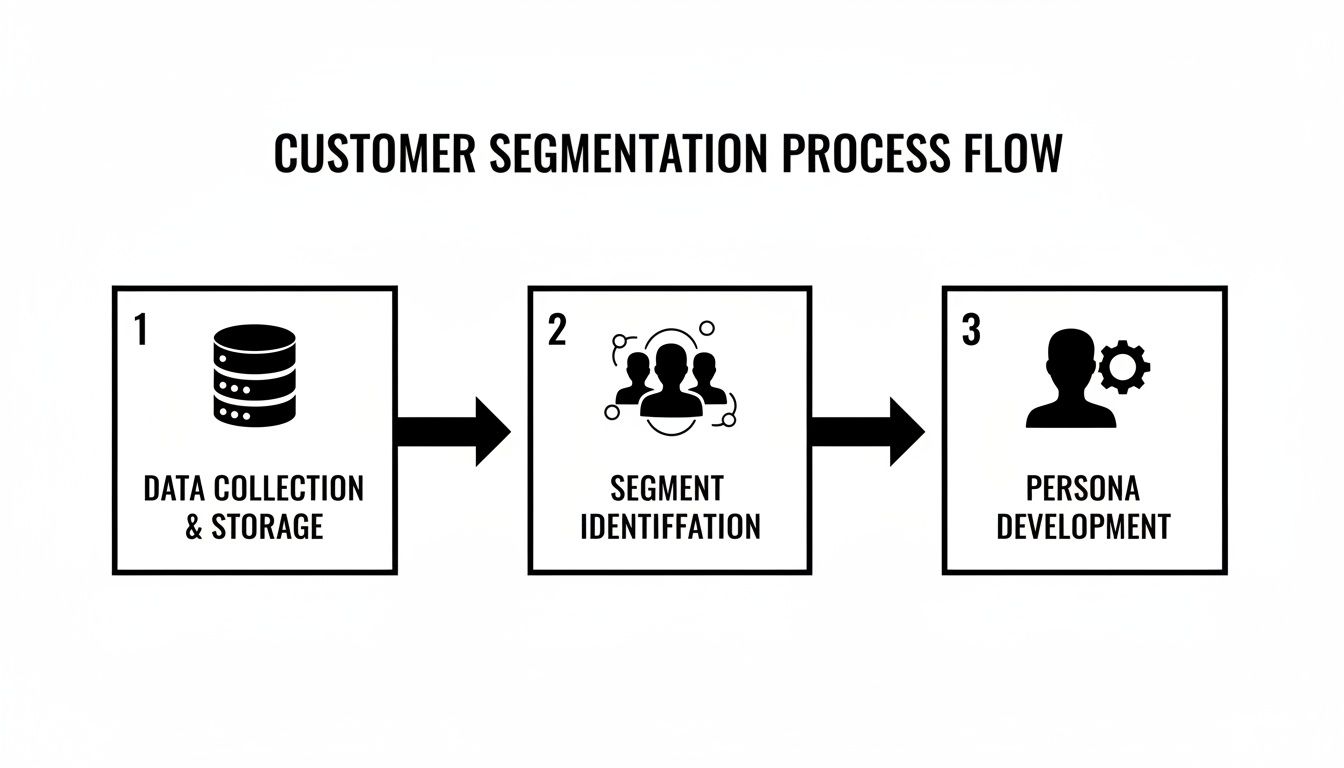
This process is your roadmap from data collection to understanding the people behind the clicks, which enables powerful personalization.
Architecting Segment-Specific Experiences
Every key touchpoint on your site is an opportunity to create a unique path instead of forcing everyone down the same funnel.
Here are a few practical applications:
- Navigation & Collections: For 'Returning VIPs,' place a "New Arrivals" link directly in the main navigation. For a 'First-Time Luxury Buyer,' feature a "Bestsellers" collection to build trust and provide a safe starting point.
- Collection Page Sorting: The default "Featured" sort order is rarely optimal. For a price-conscious segment, automatically sort collections from "Price Low to High." For a group that relies on social proof, sort by "Top Rated" to immediately show what's popular.
- Product Recommendations: Product carousels on product and cart pages must be intelligent. Someone who just bought a high-end espresso machine should see premium coffee beans, cleaning kits, or mugs, not another espresso machine.
Dynamic Content on Product Pages
The Product Detail Page (PDP) is where the sale is made or lost. This is your most valuable real estate for addressing a shopper's motivations and anxieties.
For example, a new visitor from a paid social ad is likely early in their research and nervous about the price. For them, you could dynamically display a prominent banner under the price: "Pay over 12 months with Affirm."
Now, picture a user from your 'Returning VIP' segment on the same page. They already trust you and care more about perks. For them, that same space could show, "As a VIP, enjoy complimentary white-glove delivery on this item."
This dynamic content delivers the right message to the right person at the right time, without cluttering the page.
Table: Personalization Tactics for High Value Segments
| Customer Segment | Onsite Tactic | Key Touchpoint | Goal |
|---|---|---|---|
| First-Time High-Spender | Highlight "Bestsellers" collection, show social proof pop-ups | Homepage, Collection Pages | Build confidence, reduce choice paralysis |
| Returning VIP | Prioritize "New Arrivals" in navigation, show exclusive early access offers | Main Navigation, PDPs | Foster loyalty, encourage repeat purchases |
| Research-Heavy Browser | Display a prominent "Live Chat with an Expert" widget | Product Detail Pages | Answer complex questions, overcome hesitation |
| Gift-Giver | Promote a "Gift Guide" banner and offer gift wrapping at checkout | Homepage, Cart | Simplify the buying process, increase AOV |
| Price-Sensitive Shopper | Automatically apply a "first-time buyer" discount code in cart | Cart, Checkout | Reduce friction, close the sale |
Mapping specific tactics to each group ensures every interaction feels relevant and purposeful, guiding them smoothly toward checkout.
Ensuring Ad-to-Site Continuity
One of the most damaging mistakes is running an ad for a specific offer and then directing the user to your generic homepage. This disconnect kills momentum and erodes trust.
If your ad promises 15% off office furniture, the landing page must greet that user with a headline and hero image reinforcing that exact 15% offer. Do not make them search for it.
This applies beyond discounts. If you target architects with an ad discussing material durability, the landing page should lead with content that addresses that exact value proposition, instantly confirming they are in the right place.
With global ecommerce sales projected to reach $8.1 trillion by 2026 according to Statista, high-ticket brands have the most to gain from this level of personalization. It’s how you turn a generic ad campaign into a highly profitable, segment-specific experience.
A personalized journey shows each visitor you understand them. You are not just selling a product, you are providing a guided, consultative experience that builds the confidence needed to make a high-value purchase.
Pricing, Offers, and Trust Signals
When a customer considers spending thousands of dollars, price is a major factor, but it is never the only one. They need to feel the value is undeniable and, more importantly, trust your brand completely. This requires a sophisticated approach to pricing and trust-building.
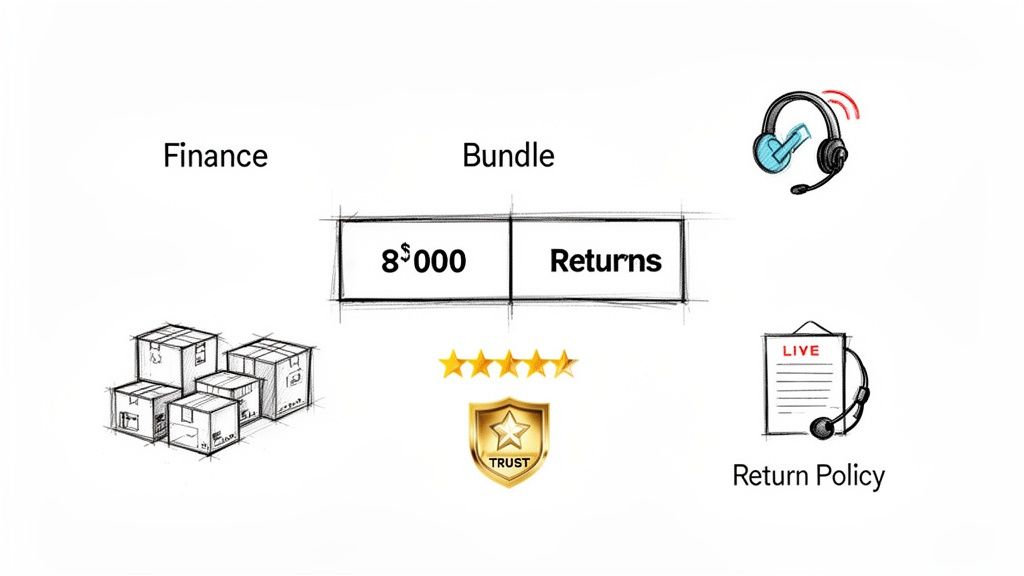
Avoid standard discounting. Slashing prices on premium products devalues the brand. Your goal is to make the investment feel more manageable while constantly reinforcing quality and value.
Reframe the Price with Smart Offers and Financing
Sticker shock kills conversions. A $3,500 price tag can be a barrier. Reframing that as $291 per month with a financing partner like Affirm or Klarna turns an intimidating expense into a manageable investment. High-ticket shoppers expect these options.
Beyond financing, structure offers to boost both perceived value and your average order value (AOV).
- Create Strategic Bundles: Do not discount your flagship product. Instead, bundle it with high-margin accessories. Selling a high-end espresso machine? Pair it with a premium grinder, artisan mugs, and a coffee subscription. This creates a valuable package and protects your main product's price.
- Offer Tiered Packages: Present "Good, Better, Best" options. The "Best" tier could include white-glove delivery, an extended warranty, and a one-on-one virtual setup session. This allows customers to self-select into a higher price point that meets their needs.
- Use a Gift with Purchase (GWP): A high-value gift can be more impactful than a small discount. Offering a free $200 accessory with a $2,000 purchase feels more special than a 10% discount, and it can often have a lower cost of goods.
Effectively managing your inventory carrying costs is crucial here. These hidden expenses impact profitability and will directly affect which bundling or GWP strategies are viable.
Build an Unshakeable Foundation of Trust
For a high-ticket purchase, trust is everything. Your website must project credibility, leaving no room for doubt. It is no surprise that typical conversion rates for high-ticket items hover between a slim 0.5% and 1.5%, lack of trust is the primary reason.
This foundation is built with a mix of explicit signals and implicit cues that reassure the customer at every step.
Every element on your product page and in your checkout must answer one question for the shopper: "Am I making a smart, safe decision?" Any hint of uncertainty means you have already lost them.
Think of it as a checklist of non-negotiables. Proactively answer every question and calm every anxiety before it becomes a deal-breaker.
Your Essential Trust Signal Checklist
The product detail page and checkout are where the sale is won or lost. These elements must be perfectly executed.
- Exhaustive Product Details: Go beyond basic specs. Use high-resolution images and videos from every angle, detailed dimensions, information on material sourcing, and clips of the product in a real-life setting. The goal is to make them feel like they have held it.
- Highly Visible Social Proof: Do not make people hunt for it. Feature customer reviews, detailed testimonials (video is especially effective), and any press mentions or expert endorsements prominently. A star rating directly below the product title is table stakes.
- Crystal-Clear Policies: Your return, warranty, and shipping information must be easy to find and written in plain English. A confusing or restrictive return policy is a massive red flag for someone making a large investment.
- Accessible Human Support: Make it simple to talk to a real person. A prominent phone number, live chat staffed by product experts, or a "Schedule a Consultation" button are crucial. It shows you stand behind your products.
- Obvious Checkout Security: The checkout must feel secure. Prominently display trust badges for payment options like Shop Pay and PayPal, alongside security seals. This visually confirms that their financial data is safe.
Combining flexible pricing strategies with an obsessive focus on trust creates an environment where customers feel both smart and safe, the powerful combination that drives high-value purchases.
Validating Your Strategy with Rigorous Testing
In high-ticket ecommerce, assumptions are expensive. Every strategic move, from a personalized product page to a new financing option, must be validated with clean, undeniable data.
Gut feelings do not scale, a disciplined testing program does. This is how you shift from guessing to building a reliable engine for compounding growth. For premium brands, this means moving beyond simple A/B tests.
When personalizing entire journeys for multiple segments, you need a more powerful validation method. This is where multivariate testing is essential. Instead of just testing a new headline, you can test a new headline, a different hero image, and a new call-to-action simultaneously. This allows you to validate complex, personalized experiences across your entire site. Understanding the nuances between different A/B and multivariate testing methodologies is critical for validating your assumptions and maximizing impact.
Crafting a Winning Test Hypothesis
Every meaningful test starts with a solid hypothesis. A vague goal like "improve the PDP" is useless. A strong hypothesis is specific, measurable, and based on a real customer insight.
It should follow a clear structure:
"If we [implement this change] for [this specific segment], then [this specific metric] will improve because [this is the underlying reason].
Here is a practical example:
"If we prominently feature Affirm financing options above the fold for the 'First-Time Luxury Buyer' segment on product pages over $2,000, then our Add to Cart rate for this segment will increase because it will reduce initial price anxiety."
This framework forces clarity on who you are targeting, what you are changing, how you will measure success, and why you believe it will work.
Looking Beyond Conversion Rate
Focusing only on your sitewide conversion rate is a common mistake in high-ticket ecommerce. The numbers are naturally lower, and small fluctuations can be misleading. You must focus on KPIs that reflect business health.
Key metrics to track in your tests include:
- Profit Per Visitor (PPV): The ultimate metric. It cuts through the noise and shows if your changes are increasing profit on a per-visitor basis.
- Average Order Value (AOV): Are your tests encouraging customers to spend more? This is essential for measuring the success of bundling or upselling strategies.
- Segment-Specific Conversion Rates: Do not get lost in the overall site number. Measure the lift for the exact audience your personalized experience was designed for. A 5% lift for your 'Returning VIPs' is a massive win, even if the sitewide rate barely moves.
A successful testing program is not about finding a single "magic bullet." It is about achieving consistent, incremental gains that compound. A 2% improvement every month results in a 26% increase in revenue over a year.
Building Your Visual Testing Roadmap
To keep your optimization program on track, a visual testing roadmap is your single source of truth. It prevents random "idea of the week" tests and keeps the team focused on a cohesive strategy.
Your roadmap should clearly lay out:
- What's Live: Current tests, their target segments, and start dates.
- What's Working: A log of completed tests documenting the winner, the KPIs impacted, and the revenue lift.
- What's Next: The pipeline of upcoming tests, prioritized by potential impact and required effort.
This disciplined approach transforms testing from chaotic experiments into a predictable, scalable program.
For a deeper dive into testing methods, see our guide on multivariate testing vs. A/B testing. By rigorously testing every assumption, you build a high-ticket strategy that adapts and improves with every visitor.
Frequently Asked Questions
When building a strategy for high-value products, several key questions consistently arise. Here are the most common ones we hear from brands, along with our direct answers.
What Is Considered a High Ticket Item in Ecommerce?
A high-ticket item is often defined as anything over $1,000. In practice, the definition is more about the customer's mindset than a specific number.
A product becomes "high-ticket" when it represents a significant, considered investment for your target audience. It is not an impulse buy. It's a purchase that demands a much deeper level of trust and information before a customer will "Add to Cart." Examples include luxury furniture, professional-grade equipment, fine jewelry, and specialized industrial machinery.
How Do I Measure the ROI of Personalization?
Measuring the ROI of personalization requires looking beyond sitewide conversion rates. The real impact is found in more specific, profit-driven metrics.
Track these KPIs:
- Profit Per Visitor (PPV): The bottom-line metric. It tells you if your changes are making the business more money from existing traffic.
- Average Order Value (AOV): Analyze this for specific customer segments. Did that personalized bundle actually get people to spend more?
- Conversion Rate for High-Value Audiences: Are your "Returning VIPs" buying more frequently now that they have a tailored experience?
The best way to see the impact is with controlled tests. If you create a custom journey for your "Paid Social Traffic" segment and it generates an extra $50,000 in revenue this month compared to the group that saw the generic site, that is a clear, direct measure of your ROI.
Can Smaller Brands Implement a High Ticket Ecommerce Strategy?
Yes. A massive budget or team is not a prerequisite. The core principles, building trust, knowing your customer, and creating an excellent user experience, are not limited by company size.
Start small and focused. Gain a deep understanding of your niche audience first. A complex tech stack is not necessary at the outset. You can begin with simple actions like targeted email campaigns for different customer groups or by offering exceptional, personal customer service.
Focus on the quality of the experience. That is how you build a loyal following and compete effectively.
What Are the Most Common Mistakes in High Ticket Ecommerce?
Most major mistakes stem from a fundamental misunderstanding of the high-value buyer's journey.
The biggest blunders include:
- Using Standard Ecommerce Tactics: Applying low-ticket, urgency-driven strategies to a purchase that requires weeks or months of consideration. It is ineffective and can damage brand perception.
- A Generic, One-Size-Fits-All Website: This creates a jarring disconnect when a customer clicks from a highly targeted ad, killing trust instantly.
- Insufficient Information: High-ticket buyers require details. Skimping on high-resolution photos, in-depth videos, or technical specs creates uncertainty and prevents sales.
- Ignoring the Post-Purchase Experience: The relationship does not end at checkout. Forgetting a customer after a significant purchase is the fastest way to lose repeat business and valuable word-of-mouth referrals.
Mastering these fundamentals is non-negotiable for scaling a high-ticket ecommerce brand.
Success in high-ticket ecommerce is not about finding more traffic, it's about converting the traffic you already have more profitably. This requires a shift from broad-stroke CRO to a precise, segment-driven personalization strategy. Identify your most valuable customers, build experiences that address their specific needs, and rigorously test every assumption. That is the path to sustainable, profitable growth.
Book a discovery call with our team to see how we build personalization programs that scale profit for Shopify Plus brands.