

Shopify Plus Checkout Customization to Drive Conversions

[ SUMMARIZE WITH AI ]
[ FREE CRO TEARDOWN ]
Find the 3 biggest revenue leaks on your store.
Every day a conversion leak goes unfixed, you're paying for traffic that doesn't buy. Get a 5-minute Loom through your PDP, cart, and checkout, with mockups of the fixes. No pitch.
Get My TeardownShopify Plus checkout customization lets you replace the default, one-size-fits-all checkout with a conversion-optimized experience tailored to different customer segments. Using Shopify's Checkout Extensibility framework, Plus merchants can add dynamic trust badges, loyalty point redemption, targeted upsells, and custom fields directly into the checkout flow without risking site stability. For brands spending heavily on acquisition, this is the heart of Shopify checkout optimization: how you stop losing revenue at the final step.
Why a Generic Checkout Is Costing You Sales
You're spending tens, or maybe hundreds, of thousands of dollars monthly on paid ads to attract motivated buyers. Your ads are hyper-specific, your landing pages are dialed in, and your product copy is on point. Then, when a customer is ready to buy, they land on a generic, one-size-fits-all checkout page. It feels completely disconnected from the curated journey they just experienced.
This abrupt shift is exactly where profits leak. A standard checkout doesn't understand crucial customer context. It gives the exact same experience to a first-time buyer from a TikTok ad as it does to a VIP customer who has spent thousands with you. This lack of personalization is a direct hit to your bottom line.
A generic checkout is like a great salesperson who builds amazing rapport, understands a customer's needs perfectly, and then shoves a blank, confusing order form in their face. It introduces friction and doubt right when you need to build trust and momentum.
The True Cost of Inaction
For any brand serious about growth, the real cost of a non-customized checkout is measured in lost revenue and torched ad spend. Every shopper who abandons their cart because of surprise shipping costs, a missing payment option, or a simple lack of trust is a direct failure to capitalize on your marketing investment. If abandonment is already hurting your numbers, our guide on how to reduce shopping cart abandonment covers the full picture.
A generic checkout falls short in critical ways:
- It Erodes Trust: It can't show dynamic trust badges, social proof, or security seals that convince a nervous buyer to finish their purchase.
- It Misses Easy Upsells: It completely misses the chance to offer relevant, low-friction upsells or cross-sells that boost your average order value (AOV).
- It Ignores Your Best Customers: It has no way to offer special perks to loyalty members or provide tailored shipping options for international shoppers.
From Afterthought to Strategic Asset
Viewing your checkout as a static, unchangeable page is a massive financial oversight. With Shopify Plus, you can transform the checkout from a basic transaction tool into a powerful engine for conversion optimization.
This isn't about adding distracting clutter. It's about making strategic tweaks that create a fluid path from ad to purchase. It's about ensuring the messaging, offers, and trust signals that got a customer to click "Add to Cart" follow them all the way to "Complete Order."
For any scaling brand, this isn't just a nice-to-have feature. It's a strategic necessity to lock in every possible sale and maximize profit from your traffic.
The Big Shift: From checkout.liquid to Checkout Extensibility
For years, the only way to modify the Shopify Plus checkout was to edit the checkout.liquid file. This was like performing open-heart surgery. You had immense power, but one wrong move could bring the entire system crashing down. It was fragile, often leading to broken checkouts, security holes, and massive headaches every time Shopify rolled out an update.
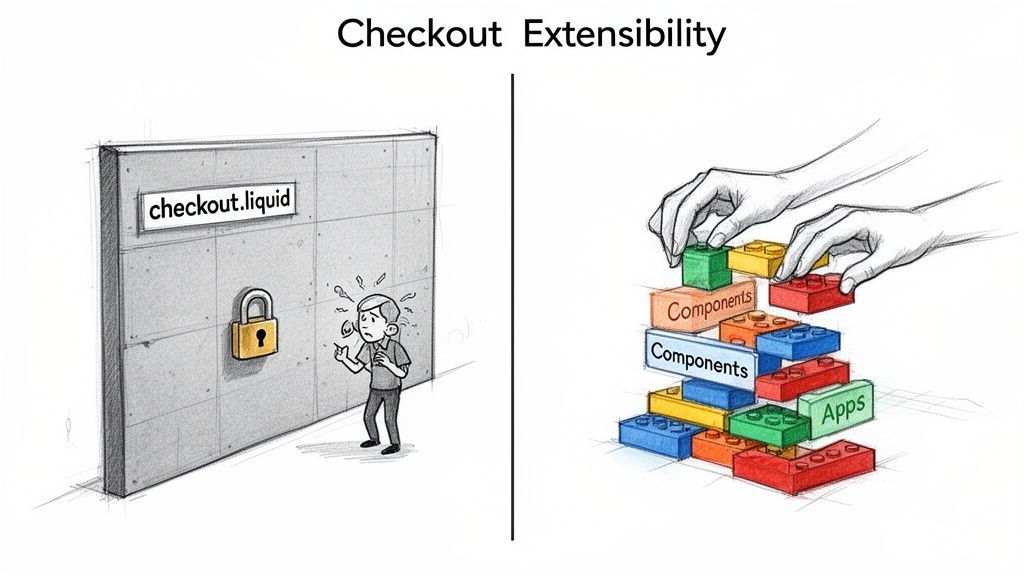
Shopify launched Checkout Extensibility in 2022 as a complete paradigm shift. They replaced the old, risky checkout.liquid edits with a secure, app-based framework that's now the standard for all Plus merchants. This new approach lets brands add custom features, like loyalty point redemptions or post-purchase upsells, directly into the checkout flow without worrying about it breaking during a flash sale.
This matters right now because Shopify is sunsetting Checkout Scripts in August 2026. If your store still relies on legacy scripts for checkout logic, migrating to Checkout Extensibility and Shopify Functions isn't optional anymore.
Why This Is a Game-Changer for Your Brand
Think of the old checkout.liquid file as a solid brick wall. If you wanted to add a window (a new feature), you had to use a sledgehammer and hope you didn't damage the whole structure. Every change was a gamble.
Checkout Extensibility is like a Lego baseplate. It gives you a stable, standardized foundation where you can safely snap on approved "bricks": UI components and apps. This model brings three huge benefits that directly impact your bottom line:
- Rock-Solid Uptime: Your customizations are "sandboxed," meaning they run in a protected area and can't interfere with the core checkout process. Shopify designed this to guarantee stability during massive traffic spikes like Black Friday, when a broken checkout could cost you six or seven figures.
- Built-in Security: By using Shopify's pre-vetted components and APIs, you remove the risk of introducing security flaws with custom scripts. Your customers' payment info stays locked down in Shopify's Level 1 PCI compliant environment.
-
Seamless Shop Pay Integration: Customizing
checkout.liquidwas notoriously incompatible with Shop Pay. You had to choose between a unique checkout and the fastest-converting payment option. Extensibility works perfectly with Shop Pay, letting you personalize the experience for the huge number of customers who prefer accelerated checkouts.
The move to Checkout Extensibility isn't a limitation, it's a liberation. It frees your team from the constant fear of breaking the most critical part of your store so they can focus on what really matters: creating personalized experiences that drive revenue.
checkout.liquid vs Checkout Extensibility for Brand Leaders
If you're a marketing manager or brand owner, the business impact matters more than the technical jargon. Here's a straightforward breakdown of what this shift means for your strategy.
| Feature | checkout.liquid (Legacy) | Checkout Extensibility (Current) |
|---|---|---|
| Reliability | High Risk. Prone to breaking during Shopify updates or high traffic. | Rock-Solid. Guaranteed uptime and stability. |
| Security | Vulnerable. Custom scripts could expose sensitive data. | Secure by Design. Sandboxed, PCI-compliant environment. |
| Shop Pay | Incompatible. Forced a choice between customization and speed. | Fully Compatible. Personalize the fastest checkout experience. |
| Maintenance | High Overhead. Required constant developer attention and fixes. | Low Maintenance. Apps and components update automatically. |
| Speed to Implement | Slow & Risky. Required deep code edits for minor changes. | Fast & Safe. Future-proof, simple to add new features via apps. |
Shopify's move to Checkout Extensibility is a massive upgrade disguised as a technical requirement. It gives your brand the stable, secure, and flexible foundation needed to build a world-class checkout experience.
Actionable Strategies to Boost Checkout Revenue
Theory is great, but execution drives revenue. Let's get into the specific, high-impact customizations you can build with Checkout Extensibility to directly increase your conversion rate and AOV. At Convertibles, these are the tactics we test and implement for scaling Shopify Plus brands every month.
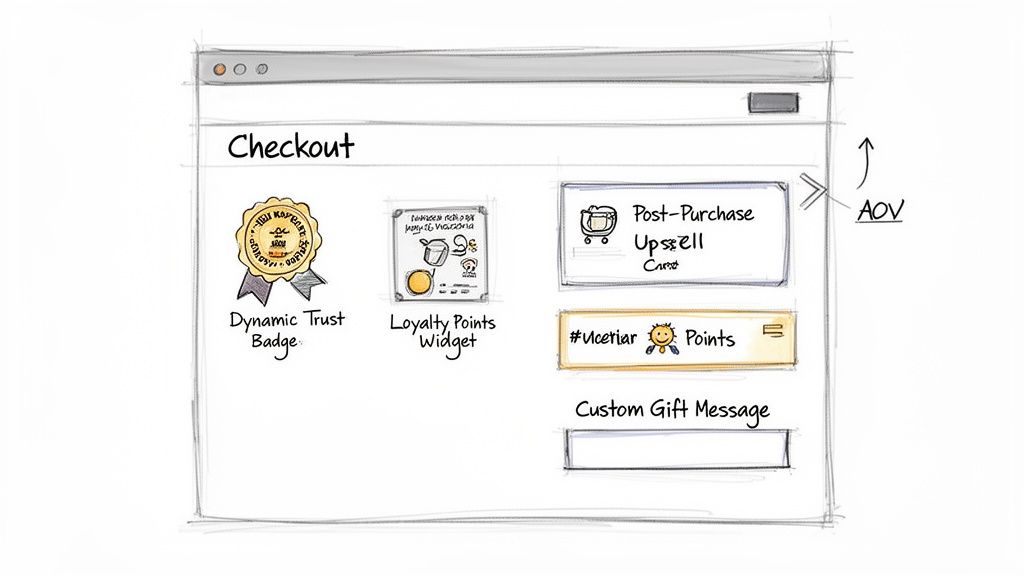
Integrate Loyalty Programs Directly Into Checkout
Making a customer leave the checkout, hunt down their points balance, and copy a code is a surefire way to cause cart abandonment. A powerful way to boost Customer Lifetime Value (LTV) is to bring your loyalty program directly into the buying process.
With a simple checkout extension, you can let customers see and redeem their loyalty points without ever leaving the page. This seamless touch does two things brilliantly: it reminds them of the value they've already earned and gives them an instant reason to complete the purchase with a discount.
Brands that embed loyalty point redemption in the checkout see a direct lift in both conversion rates and repeat purchase frequency. It transforms points from an abstract concept into a tangible, ready-to-use currency.
Add Custom Fields for Gifting and Delivery
For brands in gifting, apparel, or food and beverage, small details are everything. A standard checkout gives customers no way to add a gift message or special delivery instructions, which often leads to support tickets and unhappy buyers.
You can fix this with a custom checkout field:
- Gift Messages: Add a simple text box for customers to write a personal note. This small touch makes a huge difference in the gifting experience.
- Delivery Instructions: Let customers add notes for the courier, like "Leave on the porch" or a gate code. This cuts down on delivery failures and keeps customers happy.
These additions make your customers feel heard and catered to, smoothing the path to purchase for shoppers who just need that tiny bit of extra control.
Deploy Dynamic Trust Badges and Social Proof
Trust is everything in e-commerce, but a generic row of credit card logos doesn't cut it anymore. With Checkout Extensibility, you can show dynamic trust badges and social proof that changes based on who is looking at the page.
For instance, a checkout app can detect a user's location and display a badge saying, "Fast, Free Shipping to California," or show their country's flag. You could also add a small banner that reads, "Join 150,000+ Happy Customers," to reinforce their decision to buy.
We tested this at Convertibles for an 8-figure gin subscription brand using Intelligems. By adding an aggregate star rating ("Rated 4.9 stars from over 6,000 reviews") and three named customer testimonials directly beneath the "Pay now" button, we generated an additional A$6,145 per month in revenue. The reviews addressed the three concerns that matter most at checkout: product quality, subscription experience, and value for money.
Small, contextual trust signals outperform static images because they feel personal and relevant to that specific shopper.
Add Product Upsells Directly in Checkout
You don't have to wait until after purchase to upsell. Intelligems recently launched product upsells at checkout for Shopify Plus, letting you display a "You may also like" section right on the checkout page. No additional apps needed.
The power here is that you can A/B test the upsells before rolling them out: test your current checkout (control) vs. adding product upsells, test 1 product vs. 3 products, and test which products perform best for different customer segments. Once you find a winner, roll it out to 100% of visitors. It's a simple way to increase AOV without adding friction.
Implement Post-Purchase Upsells
The moment after a customer clicks "Complete Order" is another high-value opportunity. They are in peak buying mode, and their trust is at an all-time high. A well-timed, relevant post-purchase upsell can meaningfully increase AOV without adding any friction to the original sale.
The key is to ditch generic offers and segment your upsells based on what the customer just bought:
- Purchased a coffee maker? Offer a discounted bag of your best-selling beans.
- Bought a subscription product? Suggest a one-time add-on of a related item.
- Ordered a skincare set? Present a travel-sized version of a complementary product.
This level of relevance makes the offer feel more like a helpful suggestion than an aggressive sales pitch. For more on how small, targeted changes create outsized results, check out these 10 proven ecommerce conversion rate optimization tips that go beyond just the checkout.
Personalizing the Checkout for High-Value Segments
Why give your best customers the exact same checkout experience as a first-time visitor from a discount ad? Real Shopify Plus checkout customization is more than matching fonts and colors. It's about using customer data to build smarter, more persuasive experiences for your most important segments.
This is your chance to directly connect your acquisition strategy with your conversion strategy. When you know who you're talking to, you can change the checkout on the fly to echo the exact messages and promises that brought them in. At Convertibles, segmented checkout experiences are one of the highest-impact test categories we run for Shopify Plus brands.
Tailoring the Experience for First-Time Buyers
A first-time buyer is skeptical. They don't know you, they're wary of your shipping promises, and they're actively looking for a reason to abandon their cart. Your checkout has one job here: build trust, fast.
Instead of a generic layout, you can use checkout UI extensions to add specific trust-building elements just for this group:
- A Simple Welcome: A banner at the top of the page that says, "Welcome! Enjoy free shipping on your first order." It's a small touch that confirms they're in the right place and reinforces the offer that likely got them there.
- Targeted Trust Seals: Don't just show a bunch of badges. Show them what matters in the moment, like a Norton security seal or a clear "Guaranteed Safe Checkout" banner.
- A Little Social Proof: Add a small, clean block with a quote from another happy first-time customer. It's powerful validation right when they need it most.
These tweaks make the process feel more guided and secure, directly addressing the anxieties that cause new shoppers to bolt.
Creating an Exclusive Path for Your VIPs
Your repeat buyers and loyalty members are the lifeblood of your brand. The checkout is the perfect place to acknowledge their status and make them feel seen. That feeling is what turns a happy customer into a vocal advocate.
If a customer is tagged as a "VIP" in your system, the checkout should instantly reflect that.
Don't make your best customers hunt for their benefits. The checkout should immediately recognize them and roll out the red carpet, showing them exactly why their loyalty pays off.
Implement these VIP-specific touches:
- Exclusive Shipping Options: Automatically offer a free or upgraded shipping method that's only visible to them.
- Loyalty Points Front and Center: Show their current points balance right away and give them a one-click button to apply them for a discount.
- A Personal "Thank You": Add a simple, personalized line like, "Thanks for being a loyal customer, [First Name]!"
This level of recognition transforms a routine transaction into a rewarding moment, cementing their relationship with your brand.
Optimizing for International Shoppers
Selling globally brings a new set of challenges, from currencies and payment methods to shipping and duties. A generic checkout is a guaranteed conversion killer for international customers who can't find their preferred payment option or get a clear picture of the total cost.
With Shopify Plus, you can set up checkout rules that adapt based on the shopper's shipping country:
- Smarter Payment Options: Hide what's not relevant. A customer in Germany doesn't need to see Venmo, but they will be looking for Klarna or Sofort. Make those prominent.
- Clarity on Duties and Taxes: Nothing kills a sale like surprise fees. Integrate a service that shows the total landed cost upfront so your customers know exactly what they're paying.
- Localized Messaging: Translate key information like shipping details and return policies. It's a simple way to build trust and show you care about their business.
Customizing the checkout is a cornerstone of effective personalization because it aligns the final, critical step of the purchase with what each user needs. When you pair these customizations with Shopify's speedy Shop Pay, the impact compounds. To dig deeper into this, check out our guide on what website personalization is and how it drives revenue.
A Practical Framework for Testing Your Checkout
Making changes to your checkout based on a hunch is high-stakes gambling. Every customization, whether it's adding a trust badge or testing an upsell, needs to be proven with data. Without a structured testing framework, you're flying blind, with no way of knowing which changes are actually growing your business and which are quietly killing your conversion rate.
This isn't about running one or two quick tests. It's about creating a constant feedback loop. You form a hypothesis, you test it rigorously, you analyze the results, and you use what you learn to make your next move. If you want a full breakdown of how to build this process, our guide to building a CRO testing program for Shopify walks through it step by step.
Setting Up Meaningful A/B Tests
Great testing starts with a clear, measurable hypothesis. Don't just test "a new banner." Instead, try something specific like: "Does adding a 'Free Shipping on Orders $75+' banner at the top of the checkout increase AOV by 5% without hurting the overall conversion rate?" This sharp focus gives you results you can act on.
For checkout-specific A/B testing, Intelligems recently launched dedicated checkout testing built specifically for Shopify Plus. It lets you test checkout blocks, pricing, shipping rates, and content variations directly within the Extensibility framework. You can toggle blocks on and off, test different content versions, and run pricing experiments at checkout. We used Intelligems for our own checkout social proof test that generated A$6K/month in additional revenue.
When setting up tests, ensure your segmentation is clean. You must isolate variables to get trustworthy data. For instance, if you're testing a new feature for first-time buyers, your test should only run for that segment. Including returning customers would muddy the results.
A classic mistake is calling a test early just because one variant pulls ahead. You have to let it run long enough to get a reliable sample size. For a high-traffic store, two weeks might be enough to reach statistical significance. For a smaller store, you might need to run the test for several weeks. Be patient.
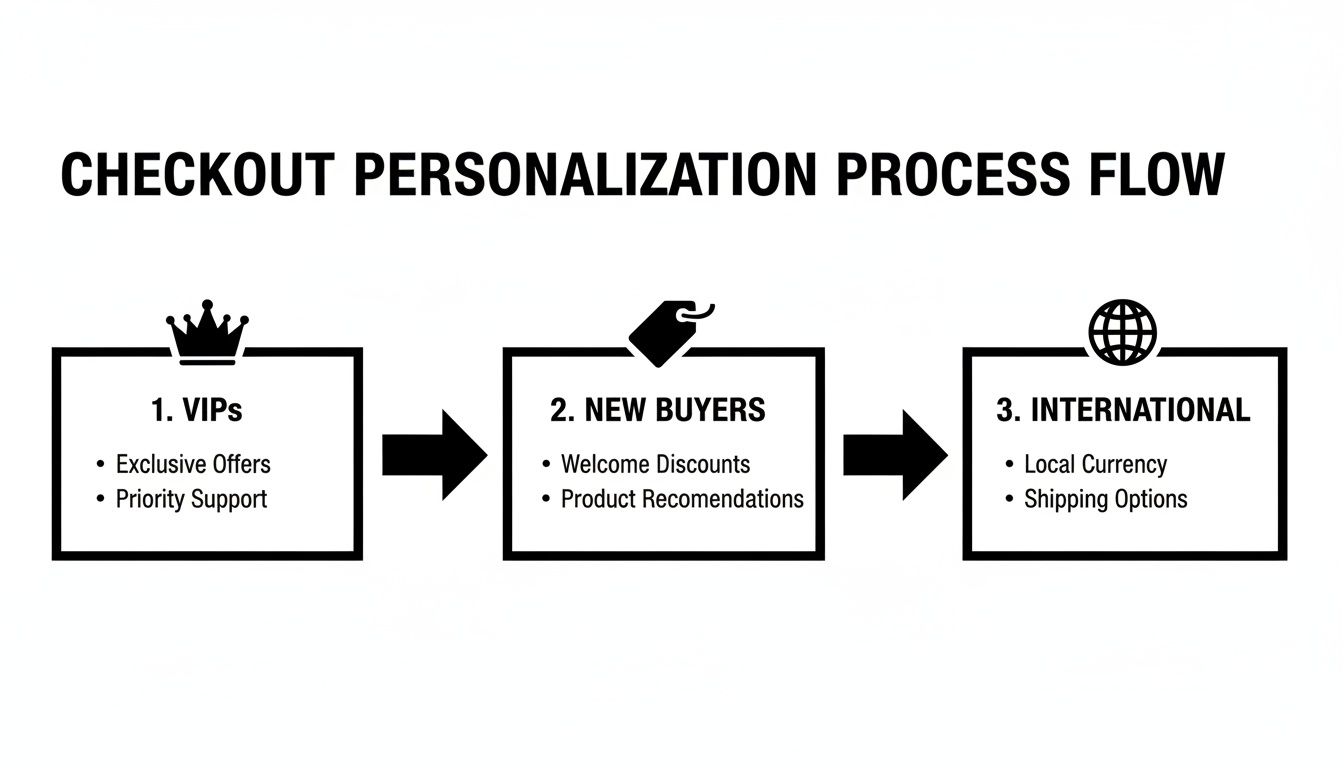
The idea is simple but powerful: VIPs, new buyers, and international shoppers should each get a unique experience. Once you've created those experiences, you can then test and optimize them individually.
Key Performance Indicators to Track
Your conversion rate is secondary, Revenue per visitor (RPV) is the star, but it doesn't tell the whole story. A true "win" should improve your main KPI without tanking secondary metrics. Here are the essential KPIs to watch for any Shopify Plus checkout customization test:
- Checkout Completion Rate: Of all the people who start the checkout, what percentage actually finish it? This is a better indicator of checkout friction than your site's overall conversion rate.
- Average Order Value (AOV): Did the change get customers to spend more? This is crucial when you're testing upsells, cross-sells, or free shipping thresholds.
- Checkout Duration: How long does it take the average person to get from start to finish? A new feature that adds 30 seconds to the process probably isn't a real win.
- Error Rate: Keep an eye on how many people run into validation errors. A confusing custom field could make this number spike.
By tracking a balanced scorecard of metrics, you get a full picture of a customization's real impact. If you're trying to figure out the right testing method, our guide comparing multivariate testing vs A/B testing breaks down when to use each approach.
When to Partner With a Checkout Optimization Agency
So, you're ready to customize your Shopify Plus checkout. The question is: do you tackle it yourself or bring in a specialized team? Going the DIY route might look cheaper initially, but it's a decision that can backfire without the right expertise.
The True Cost of a DIY Approach
To pull this off in-house, you need a full optimization squad: a seasoned Shopify Plus developer who deeply understands Checkout Extensibility, a senior CRO strategist who can build a testing plan and interpret results, and a project manager to keep the engine running.
Without this trio, it's easy to stumble. We've seen brands launch a new feature that accidentally torpedoes a payment option or, worse, slows the entire checkout to a crawl. Many get stuck running low-impact tests that eat up time and money without moving the needle.
Why a Specialized Partner Accelerates Results
Working with a specialized agency isn't just about handing off coding tasks. It's about buying speed and tapping into expertise that's nearly impossible to build internally without a massive budget.
An agency's value isn't just in the code they write. It's in the hundreds of tests they've already run for other brands. They know what works, what doesn't, and how to get you a real ROI faster than you could on your own.
At Convertibles, we build and test segmented checkout experiences for 8-figure Shopify Plus brands. Our checkout social proof test generated an additional A$6K/month for a single client, and our cart drawer optimization program has driven over $155K/month in combined test wins across the pre-checkout funnel. Every test is backed by statistical rigor and measured against revenue/profit per visitor, not vanity metrics.
The right partner will build a clear roadmap, launch multiple experiments every month, and prove what's working with solid data. For brands spending over $50,000 per month on paid ads, you can't afford to waste that traffic on a leaky checkout. Learn more about our ecommerce conversion rate optimization services and how we help ambitious brands grow faster.
Got Questions? We've Got Answers
Straight-to-the-point answers to the most common questions about customizing the Shopify Plus checkout.
What's the Real Win with Shopify Checkout Extensibility?
It's all about security and upgradability. The old checkout.liquid file was the wild west: you could add any code you wanted, but one wrong move could crash your entire checkout.
Checkout Extensibility changes the game by using sandboxed apps. Think of it like a secure playground for your customizations. They can't interfere with the core checkout functionality, so you get to add custom features and branding without ever worrying about breaking anything. Plus, it works seamlessly with modern payment methods like Shop Pay, which is a must-have for conversion rates today.
Can I A/B Test My Shopify Plus Checkout?
Yes, and you absolutely should be. While Shopify doesn't offer a built-in A/B testing tool for the checkout, Intelligems now offers dedicated checkout testing for Shopify Plus merchants. You can test checkout blocks, pricing, shipping rates, and content variations directly within the Extensibility framework.
This is how you move from guesswork to data-driven decisions. Want to know if that new trust badge really works? Or which upsell offer resonates best? Test it. This is the secret to methodically improving your checkout over time.
Will All These Customizations Slow Down My Site?
Not if you do it the right way. The Checkout Extensibility framework was built with performance in mind. Unlike the old checkout.liquid method where sloppy code could easily bog down page load times, these new apps are loaded much more efficiently.
The result is a snappy, smooth experience for your customers, whether they're on a desktop or their phone. You get the benefits of a custom-feeling checkout without the performance penalty that used to come with it.
What Are the Best Tools for Shopify Plus Checkout Customization?
The core tools are Shopify's own Checkout Editor (for visual layout changes) and Checkout UI Extensions (for custom components). For A/B testing your checkout changes, Intelligems is purpose-built for Shopify Plus and lets you test blocks, pricing, and content variations. Intelligems also recently launched in-checkout product upsells, so you can test and deploy "You may also like" recommendations without a separate app. For post-purchase upsells, apps like Rebuy and AfterSell integrate with the Extensibility framework. And for checkout logic like auto-applying discounts or conditional shipping, Shopify Functions replaces the old Checkout Scripts being sunset in August 2026.
Your checkout shouldn't be a generic afterthought. It should be a conversion machine. The team at Convertibles builds and tests segmented checkout experiences that boost profit per visitor for ambitious Shopify Plus brands.
Book a call with us to map out your checkout optimization strategy.