

10 CRO Best Practices for Shopify Plus Brands (2026)

[ SUMMARIZE WITH AI ]
[ FREE CRO TEARDOWN ]
Find the 3 biggest revenue leaks on your store.
Every day a conversion leak goes unfixed, you're paying for traffic that doesn't buy. Get a 5-minute Loom through your PDP, cart, and checkout, with mockups of the fixes. No pitch.
Get My TeardownIf your brand generates $2M+ annually, you have already moved past generic CRO advice. Standard A/B testing on button colors and broad homepage changes delivers diminishing returns. The next phase of growth is not just about lifting your overall conversion rate, it is about increasing profit per visitor through surgical precision. This requires a fundamental shift from treating all traffic equally to engineering segment-specific user experiences.
For growth-stage Shopify Plus brands, the most impactful conversion rate optimization best practices are rooted in data-driven personalization, hypothesis-led testing, and a deep understanding of customer intent. A higher conversion rate is a valuable metric, but maximizing revenue per session ensures that your optimization efforts directly contribute to bottom-line growth. This means focusing on the quality of conversions, not just the quantity. It involves attracting higher-value customers, increasing average order value (AOV), and improving customer lifetime value (LTV) through targeted experiments.
This article provides actionable frameworks, not just theory. We will dive into 10 practitioner-led strategies, from ads-to-site continuity and multi-variation testing to segment-specific personalization. You will learn the specific tactics used to generate compounding revenue gains for high-growth ecommerce brands, equipping you to build a more sophisticated and profitable optimization program.
Before picking optimization tactics, benchmark your current CVR against your vertical. Our industry CVR benchmark calculator returns average and top performer ranges by vertical, plus the monthly revenue gap at your current traffic and AOV.
1. Segment-Specific Personalization & Data-Driven Segment Mapping
Effective conversion rate optimization best practices move beyond treating all visitors the same. Instead of a one-size-fits-all approach, segment-specific personalization involves tailoring your website experience to distinct groups of users. This strategy combines behavioral data, like traffic source or device, with transactional data, like AOV or lifetime value, to create contextually relevant messaging, offers, and navigation for your most valuable customers. The goal is to make each visitor feel like the site was designed specifically for them.
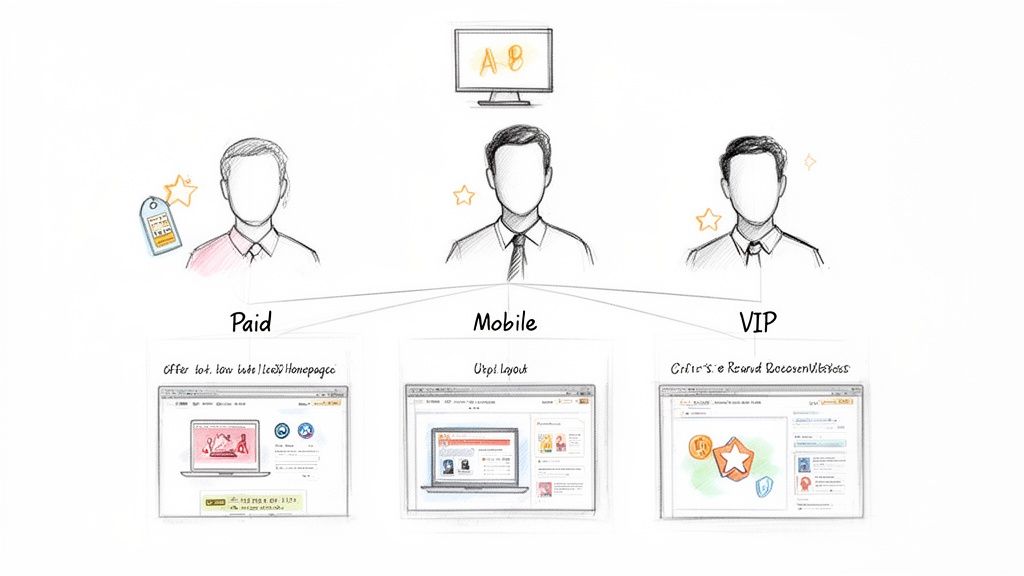
This method ensures your optimization efforts are focused on the highest-potential segments, maximizing ROI. For example, a luxury brand might find that visitors arriving from an influencer collaboration respond best to lifestyle imagery and social proof, while those from paid search ads convert higher with direct, benefit-driven headlines. By personalizing the homepage for each segment, the brand can significantly lift conversions without changing the core product. This targeted approach is a cornerstone of modern CRO.
How to Implement Data-Driven Segmentation
- Identify High-Value Segments: Start by analyzing your customer data. Use metrics like Recency, Frequency, and Monetary (RFM) value, or look at cohorts with the highest lifetime value (LTV). Prioritize the segments that drive the most revenue first. For instance, customers with an AOV over $200 could be routed to a VIP experience with exclusive offers.
- Map the User Journey: Understand how different segments arrive and navigate your site. Are mobile users dropping off at a specific checkout step? Do paid search visitors bounce from the homepage? Use tools like Google Analytics and heatmaps to identify friction points unique to each group.
- Build an Opportunity Score: To prioritize your efforts, calculate the potential revenue lift for each segment. Use this simple formula: (Benchmark Conversion % - Current Conversion %) × Monthly Traffic × Average Order Value. This helps you focus on tests with the highest financial impact.
- Launch Targeted Tests: Develop hypotheses for specific segments. You might test a streamlined, mobile-first checkout for your mobile traffic or align landing page messaging with the exact ad copy a visitor clicked on to improve ads-to-site continuity.
By systematically identifying, prioritizing, and personalizing experiences for key customer groups, you create a more efficient and profitable optimization program. To dive deeper into the fundamentals, you can learn more about the essentials of website personalization.
2. Multi-Variation Testing (A/B/n Testing)
While standard A/B testing compares two versions of a page, multi-variation testing (or A/B/n testing) accelerates the learning process by simultaneously testing three or more variations against a control. This approach is a core component of high-velocity conversion rate optimization best practices. It allows brands to explore a wider range of hypotheses in a single experiment, quickly identifying the highest-performing option without running sequential, time-consuming tests. The goal is to maximize learning and impact from your available traffic.
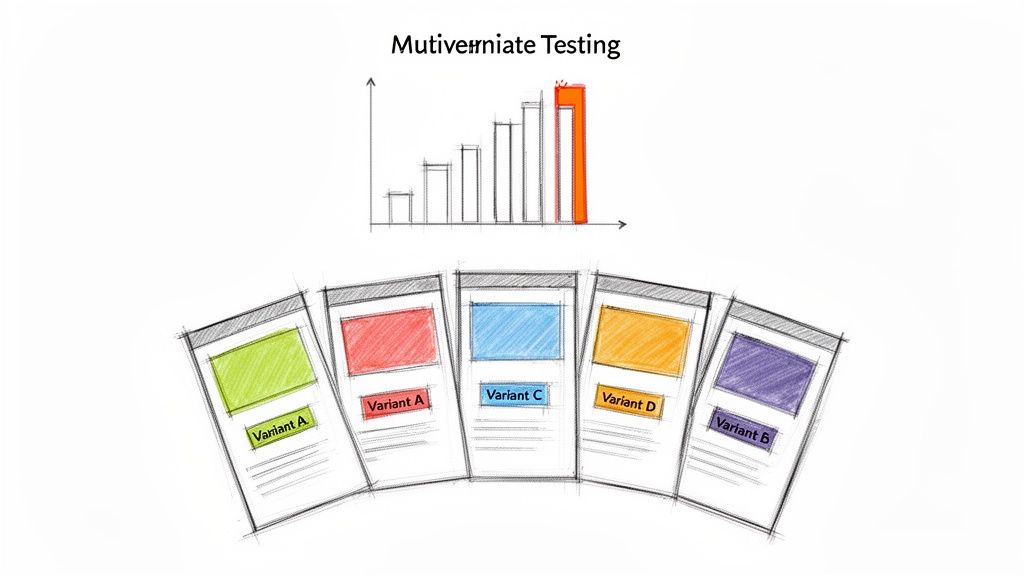
This method is particularly effective for testing high-impact variables with several potential solutions. For instance, a Shopify Plus store could test four distinct discount offers on its product page: 10% off, 15% off, free shipping, or a free gift with purchase. An A/B/n test reveals not just which offer converts best but also provides deeper insights into customer motivation, all within one testing cycle. This efficiency is critical for growth-stage brands looking to scale their optimization efforts.
How to Implement Multi-Variation Testing
- Isolate One High-Impact Variable: The key to a clean A/B/n test is focusing on a single element. This could be the headline, the call-to-action button color, the primary hero image, or a promotional offer. Testing multiple elements at once (multivariate testing) is a different discipline that requires significantly more traffic.
- Calculate Required Sample Size: Before launching, ensure you have enough traffic to reach statistical significance. Use an online calculator to determine the daily visitors needed per variation to conclude the test within a reasonable timeframe, typically 2-4 weeks. Launching an underpowered test is a common CRO pitfall.
- Define a Clear "Winner" Threshold: Establish your success metrics upfront. A typical standard is declaring a winner when a variation shows a lift of over 5% at a 95% statistical confidence level. This prevents you from calling tests too early or acting on inconclusive data.
- Leverage a Dedicated Testing Platform: Use robust tools like Intelligems, Optimizely, VWO, or Convert that have built-in statistical engines and can handle complex traffic allocation. These platforms simplify the setup and ensure your results are statistically sound, which is crucial for making confident business decisions.
By expanding your tests beyond a simple A/B format, you can significantly increase the speed and impact of your optimization program. To understand the nuances between different testing methodologies, you can find a detailed comparison of multivariate testing vs. A/B testing.
3. Ads-to-Site Continuity
Ads-to-site continuity is the practice of creating a seamless and consistent user experience from the moment a person clicks an ad to the moment they land on your website. It involves matching the messaging, visuals, and offers between your ad creative and the corresponding landing page. This alignment reduces cognitive friction, builds immediate trust, and reassures visitors they are in the right place, directly impacting conversion rates and ad spend efficiency. The goal is to eliminate any jarring disconnect that could cause a user to bounce.
This strategy ensures that the promise made in your ad is instantly fulfilled on the landing page. For example, an Instagram ad promoting a "30% Off Summer Collection" should click through to a dedicated page featuring the same hero image, headline, and offer code. A disjointed experience, like landing on a generic homepage, forces users to reorient themselves and hunt for the offer, leading to high drop-off rates. This is a crucial element of modern conversion rate optimization best practices.
How to Implement Ads-to-Site Continuity
- Audit Your Ad-to-Landing Page Funnels: Start by creating a simple monthly audit. In a spreadsheet, list your top-performing ads and their destination URLs. Compare the ad’s headline, image, and offer directly against the landing page’s H1, hero image, and primary call-to-action. Score the continuity and identify the biggest gaps.
-
Use UTMs for Dynamic Personalization: Leverage UTM parameters to dynamically change landing page content. For instance, a
utm_campaign=wool_sweatersparameter from a Google Search ad can trigger a headline on your landing page that reads, "The Coziest Wool Sweaters Are Here," perfectly matching the ad copy and search intent. - Align Creative and CRO Teams: Establish a regular sync between your media buying and website optimization teams. Share insights from A/B tests to inform future ad creative, and use ad performance data to prioritize which landing pages to optimize first. This collaborative workflow ensures both sides are working toward the same goal.
- Test Landing Page Variants: Don't assume one landing page fits all. For a high-performing ad campaign, create and test multiple landing page variations. You might test a different hero image, a more prominent offer display, or a simplified layout to find the combination that maximizes conversions for that specific ad creative and audience.
By systematically aligning your ad creative with your onsite experience, you create a powerful and efficient conversion funnel. To learn more about connecting your ads to your website effectively, you can read about high-converting Facebook ad strategies, or get a free audit from us.
4. Offer and Pricing Optimization
Beyond just changing button colors, one of the most powerful conversion rate optimization best practices involves strategically testing what you’re actually selling: the price and the offer. Offer and pricing optimization moves beyond a static discount strategy, using controlled experiments to find the most profitable combination of price points, discount structures, and promotional incentives. The goal is to maximize both conversion rate and average order value (AOV) without needlessly sacrificing your profit margins.
This method ensures you are not leaving money on the table or conditioning customers to only buy on sale. For example, a DTC brand might test a “15% Off” welcome offer against a “Free Shipping on First Order” incentive. While the percentage discount might drive more initial conversions, they may find that the free shipping offer attracts customers with a 20% higher AOV, making it the more profitable choice long-term. This data-driven approach is fundamental to sustainable growth.
How to Implement Offer and Pricing Optimization
- Calculate Breakeven Points: Before launching any test, determine the conversion lift required for an offer to be profitable. For a 10% discount, you need to know exactly how many more sales you need to make to justify the margin loss. This ensures your tests are built on a solid financial foundation.
- Segment Your Offers: Not all customers should see the same deal. Test exclusive offers for high-value segments like repeat purchasers or VIPs, for example, “20% off for loyal customers”, against broader, less aggressive offers for new visitors. This protects your margins while rewarding your best customers.
- Test Offer Structures and Thresholds: Pit different types of incentives against each other. For example, test a tiered discount like "$25 off $100, $50 off $200" against a sitewide "20% Off" to see which model better encourages cart building and a higher AOV. Read our case study on this concept.
- Leverage Urgency and Placement: Experiment with the context of your offer. Test placing an incentive in an exit-intent pop-up versus a top banner. You can also add strategic urgency or scarcity messaging, like “Offer ends in 24 hours” or “Only 50 left at this price,” to motivate immediate action.
By systematically testing and personalizing your pricing and offers, you can uncover significant profit opportunities hidden within your existing traffic. For a documented example, see our subscription buy-box value-breakdown test that lifted conversion 18% on a Shopify Plus brand. To learn more about how brands are using these strategies, you can explore platforms like Intelligems, which specializes in this type of optimization.
5. Product Page Optimization (PDP Testing)
Your Product Detail Page (PDP) is the final hurdle before a customer adds an item to their cart. Product page optimization is the process of systematically testing and refining every element on this page to build customer confidence, increase add-to-cart rates, and boost average order value. Instead of guessing what works, this data-driven approach uses A/B testing to validate changes to photography, copy, social proof, and layout, ensuring your most critical pages are engineered for conversion.
This practice is one of the most impactful conversion rate optimization best practices because it directly influences the purchase decision at its most critical moment. For instance, testing lifestyle photography against standard white-background shots could reveal a 12% conversion lift by helping shoppers visualize the product in their lives. Similarly, moving customer reviews and star ratings above the fold can provide immediate social proof, addressing a key purchase anxiety before the user even scrolls. These targeted refinements turn hesitant browsers into confident buyers.
How to Implement PDP Testing
- Prioritize High-Impact Pages: Begin with your highest-traffic product pages or best-sellers. These pages will provide enough data to reach statistical significance quickly, allowing you to validate tests and roll out winners faster.
- Isolate Key Elements: Test one primary element at a time to understand its direct impact. Start with your visual hierarchy: product photos, pricing, review count, and the add-to-cart button. For example, run a test comparing a single "Add to Cart" CTA versus offering a "Buy Now" express checkout option.
- Test Social Proof and Copy: Experiment with the placement and format of social proof. A/B test star ratings plus review count against a carousel of user-generated content (UGC). Test description formats like short, benefit-driven bullet points against a more detailed 150-word paragraph to see what resonates with your audience.
- Optimize for AOV: Use your PDP to increase order value. Test cross-sell and upsell modules like a "Frequently Bought Together" bundle. According to McKinsey, targeted product recommendations can increase sales by 35%. The goal is to make relevant recommendations without distracting from the primary purchase.
By continuously testing and optimizing your product pages, you can systematically improve add-to-cart rates and overall revenue. For one example of how visual hierarchy plays out in practice, see our product gallery text-overlay test that added $15.8K/month on a 7-figure brand.
6. Cart and Checkout Optimization
Cart and checkout optimization is the process of systematically removing friction from the final steps of the customer journey. This critical phase is where many sales are lost, often due to unexpected costs, complicated forms, or a lack of trust. By streamlining fields, clarifying all costs upfront, offering guest checkout, and testing different payment options, you can significantly reduce abandonment rates and capture revenue that would otherwise be lost.
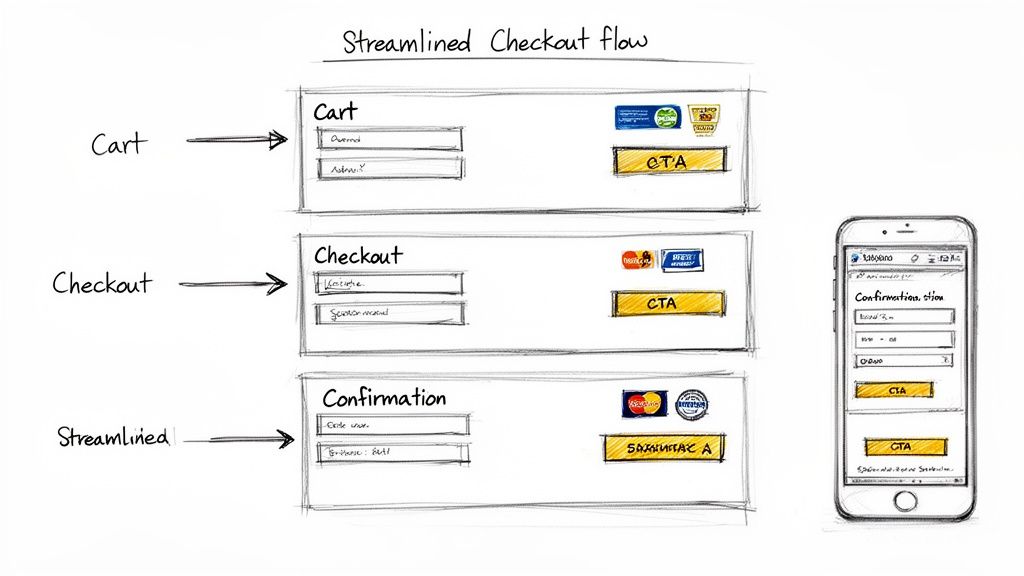
This practice is one of the highest-leverage conversion rate optimization best practices because it targets users with the strongest purchase intent. For example, according to the Baymard Institute, 19% of shoppers abandon carts because the site wanted them to create an account. A simple test making guest checkout the primary call-to-action can lift conversions significantly by removing this barrier. Reducing form fields simplifies the process and boosts completion rates. It’s about making the final step to purchase as easy and transparent as possible.
How to Implement Cart and Checkout Optimization
- Analyze Checkout Funnel Drop-off: Use your analytics platform to identify where users abandon the checkout process. Is it after shipping costs are revealed? Or on the payment information step? This data will tell you exactly where to focus your optimization efforts. Pinpointing the biggest leaks is the first step to fixing them.
- Eliminate Surprise Costs: One of the top reasons for cart abandonment is unexpected fees. Test showing shipping costs, taxes, and the final order total as early as possible in the cart or on the first step of checkout. Transparency builds trust and prevents last-minute sticker shock.
- Streamline Form Fields & Offer Guest Checkout: Audit every field in your checkout form. Remove any non-essential fields and make guest checkout a prominent, easy-to-select option. Forcing account creation is a known conversion killer, so prioritize a frictionless path to purchase for new customers.
- Optimize Payment Options: Test the impact of adding express payment methods like Apple Pay, Google Pay, and PayPal. These options can dramatically speed up the process, especially for mobile users. Also consider offering "Buy Now, Pay Later" solutions like Klarna or Afterpay, which can increase AOV and conversion rates for high-ticket items.
By methodically identifying and removing friction points, you can turn a leaky checkout funnel into a high-converting final step. Two documented examples from our portfolio: a cart-drawer free gift threshold progress bar test that added $50K/month and a cart-drawer trust signal stack test that added $32K/month. To learn more about advanced testing strategies, explore how to reduce shopping cart abandonment.
7. Homepage and Navigation Personalization
Your homepage is your digital storefront, yet most brands treat it like a static billboard. A key conversion rate optimization best practice involves transforming this high-traffic page into a dynamic, personalized welcome mat. This means customizing the hero messaging, featured collections, and even the navigation structure based on visitor segment, traffic source, or lifecycle stage. The objective is to immediately guide different customer types toward the products and content most relevant to them, reducing friction and bounce rates.
This strategy ensures that a first-time visitor arriving from a paid ad sees a different experience than a loyal VIP customer. For instance, a new user might be greeted with a "Welcome! 15% Off Your First Order" hero banner, while a repeat buyer sees messaging about their loyalty tier benefits and new arrivals. This level of relevance makes users feel understood and significantly improves their journey from landing to conversion.
How to Implement Homepage and Navigation Personalization
- Map Traffic Sources to Intent: Begin by analyzing where your visitors come from and what that implies about their intent. Paid search traffic often has high purchase intent for specific products, while organic visitors might be in a research phase. Tailor your homepage hero to match the ad copy or search term that brought them to your site.
- Test Segment-Specific Hero Messaging: Develop hypotheses for your primary segments. For example, test a lifestyle-focused hero image for visitors from an influencer campaign against a product-benefit headline for those from Google Shopping. This aligns the on-site experience with their pre-arrival context.
- Personalize Collection Prominence: Not every customer is interested in the same products. Use browsing history and past purchase data to dynamically feature collections. If a user previously viewed men's shoes, ensure the men's footwear collection is prominently displayed on their next visit.
- Adapt Navigation for Device and History: A mobile visitor benefits from a simplified, search-first navigation menu, while a desktop user can handle more complex category menus. Furthermore, you can personalize the navigation links themselves, routing traffic from a men's category ad directly to a men-specific navigation structure. Achieving this level of sophistication often starts with a solid site structure, which is why many brands consult with professional web design services to build a flexible foundation.
For a documented example of how a homepage rebuild can move the needle on a premium brand, see our homepage story-first module test that added $130K/month.
8. Customer Lifecycle Stage Personalization
Effective conversion rate optimization best practices involve speaking to customers differently based on their relationship with your brand. Instead of a uniform experience, customer lifecycle stage personalization tailors messaging, offers, and content to where a user is in their journey: from a first-time visitor to a loyal VIP. This strategy uses purchase history, browsing behavior, and email engagement to create relevant experiences that guide users from one stage to the next. The goal is to nurture the relationship, not just close a one-time sale.
This method shifts focus from a single conversion event to maximizing lifetime value (LTV). For example, a new visitor might see a "15% Off Your First Order" banner to overcome initial purchase friction. A repeat customer, however, might be greeted with "Welcome Back! Earn Double Points On Your Next Order," encouraging retention and loyalty. By aligning your site's experience with the customer's context, you build a stronger connection and drive sustainable growth. This is a crucial element of a mature CRO program.
How to Implement Lifecycle Personalization
- Define and Map Your Lifecycle Stages: Clearly outline the stages for your business. A common framework is: New Visitor (no purchase), First-Time Customer (1 purchase), Repeat Customer (2-5 purchases), Loyal Customer (6+ purchases), and Lapsed Customer (no purchase in 90+ days). Use your e-commerce platform data to segment your customer base accordingly.
- Create Stage-Specific Messaging Strategies: Develop unique offers and messaging for each segment. For new visitors, focus on incentives and trust-building. For repeat customers, highlight loyalty rewards and new arrivals. For lapsed customers, deploy a targeted win-back offer combined with product recommendations based on their past purchases.
- Automate Your Personalization Workflows: Use your ESP, CDP, or a personalization platform to create automated triggers. Build a welcome series for new subscribers, a post-purchase follow-up sequence, and a re-engagement campaign for at-risk customers. This ensures every customer receives a timely and relevant experience without manual effort.
- Monitor Cohort Performance: Track key metrics beyond conversion rate. Analyze customer LTV, retention rate, and purchase frequency for each lifecycle cohort. Measure how your personalization treatments impact these long-term metrics to prove the ROI of your efforts.
By tailoring the on-site experience to each customer’s unique relationship with your brand, you transform your website from a simple sales channel into a powerful retention engine. For the full playbook on activating these segments to compound retention, see our guide on improving customer lifetime value. To learn more about building these kinds of tailored experiences, explore the fundamentals of designing high-converting landing pages.
9. Mobile-First Optimization and Testing
True mobile optimization goes far beyond a simple responsive design. It involves designing and testing experiences specifically for mobile users, acknowledging their unique behaviors, smaller screen sizes, touch interactions, and different contexts. Instead of shrinking a desktop site, a mobile-first approach treats the mobile experience as the primary platform. This strategy recognizes that mobile visitors are often more goal-oriented and have less patience for friction, requiring a fundamentally different approach to navigation, forms, and product discovery.
This method is crucial because mobile traffic often accounts for the majority of visitors for Shopify Plus brands, yet frequently converts at a lower rate. For example, testing a single-column, touch-friendly checkout form specifically for mobile users can increase conversions compared to a two-column desktop layout. By prioritizing the mobile experience, you directly address the largest segment of your audience and close the conversion gap between devices, making it a powerful conversion rate optimization best practice.
How to Implement Mobile-First Optimization
- Analyze Mobile Behavior Separately: Dive into your analytics and filter for mobile traffic only. Identify top landing pages, drop-off points in the funnel, and user behavior flows. Are mobile users struggling with your product filters or abandoning carts at the payment step? Use this data to form your hypotheses.
- Design and Test for Touch: Ensure all interactive elements, like buttons and links, are large enough for easy tapping. The recommended minimum size is 44x44 pixels. Test swipeable carousels for product images versus a vertical grid, as swipe gestures are more intuitive on mobile and can increase engagement.
- Streamline Forms and Payments: Ruthlessly cut unnecessary fields from your mobile checkout and lead-capture forms. Prioritize and prominently display mobile-native payment options like Apple Pay and Google Pay. A test featuring these "express" payment methods at the top of the checkout page can lift mobile conversions significantly.
- Optimize for Speed and Performance: Mobile users are highly sensitive to slow load times. Compress images using modern formats like WebP, implement lazy loading, and minimize code. Continuously monitor your mobile Core Web Vitals (LCP, FID, CLS) in Google Search Console, as they impact both user experience and SEO rankings.
By treating your mobile site as its own distinct platform, you can create a faster, more intuitive experience that directly caters to the needs of the majority of your visitors. To learn more about creating high-converting mobile experiences, you can explore Google's principles of mobile site design.
10. Testing Roadmap and Experiment Velocity Management
Effective conversion rate optimization best practices rely on structure, not sporadic testing. A formalized testing roadmap organizes your experiments, prioritizing them based on potential impact and effort. This strategic approach ensures you balance quick wins, like CTA button tests, with more significant improvements, such as a component redesigns. The goal is to maintain a consistent experiment velocity, typically 2-4 tests per month, to create a flywheel of continuous learning and compounding revenue growth.
This method prevents your CRO program from getting sidetracked by low-impact ideas or losing momentum. For example, a growth-stage brand can use a roadmap to plan two small-scale offer optimizations alongside one larger strategic test personalizing the homepage for a key user segment. This disciplined approach, managed through a visual dashboard, provides clarity for the entire team and ensures optimization efforts are always aligned with high-level business objectives.
How to Implement a Testing Roadmap
- Define a Prioritization Framework: Use a simple matrix to score test ideas. A common formula is Impact × Certainty × Effort. Impact is the potential revenue lift, Certainty is your confidence in the hypothesis, and Effort is the required resources. This removes guesswork and focuses the team on the highest-value experiments first.
- Create Hypothesis Templates: Standardize how experiments are designed and proposed. A template should include the core hypothesis ("If we change X, then Y will happen, because..."), the target segment, success metrics, and the required design or development work. This streamlines the ideation process and ensures every test is well-conceived.
- Plan Quarterly and Maintain a Rolling View: Build your roadmap on a quarterly basis but keep a two-month rolling view visible to the team. This balances long-term strategic planning with the flexibility to adapt to new data or market changes. Use a tool like Basecamp, Asana or our own TestBuddy to track progress.
- Document and Socialize Learnings: Every test, whether it wins or fails, provides valuable insights. Maintain a central wiki or repository documenting the hypothesis, design, results, and key learnings from each experiment. Share these findings widely through newsletters or team meetings to embed a culture of data-driven decision-making across the organization.
By managing your experiments with a structured roadmap and consistent velocity, you transform CRO from a series of random tactics into a predictable engine for growth. To see how a structured program drives results, you can explore more about the CONVERTIBLES testing methodology.
Your Next Step: From Best Practices to a Personalization Program
The common thread connecting all these tactics is a fundamental shift in mindset. The goal is not simply to run A/B tests. The goal is to build a systematic, scalable personalization program that treats your website not as a static brochure, but as a dynamic sales engine. This engine should intelligently adapt to every visitor, recognizing their origin, intent, and position in the customer lifecycle. By mastering these concepts, you transition from chasing a single, blended conversion rate to strategically optimizing for profit per visitor across your most valuable customer segments. For the test-level playbook, see how to increase your ecommerce conversion rate.
Armed with these best practices, your next step is to operationalize them. Move from a list of ideas to a structured program. This involves defining your KPI framework, selecting the right tools, and dedicating resources to manage the process. The journey from practicing CRO to running a true personalization program is the difference between incremental tweaks and transformative growth. It’s about building a competitive advantage that is difficult for others to replicate because it is uniquely tailored to your customers and your business. The insights you gain will not only lift conversions but will also inform your marketing, product development, and overall brand strategy. For a tactical walkthrough on how to improve ecommerce conversion rate across PDP, cart, and checkout, see our 12-fix guide.
Frequently Asked Questions
How long does it take to see results from CRO?
Individual tests typically reach statistical significance within 2-4 weeks. However, meaningful, sustained revenue impact from a structured CRO program usually takes 3-6 months of consistent testing. The value compounds over time as winning tests stack on top of each other.
What is a good conversion rate for a Shopify store?
The average Shopify store converts at 1.4%, but this includes new and unoptimized stores. The top 20% of Shopify stores convert at 3.2% or higher, and the top 10% exceed 4.7%. Benchmark against your industry vertical and traffic mix rather than the overall average.
How many A/B tests should I run per month?
A healthy optimization program runs 2-4 tests per month. This cadence balances learning velocity with statistical rigor. Running fewer means slow progress; running more risks splitting traffic too thin and getting inconclusive results. Prioritize tests using an impact-versus-effort framework.
What should I test first on my ecommerce site?
Start with your highest-traffic, highest-revenue pages, typically product pages and collection pages. Focus on elements that directly influence purchase decisions: value proposition, social proof placement, pricing presentation, and call-to-action design. Use your analytics to identify where the biggest drop-offs occur.
At CONVERTIBLES, we are the dedicated team that Shopify Plus brands trust to build and manage their personalization programs. We bridge the gap between your paid ads and your onsite experience, shipping 2-4 personalized tests and experiences every month to deliver compounding revenue growth. If you're ready to move beyond generic CRO and install a high-velocity optimization engine, let's connect.